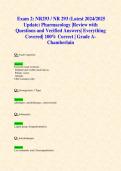
Exam 2: NR293 / NR 293 (Latest 2024/2025 Update) Pharmacology |Review with Questions and Verified Answers| Everything Covered| 100% Correct | Grade A-Chamberlain
Exam 2: NR293 / NR 293 (Latest 2024/2025 Update) Pharmacology |Review with Questions and Verified Answers| Everything Covered| 100% Correct | Grade A-Chamberlain Q: Nasal Congestion Excessive nasal secretions Inflamed and swollen nasal mucosa Primary causes Allergies URIs (common cold) Q: Decongestants: 3 Types Answer: adrenergics, anticholinergics, corticosteroids Q: Adrenergics; Answer: Largest group, Sympathomimetics Q: Anticholinergics Answer: Less commonly used, Parasympatholytics Q: Corticosteroids Answer: Topical, intranasal steroids Q: Decongestants: Types Answer: Two dosage forms which are oral or Inhaled or topically applied to the nasal membranes Q: Oral Decongestants Answer: Prolonged decongestant effects but delayed onset Effect less potent than topical No rebound congestion Exclusively adrenergic Example: pseudoephedrine (Sudafed) Q: Topical Nasal Decongestants Answer: Prompt onset Potent Sustained use over several days causes rebound congestion, making the condition worse. Ephedrine, oxymetazoline, phenylephrine, and tetrahydrozoline Q: Inhaled Intranasal Steroids and Anticholinergic Drugs Answer: Not associated with rebound congestion Often used prophylactically to prevent nasal congestion in patients with chronic upper respiratory tract symptoms Q: Topical Nasal Decongestants types Answer: Adrenergics; Ephedrine, oxymetazoline Intranasal steroids; Beclomethasone dipropionate (Beconase),budesonide (Rhinocort), flunisolide (Nasalide),fluticasone (Flonase), triamcinolone (Nasacort),ciclesonide (Omnaris) Intranasal anticholinergic; Ipratropium (Atrovent) Q: Nasal Decongestants: Mechanism of Action Answer: Site of action: blood vessels surrounding nasal sinuses Adrenergics; Constrict small blood vessels that supply upper respiratory tract structures, As a result, these tissues shrink, and nasal secretions in the swollen mucous membranes are better able to drain Q: nasal steroids mechanism of action Answer: Anti inflammatory effect; Work to turn off the immune system cells involved in the inflammatory response, Decreased inflammation results in decreased congestion Q: Nasal Decongestants: Drug Effects Answer: Shrink engorged nasal mucous membranes Relieve nasal stuffiness Q: Nasal Decongestants: Indications Answer: Relief of nasal congestion associated with: Acute or chronic rhinitis, Common cold, Sinusitis, Hay fever, Other allergies, May also be used to reduce swelling of the nasal passage and facilitate visualization of the nasal or pharyngeal membranes before surgery or diagnostic procedures Q: Nasal Decongestants: Contraindications Answer: Drug allergy, Narrow-angle glaucoma, Uncontrolled cardiovascular disease, hypertension, Diabetes and hyperthyroidism, History of cerebrovascular accident or transient ischemic attacks, Long-standing asthma, BPH, Diabetes Q: Nasal Decongestants: Adverse Effects Answer: Adrenergics: Nervousness, Insomnia, Palpitations, Tremors steroids: Local mucosal dryness and irritation (Systemic effects caused by adrenergic stimulation of theheart, blood vessels, and CNS) Q: Nasal Decongestants: Interactions Answer: Systemic sympathomimetic drugs and sympathomimetic nasal decongestants are likely to cause drug toxicity when given together. Monoamine oxidase inhibitors and sympathomimetic nasal decongestants raise blood pressure. Methyldopa Urinary acidifiers and alkalinizers Q: Nasal Decongestants: Nursing Implications
Written for
Document information
- Uploaded on
- March 24, 2024
- Number of pages
- 106
- Written in
- 2023/2024
- Type
- Exam (elaborations)
- Contains
- Questions & answers
Subjects
-
nr 293 nr293nr 293 nr293 exam
-
nr 293 nr293nr 293 nr293 exam 1
-
nr 293 nr293nr 293 nr293 exam 2
-
nr 293 nr293nr 293 nr293 exam 3
-
nr 293 nr293nr 293 nr293 final exam
-
exam 2 nr293 nr 293 latest update
-
na

Also available in package deal