Ultimate CPDT-KA study guide Questions & Answers(RATED A+)
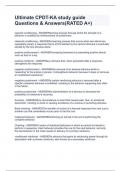
operant conditioning - ANSWERlearning process through which the strength of a behavior is modified by reinforcement or punishment. classical conditioning - ANSWERa learning process that occurs when two stimuli are repeatedly paired; a response that is at first elicited by the second stimulus is eventually elicited by the first stimulus alone. positive reinforcement - ANSWERIncreasing behaviors by presenting positive stimuli, such as food or a toy. positive reinforcer - ANSWERany stimulus that, when presented after a response, strengthens the response negative reinforcement - ANSWERthe removal of an adverse stimulus which is 'rewarding' to the animal or person. It strengthens behavior because it stops or removes an unpleasant experience.' negative punishment - ANSWERa certain reinforcing stimulus is removed after a specific undesired behavior is exhibited, resulting in the behavior happening less often in the future. positive punishment - ANSWERthe administration of a stimulus to decrease the probability of a behavior's recurring Aversive - ANSWERAny circumstance or event that causes pain, fear, or emotional discomfort. Tending to avoid or causing avoidance of a noxious or punishing stimulus. Back-chaining - ANSWERThe transfer of control of a learned response from one cue to another cue that consistently occurs prior to the first cue. Captured behavior - ANSWERReinforcing an animal in the act of performing the complete behavior. Chaining - ANSWERA series of individual behaviors in which an animal is trained to perform in sequence. Each behavior provides the cue for the next behavior, and only the last behavior in the chain results in delivery of a primary reinforcer. conditioned reinforcer - ANSWERa stimulus that gains its reinforcing power through its association with a primary reinforcer; also known as a secondary reinforcer counter conditioning - ANSWERa behavior therapy procedure that conditions new responses to stimuli that trigger unwanted behaviors; based on classical conditioning Desensitization - ANSWERThe process of increasing an animal's tolerance to a particular stimulus by gradually increasing the presence of the stimulus. Extinction - ANSWERThe process of decreasing behavior by permanently removing the maintaining reinforcer. When operant behavior that has been previously reinforced no longer produces reinforcing consequences the behavior gradually stops occurring. Fading - ANSWERTo slowly remove all prompts so that the cue (SD) alone leads to the behavior. fixed duration - ANSWERA schedule of reinforcement, which sets the rule that the target behavior must be exhibited continuously for a specified period of time, at which point reinforcement is delivered. fixed interval - ANSWERA schedule of reinforcement, which sets the rule that reinforcement is delivered immediately following the first response exhibited after a specific interval of time has passed. fixed ratio - ANSWERA schedule of reinforcement, which sets the rule that reinforcement is delivered following the final response after a fixed number of responses have occurred. Flooding - ANSWERA form of behavior therapy, based on the principles of respondent extinction, in which a subject is exposed, usually at full intensity, to an aversive stimulus, where escape behavior is prevented, until escape responding ceases. Habituation - ANSWERThe diminishing of an instinctive response to a frequently repeated stimulus. Therefore people or animals become used to something, so that they no longer find it unpleasant or think it is a threat intermittent reinforcement - ANSWERReinforcement is given only part of the time a subject gives the desired response. interval reinforcement - ANSWERIt is a schedule of reinforcement where the first response is rewarded only after a specified amount of time has elapsed. Latency - ANSWERthe time between the cue and the beginning of the pet's response, the behavior. neutral stimulus - ANSWERA stimulus that does not evoke or elicit the behavior in question. Premack Principle - ANSWERA principle that states that making the opportunity to engage in a high-probability behavior contingent on the occurrence of a low-frequency behavior will function as reinforcement for the low-frequency behavior. antecedent - ANSWERAny stimulus present in the environment before the behavior occurs ABC of behavior - ANSWERAntecedents, Behavior and Consequences. extinction burst - ANSWERThe phenomena of behavior temporarily or briefly getting worse not better when a previously rewarded behavior is not rewarded random reinforcement - ANSWERThe reward is not given every time when the behavior happens 4 D's - ANSWERDistance, duration, different environment, delivery of reward stimulus control - ANSWERThe dog does what is asked correctly and not in other situations superstitious behavior - ANSWERCoincidental learning of some irrelevant behavior along with desired one. Shaping - ANSWERRewarded for successive approximations of the desired behavior Physical Modeling - ANSWERphysically manipulate into position What age is ok for "large-breed" dogs to start endurance exercise? - ANSWER2-2.5 years What age is ok for "smaller" dogs to start endurance exercise? - ANSWER1.5 years What age do growth plates typically harden? - ANSWER10-14 months How far apart should you space a puppy's shots? - ANSWER3-4 weeks How many rounds of vaccines do puppies need to be fully immunized? - ANSWER3 What is the average gestation period for a dog? - ANSWER63 days What may cause bone and joint abnormalities in large breed puppies? - ANSWEROverfeeding and over supplementing When do dogs typically experience their first heat cycles? - ANSWER6-9 months When should puppies receive their first Parvovirus vaccine? - ANSWER5-7 weeks When should puppies receive their first set of vaccinations - ANSWER6-8 weeks When should puppies begin strength exercise (like fetch)? - ANSWERafter 6 months True or False: An exercise program for puppies should not include long play periods or strenuous exercise - ANSWERTrue. An exercise program for puppies shouldn't include strenuous exercise or long play periods Describe the benefits of neutering male dogs. - ANSWERhelps stop overpopulation, less roaming, less territorial marking, less aggression towards male dogs, prevents prostate problems, no chance of testicular cancer Describe the benefits of spaying female dogs - ANSWERhelps stop overpopulation, prevents hormonal mood swings, prevents pyometra (infection of uterus); if dog is spayed before 1st heat cycle it reduces the chance of mammary cancer How much fat does the average adult dog need in his diet? - ANSWER5% How much fat does a puppy need in his diet? - ANSWER8% How much protein does the average adult dog need? - ANSWER18% How much protein does a puppy need? - ANSWER22% Sugar starches and cellulose are examples of what? - ANSWERCarbohydrates Too much fat in dog's diet causes obesity and plays a roll in the development of ___________ - ANSWERPancreatitis _____________ forms glucose and assists in the digestion of nutrients. - ANSWERCarbohydrates What helps provide energy, supply skin, healthy coat and vitamin absorption? - ANSWERFat What is a sign that your dog's protein isn't highly digestible? - ANSWERHigh volume of feces What is the best type of food for a large-breed puppy? - ANSWEReither Large Breed Puppy Food or Adult Maintenance Food What is the most critical component in dog food? - ANSWERProtein What's the typical amount of fiber in dog/puppy food? - ANSWER3-6% When feeding, adult dogs should ____________ than puppies/adolescents - ANSWEReat less than puppies/adolescent Why is fiber important in a canine's diet? - ANSWERHelps intestinal contents absorb water, forming stools which are readily expelled. You should stop feeding large breed puppy food when puppy has reached ________ of anticipated adult weight. - ANSWER80% True or False: Only animal source proteins are com
Escuela, estudio y materia
- Institución
- Ultimate CPDT-KA
- Grado
- Ultimate CPDT-KA
Información del documento
- Subido en
- 29 de marzo de 2024
- Número de páginas
- 40
- Escrito en
- 2023/2024
- Tipo
- Examen
- Contiene
- Preguntas y respuestas
Temas
- ultimate cpdt ka 2024
-
ultimate cpdt ka study guide questions answersr
-
operant conditioning answerlearning process thro
-
classical conditioning answera learning process

Documento también disponible en un lote