NCLEX 3500 Exam Questions With 100% Correct Answers 2024/2025
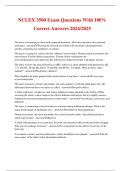
NCLEX 3500 Exam Questions With 100% Correct Answers 2024/2025 The nurse is examining a client with suspected peritonitis. How does the nurse elicit rebound tenderness - answerPressing the affected area firmly with one hand, releasing pressure quickly, and noting any tenderness on release The nurse is caring for a client who has suffered a severe stroke. During routine assessment, the nurse notices Cheyne-Stokes respirations. Cheyne-Stokes respirations are: - answerprogressively deeper breaths followed by shallower breaths with apneic periods. The nurse reviews the arterial blood gas (ABG) values of a client admitted with pneumonia: pH, 7.51; PaCO2, 28 mm Hg; PaO2, 70 mm Hg; and HCO3-, 24 mEq/L. What do these values indicate? - answerRespiratory alkalosis Why shouldn't the nurse palpate both carotid arteries at one time? - answerIt may cause severe bradycardia. The nurse measures a client's apical pulse rate and compares it with the radial pulse rate. The differential between these two pulses is called: - answerthe pulse deficit. A client with fever, weight loss, and watery diarrhea is being admitted to the facility. While assessing the client, a nurse inspects the client's abdomen and notices that it's slightly concave. Additional assessment should proceed in which order? - answerAuscultation, percussion, and palpation The nurse is monitoring a client for adverse reactions during barbiturate therapy. What is the major disadvantage of barbiturate use? - answerPotential for drug dependence During assessment, the nurse auscultates for a client's breath sounds. Auscultation produces which type of data? - answerObjective A child with rheumatic fever must have his heart rate measured while awake and while sleeping. Why are two readings necessary? - answerTo compensate for the effects of activity on the heart rate To evaluate a client's posterior tibial pulse, where should the nurse palpate? - answerOn the inner aspect of the ankle, below the medial malleolus At 8 a.m., the nurse assesses a client who's scheduled for surgery at 10 a.m. During the assessment, the nurse detects dyspnea, a nonproductive cough, and back pain. What should the nurse do next? - answerNotify the physician immediately of these findings When a nurse enters the client's room, the client complains that she's spitting up blood when she coughs. The nurse takes a quick health history that includes: - answerthe history of the present problem, allergies, medications, and recent major operations. The nurse is auscultating a client's chest. How can the nurse differentiate a pleural friction rub from other abnormal breath sounds? - answerA rub occurs during both inspiration and expiration and produces a squeaking or grating sound. When auscultating a client's abdomen, the nurse detects high-pitched gurgles over the lower right quadrant. Based on this finding, the nurse suspects: - answernothing abnormal. The nurse prepares to perform an otoscopic examination on an adult. For proper visualization, the nurse should position the client's ear by pulling the: - answerhelix up and back. The nurse is helping to plan a teaching session for a client who will be discharged with a colostomy. When describing a healthy stoma, which statement should the nurse be sure to include? - answer"At first, the stoma may bleed slightly when touched." The nurse is assessing a client's abdomen. Which finding should the nurse report as abnormal? - answerShifting dullness over the abdomen After suctioning a tracheostomy tube, the nurse assesses the client to determine the effectiveness of the suctioning. Which findings indicate that the airway is now patent? - answerEffective breathing at a rate of 16 breaths/minute through the established airway The nurse is evaluating a client's auditory function. To compare air conduction to bone conduction, the nurse should conduct which test? - answerRinne test A mother comes to the clinic with her 5-year-old son who's complaining of a fever and sore throat. The nurse documents the client's tonsils as 3+. This means they're: - answertouching the uvula. When examining a client with abdominal pain, the nurse should assess: - answerthe symptomatic quadrant last. The nurse can auscultate for heart sounds more easily if the client is: - answerleaning forward. Before a transesophageal echocardiogram, a client is given an oral topical anesthetic spray. Upon return from the procedure, the nurse observes that the client has no active gag reflex. In response, the nurse should - answerwithhold food and fluids.
Written for
- Institution
- NCLEX 3500
- Course
- NCLEX 3500
Document information
- Uploaded on
- April 2, 2024
- Number of pages
- 7
- Written in
- 2023/2024
- Type
- Exam (elaborations)
- Contains
- Questions & answers
Subjects
-
nclex 3500 exam questions with 100 correct answer

Also available in package deal