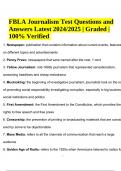
FBLA Journalism Test Questions and Answers Latest 2024/2025 | Graded | 100% Verified.
FBLA Journalism Test Questions and Answers Latest 2024/2025 | Graded | 100% Verified. Newspaper: publication that contains information about current events, features on different topics and advertisements 2. Penny Press: newspapers that were named after the cost, 1 cent 3. Yellow Journalism: mid-1890s journalism that represented sensationalism, screaming headlines and cheap melodrama 4. Muckraking: the beginning of investigative journalism; journalists took on the role of promoting social responsibility investigating corruption, especially in big business, social institutions and politics 5. First Amendment: the First Amendment to the Constitution, which provides the rights to free speech and free press 6. Censorship: the prevention of printing or broadcasting materials that are considered by some to be objectionable 7. Mass Media: refers to all the channels of communication that reach a large audience 8. Golden Age of Radio: refers to the 1930s when Americans listened to radios for FBLA Journalism Test Questions and Answers Latest 2024/2025 | Graded | 100% Verified 2 / 7 music, drama, comedy, variety shows and news 9. Multiple Platforms: the news organization has both a print publication and an Internet site; media through which consumers obtain news, such as through newspapers and news magazines, television, radio, and the Internet 10. Multiple Media: may include print, broadcast and Internet; adding audio and video elements to a print story 11. Correspondent: a reporter 12. Ethics: the moral principals that govern the appropriate conduct for individuals and organizations 13. Accuracy: getting all the facts right and always seeking the truth 14. Integrity: In journalistic terms, it means: 1) not to sell your services for financial reward other than the salary you receive from your employer 2) not to take money from a person, group or organization in return for ensuring their story is covered by your news organization 3) not to promote a story based on any personal, group, or partisan interests. 4) not to endorse or appear to endorse any organization, its products, activities or services 5) not to promote commercial products or services 3 / 7 6) not to promote our own media organization. 15. Fabrication: an invention; a lie 16. Public Official: anyone in a position of official authority that is conferred by a state (ex.: government worker, senator, etc.) 4 / 7 17. Precedent: a legal decision or form of proceeding serving as an authoritative rule or pattern in future similar or analogous cases 18. Sunshine Laws: laws requiring certain proceedings of government agencies to be open or available to the public 19. Storyboard: A storyboard is a sketch of how to organize a story and a list of its contents 20. Videographer: a person who makes video films 21. Circulation: the number of copies of newspapers distributed on an average day; one of the principal factors used to set advertising rates; not always the same as copies sold, since some newspapers are distributed without cost to the reader 22. Online Journalism: contemporary form of journalism where editorial content is distributed via the Internet as opposed to publishing via print or broadcast 23. Beat: genre of journalism that can be described as the craft of in-depth reporting on a particular issue, sector, organization or institution over time 24. General Assignment: form of reporting that requires the ability to report and write about a wide range of topics 25. Enterprise Reporting: a methodology that involves providing substantial information to the managers in an organization to help them make business decisions 26. Pitch: a writer's description of a potential story (and why it should matter) to an 5 / 7 editor 27. Tipping Point: the critical point in an evolving situation that leads to a new and irreversible development 28. Jargon: language that pertains to one's business 29. Interview: takes the form of a conversation between two or more people: interviewer(s) ask questions to elicit facts or statements from interviewee(s). Interviews are a standard part of journalism and media reporting 30. Primary Source: an artifact, a document, diary, manuscript, autobiography, a recording, or any other source of information that was created at the time under study 31. Secondary Source: a source that was created later by someone who did not experience first-hand or participate in the events or conditions that are the topic at hand 32. On Background: means that a reporter can use the information you give them, but cannot name or quote you directly; different from off-the-record, which means that information dispensed during an interaction cannot be dispensed in ANY way 33. Confidential Source: a person who provides information to a law-enforcement agency or to a journalist on the express or implied guarantee of anonymity
Written for
- Institution
- FBLA Journalism
- Module
- FBLA Journalism
Document information
- Uploaded on
- April 6, 2024
- Number of pages
- 17
- Written in
- 2023/2024
- Type
- Exam (elaborations)
- Contains
- Questions & answers
Subjects
- fbla journalism
- fbla
- latest 2024
- graded
- verified answers
-
fbla journalism test questions and answers

Also available in package deal