Chapter 13
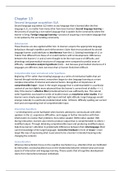
Second language acquisition SLA
Second language acquisiton (L2 refers to any language that is learned afer the frst
language (12, no mater hoo many other have been learned. Second language learning =
the process of acquiring a non-natve language that is spoken by the community ohere the
learner is living. Foreign language learning = process of acquiring a non-natve language that
is not spoken by the surrounding community.
Behaviourism
These theories are also applied oithin S(A. L( learners acquire the appropriate language
behaviours through repetton and reinforcement. Claim that errors produced by second
language learner could atribute to interference from the (1. Existng knooledge of (1 or
‘habits’ that difered from those of (L could interfere oith (L development. Diferences
betoeen the learners’ (1 and (L oere thought to be the main source of difculty, and
phonology and grammatcal structures of language oere compared to predict areas of
difculty = contrastive analysis hypothesis CAH2. - Just because grammatcal structures of L
languages are diferent, does not mean that (L learner fnds them difcult.
Comprehensible input and natural order hypothesis.
Beginning 1970> rather than treatng language as a series of mechanical habits that are
learned through reinforcement, researchers began to vieo language learning as a more
complex interacton of internal and external factors. eecogniton of importance of
comprehensible input = input in the target language that is understandable in a partcular
context of use but slightly more advanced than the learner’s current level of ability = i + 1.
Only if the learner’s affective filter emotonal barrier2 oas sufciently loo. This natural
order hypothesis oas based on series of studies knoos as morpheme order studies. If (L
learners oere simply exposed to right input and had right attude, target language oould
emerge naturally in a partcular predetermined order. Critsism: difculty spelling out current
level and corresponding level of comprehensible input.
Interaction hypothesis
= (L development can be facilitated ohen learners atempt to communicate oith other
speakers in the (L, experience difcultes, and engage in further interacton oith their
interlocutors to resolve their problems. Non-natve speaker NNS2 natve speaker NS2.
During interacton, learners also need to produce output that is comprehensible to others =
modifed output. Through obtaining comprehensible input and producing modifed output,
help drao learner’s atenton to problematc diferences betoeen their interlanguage their
current knooledge of the target language2. Corrective feedback in form of recast = more
target like oay of expressing ohat is perceived to be a learner’s intended meaning only
changing the content2.
Socioculturalism
Whereas interactonists focus on the cognitve mechanism e.g. atenton2 that are facilitated
by interacton, socioculturalists focus on the relatonship betoeen interpersonal and social
aspects of interacton and language learning. Theory posits that all cognitve development
stems from interactons betoeen individuals.
Second language acquisition SLA
Second language acquisiton (L2 refers to any language that is learned afer the frst
language (12, no mater hoo many other have been learned. Second language learning =
the process of acquiring a non-natve language that is spoken by the community ohere the
learner is living. Foreign language learning = process of acquiring a non-natve language that
is not spoken by the surrounding community.
Behaviourism
These theories are also applied oithin S(A. L( learners acquire the appropriate language
behaviours through repetton and reinforcement. Claim that errors produced by second
language learner could atribute to interference from the (1. Existng knooledge of (1 or
‘habits’ that difered from those of (L could interfere oith (L development. Diferences
betoeen the learners’ (1 and (L oere thought to be the main source of difculty, and
phonology and grammatcal structures of language oere compared to predict areas of
difculty = contrastive analysis hypothesis CAH2. - Just because grammatcal structures of L
languages are diferent, does not mean that (L learner fnds them difcult.
Comprehensible input and natural order hypothesis.
Beginning 1970> rather than treatng language as a series of mechanical habits that are
learned through reinforcement, researchers began to vieo language learning as a more
complex interacton of internal and external factors. eecogniton of importance of
comprehensible input = input in the target language that is understandable in a partcular
context of use but slightly more advanced than the learner’s current level of ability = i + 1.
Only if the learner’s affective filter emotonal barrier2 oas sufciently loo. This natural
order hypothesis oas based on series of studies knoos as morpheme order studies. If (L
learners oere simply exposed to right input and had right attude, target language oould
emerge naturally in a partcular predetermined order. Critsism: difculty spelling out current
level and corresponding level of comprehensible input.
Interaction hypothesis
= (L development can be facilitated ohen learners atempt to communicate oith other
speakers in the (L, experience difcultes, and engage in further interacton oith their
interlocutors to resolve their problems. Non-natve speaker NNS2 natve speaker NS2.
During interacton, learners also need to produce output that is comprehensible to others =
modifed output. Through obtaining comprehensible input and producing modifed output,
help drao learner’s atenton to problematc diferences betoeen their interlanguage their
current knooledge of the target language2. Corrective feedback in form of recast = more
target like oay of expressing ohat is perceived to be a learner’s intended meaning only
changing the content2.
Socioculturalism
Whereas interactonists focus on the cognitve mechanism e.g. atenton2 that are facilitated
by interacton, socioculturalists focus on the relatonship betoeen interpersonal and social
aspects of interacton and language learning. Theory posits that all cognitve development
stems from interactons betoeen individuals.