Covalent Bonds Test Questions and Answers
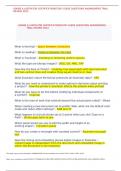
Covalent Bonds Test Questions and Answers A nitrogen molecule has one triple bond. How many electrons do the nitrogen atoms share? - Answer-6 Compared to ionic compounds, molecular compounds generally have - Answer-low boiling point Compared to ionic compounds, molecular compounds generally have - Answer-poor conductivity The chemical bond formed when two atoms share electrons is called an ionic bond - Answer-false Covalent bonds usually form when a nonmetal combines with a metal - Answer-false An ion is a neutral group of atoms joined by covalent bonds - Answer-false If a molecule gains polar bonds, the molecule may or may not be polar overall - Answer- true In a polar bond, one atom pulls on the shared electrons more than the other atom - Answer-True The forces between molecules are much stronger than the forces between ions - Answer-False What is the definition of a covalent bond? - Answer-a chemical bond formed when two atoms share electrons what is the definition of a molecule? - Answer-a neutral group of two or more atoms held together by covalent bonds What is the definition of a double bond? - Answer-a chemical bond formed when atoms share two pairs of electrons What is the definition of a triple bond? - Answer-a chemical bond formed when atoms share three pairs of electrons What is the definition of a molecular compound? - Answer-a compound that is composed of molecules What is the definition of a nonpolar bond? - Answer-a covalent bond in which electrons are shared equally
Written for
- Institution
- Covalent Bonds
- Course
- Covalent Bonds
Document information
- Uploaded on
- April 12, 2024
- Number of pages
- 2
- Written in
- 2023/2024
- Type
- Exam (elaborations)
- Contains
- Questions & answers
Subjects
- covalent bonds
- covalent bonds test
-
covalent bonds test questions and answers

Also available in package deal