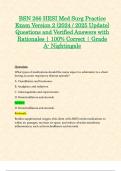
BSN 266 HESI Med Surg Practice
Exam Version 2 ( Update)
Questions and Verified Answers with
Rationales | 100% Correct | Grade
A- Nightingale
Question:
What types of medications should the nurse expect to administer to a client
during an acute respiratory distress episode?
A. Vasodilators and hormones.
B. Analgesics and sedatives.
C. Anticoagulants and expectorants.
D. Bronchodilators and steroids.
Answer:
D. Bronchodilators and steroids.
Rationale
Besides supplemental oxygen, this client with ARDS needs medications to
widen air passages, increase air space, and reduce alveolar membrane
inflammation, such as bronchodilators and steroids.
,Question:
A female client is brought to the clinic by her daughter for a flu shot. She has
lost significant weight since the last visit. She has poor personal hygiene and
inadequate clothing for the weather. The client states that she lives alone
and denies problems or concerns. What action should the nurse implement?
A. Notify social services immediately of suspected elderly abuse.
B. Discuss the need for mental health counseling with the daughter.
C. Explain to the client that she needs to take better care of herself.
D. Collect further data to determine whether self-neglect is occurring.
Answer:
D. Collect further data to determine whether self-neglect is occurring.
Rationale
Changes in weight and hygiene may be indicators of self-neglect or neglect
by family members. Further assessment is needed before notifying social
services or discussing a need for counseling.
Question:
The nurse is assisting a client out of bed for the first time after surgery. What
action should the nurse do first?
A. Place a chair at a right angle to the bedside.
B. Encourage deep breathing prior to standing.
C. Help the client to sit and dangle legs on the side of the bed.
D. Allow the client to sit with the bed in a high Fowler's position.
Answer:
D. Allow the client to sit with the bed in a high Fowler's position.
,Rationale
The first step is to raise the head of the bed to a high Fowler's position,
which allow venous return to compensate from lying flat and the
vasodilation effects of perioperative drugs. This helps prevent the client from
becoming light-headed and decreases the chance of a client fall.
Question:
A 32-year-old female client complains of severe abdominal pain each month
before her menstrual period, painful intercourse, and painful defecation.
Which additional history should the nurse obtain that is consistent with the
client's complaints?
A. Frequent urinary tract infections.
B. Inability to get pregnant.
C. Premenstrual syndrome.
D. Chronic use of laxatives.
Answer:
B. Inability to get pregnant.
Rationale
Dysmenorrhea, dyspareunia, and difficulty or painful defecation are
common symptoms of endometriosis, which is the abnormal displacement of
endometrial tissue in the dependent areas of the pelvic peritoneum. A
history of infertility is another common finding associated with
endometriosis.
, Question:
The nurse would be correct in withholding a dose of digoxin in a client with
congestive heart failure without specific instruction from the healthcare
provider if the client's
A. serum digoxin level is 1.5.
B. blood pressure is 104/68.
C. serum potassium level is 3.
D. apical pulse is 68/min.
Answer:
C. serum potassium level is 3.
Rationale
Hypokalemia can precipitate digitalis toxicity in persons receiving digoxin
which will increase the chance of dangerous dysrhythmias (normal
potassium level is 3.5 to 5.5 mEq/L).
Question:
In assessing cancer risk, the nurse identifies which woman as being at
greatest risk of developing breast cancer?
A. A 35-year-old multipara who never breastfed.
B. A 50-year-old whose mother had unilateral breast cancer.
C. A 55-year-old whose mother-in-law had bilateral breast cancer.
D. A 20-year-old whose menarche occurred at age 9.
Answer:
B. A 50-year-old whose mother had unilateral breast cancer.
Rationale
Exam Version 2 ( Update)
Questions and Verified Answers with
Rationales | 100% Correct | Grade
A- Nightingale
Question:
What types of medications should the nurse expect to administer to a client
during an acute respiratory distress episode?
A. Vasodilators and hormones.
B. Analgesics and sedatives.
C. Anticoagulants and expectorants.
D. Bronchodilators and steroids.
Answer:
D. Bronchodilators and steroids.
Rationale
Besides supplemental oxygen, this client with ARDS needs medications to
widen air passages, increase air space, and reduce alveolar membrane
inflammation, such as bronchodilators and steroids.
,Question:
A female client is brought to the clinic by her daughter for a flu shot. She has
lost significant weight since the last visit. She has poor personal hygiene and
inadequate clothing for the weather. The client states that she lives alone
and denies problems or concerns. What action should the nurse implement?
A. Notify social services immediately of suspected elderly abuse.
B. Discuss the need for mental health counseling with the daughter.
C. Explain to the client that she needs to take better care of herself.
D. Collect further data to determine whether self-neglect is occurring.
Answer:
D. Collect further data to determine whether self-neglect is occurring.
Rationale
Changes in weight and hygiene may be indicators of self-neglect or neglect
by family members. Further assessment is needed before notifying social
services or discussing a need for counseling.
Question:
The nurse is assisting a client out of bed for the first time after surgery. What
action should the nurse do first?
A. Place a chair at a right angle to the bedside.
B. Encourage deep breathing prior to standing.
C. Help the client to sit and dangle legs on the side of the bed.
D. Allow the client to sit with the bed in a high Fowler's position.
Answer:
D. Allow the client to sit with the bed in a high Fowler's position.
,Rationale
The first step is to raise the head of the bed to a high Fowler's position,
which allow venous return to compensate from lying flat and the
vasodilation effects of perioperative drugs. This helps prevent the client from
becoming light-headed and decreases the chance of a client fall.
Question:
A 32-year-old female client complains of severe abdominal pain each month
before her menstrual period, painful intercourse, and painful defecation.
Which additional history should the nurse obtain that is consistent with the
client's complaints?
A. Frequent urinary tract infections.
B. Inability to get pregnant.
C. Premenstrual syndrome.
D. Chronic use of laxatives.
Answer:
B. Inability to get pregnant.
Rationale
Dysmenorrhea, dyspareunia, and difficulty or painful defecation are
common symptoms of endometriosis, which is the abnormal displacement of
endometrial tissue in the dependent areas of the pelvic peritoneum. A
history of infertility is another common finding associated with
endometriosis.
, Question:
The nurse would be correct in withholding a dose of digoxin in a client with
congestive heart failure without specific instruction from the healthcare
provider if the client's
A. serum digoxin level is 1.5.
B. blood pressure is 104/68.
C. serum potassium level is 3.
D. apical pulse is 68/min.
Answer:
C. serum potassium level is 3.
Rationale
Hypokalemia can precipitate digitalis toxicity in persons receiving digoxin
which will increase the chance of dangerous dysrhythmias (normal
potassium level is 3.5 to 5.5 mEq/L).
Question:
In assessing cancer risk, the nurse identifies which woman as being at
greatest risk of developing breast cancer?
A. A 35-year-old multipara who never breastfed.
B. A 50-year-old whose mother had unilateral breast cancer.
C. A 55-year-old whose mother-in-law had bilateral breast cancer.
D. A 20-year-old whose menarche occurred at age 9.
Answer:
B. A 50-year-old whose mother had unilateral breast cancer.
Rationale