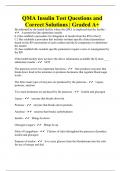
Chapter 1: Fair-Minded Thinking Exam Questions And Answers
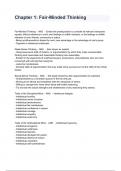
Chapter 1: Fair-Minded Thinking Exam Questions And Answers Fair-Minded Thinking - ANS - Entails the predisposition to consider all relevant viewpoints equally, without reference to one's own feelings or selfish interests, or the feelings or selfish interests of one's friends, community or nation. - Being uninfluenced/non biased by one's own advantage or the advantage of one's group. - Opposite is intellectual unfairness Weak-Sense Thinking - ANS - Also known as sophist - Using lower-level skills of rhetoric, or argumentation by which they make unreasonable thinking look reasonable and reasonable thinking look reasonable. - Evident in the arguments of unethical lawyers, prosecutors, and politicians who are more concerned with winning than being fair. - Lacks fair mindedness. - Develop skills of argumentation that may entail some success but not the skills of the critical thinker. Strong-Sense Thinking - ANS - Not easily tricked by slick argumentation by sophistry - Characterized by a consistent pursuit of the fair and just. - Striving to be ethical and empathize with the viewpoints of others. - Willing to change their views when faced with better reasoning. - Try and see the actual strengths and weaknesses of any reasoning they assess. Traits of the Disciplined Mind - ANS - Intellectual integrity - Intellectual humility - Intellectual sense of justice
Written for
- Institution
- B250
- Course
- B250
Document information
- Uploaded on
- April 25, 2024
- Number of pages
- 3
- Written in
- 2023/2024
- Type
- Exam (elaborations)
- Contains
- Questions & answers
Subjects
-
chapter 1 fair minded thinking

Also available in package deal