Multiple Sclerosis 2023 Exam Questions and Answers
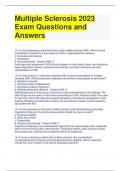
Multiple Sclerosis 2023 Exam Questions and Answers 13. A nurse assesses a client with early-onset multiple sclerosis (MS). Which clinical manifestation should the nurse expect to find?a. Hyperresponsive reflexes b. Excessive somnolence c. Nystagmus d. Heat intolerance - Answer-ANS: C Early signs and symptoms of MS include changes in motor skills, vision, and sensation. Hyperresponsive reflexes, excessive somnolence, and heat intolerance are later manifestations of MS. 14. A nurse cares for a client who presents with an acute exacerbation of multiple sclerosis (MS). Which prescribed medication should the nurse prepare to administer? a. Baclofen (Lioresal) b. Interferon beta-1b (Betaseron) c. Dantrolene sodium (Dantrium) d. Methylprednisolone (Medrol) - Answer-ANS: D Methylprednisolone is the drug of choice for acute exacerbations of the disease. The other drugs are not used to treat acute exacerbations of MS. Interferon beta-1b is used to treat and control MS, decrease specific symptoms, and slow the progression of the disease. Baclofen and dantrolene sodium are prescribed to lessen muscle spasticity associated with MS. 15. A nurse assesses a client with multiple sclerosis after administering prescribed fingolimod (Gilenya). For which adverse effect should the nurse monitor? a. Peripheral edema b. Black tarry stools c. Bradycardia d. Nausea and vomiting - Answer-ANS: C Fingolimod (Gilenya) is an antineoplastic agent that can cause bradycardia, especially within the first 6 hours after administration. Peripheral edema, black and tarry stools, and nausea and vomiting are not adverse effects of fingolimod. 16. A nurse is teaching a client with multiple sclerosis who is prescribed cyclophosphamide (Cytoxan) and methylprednisolone (Medrol). Which statement should the nurse include in this client's discharge teaching? a. "Take warm baths to promote muscle relaxation." b. "Avoid crowds and people with colds." c. "Relying on a walker will weaken your gait." d. "Take prescribed medications when symptoms occur." - Answer-ANS: B The client should be taught to avoid people with any type of upper respiratory illness because these medications are immunosuppressive. Warm baths will exacerbate the client's symptoms. Assistive devices may be required for safe ambulation. Medication should be taken at all times and should not be stopped. 17. A nurse assesses a client with a neurologic disorder. Which assessment finding should the nurse identify as a late manifestation of amyotrophic lateral sclerosis (ALS)? a. Dysarthria b. Dysphagia c. Muscle weakness d. Impairment of respiratory muscles - Answer-ANS: D In ALS, progressive muscle atrophy occurs until a flaccid quadriplegia develops. Eventually, the respiratory muscles are involved, which leads to respiratory compromise. Dysarthria, dysphagia, and muscle weakness are early clinical manifestations of ALS. 18. A nurse cares for several clients on a neurologic unit. Which prescription for a client should direct the nurse to ensure that an informed consent has been obtained before the test or procedure? a. Sensation measurement via the pinprick method b. Computed tomography of the cranial vault c. Lumbar puncture for cerebrospinal fluid sampling d. Venipuncture for autoantibody analysis - Answer-ANS: C A lumbar puncture is an invasive procedure with many potentially serious complications. The other assessments or tests are considered noninvasive and do not require an informed consent. 19. A nurse prepares a client for prescribed magnetic resonance imaging (MRI). Which action should the nurse implement prior to the test? a. Implement nothing by mouth (NPO) status for 8 hours. b. Withhold all daily medications until after the examination. c. Administer morphine sulfate to prevent claustrophobia during the test. d. Place the client in a gown that has cloth ties instead of metal snaps. - Answer-ANS: D Metal objects are a hazard because of the magnetic field used in the MRI procedure. Morphine sulfate is not administered to prevent claustrophobia; lorazepam (Ativan) or diazepam (Valium) may be used instead. The client does not need to be NPO, and daily medications do not need to be withheld prior to MRI. 21. A nurse cares for a client with amyotrophic lateral sclerosis (ALS). The client states, "I do not want to be placed on a mechanical ventilator." How should the nurse respond? a. "You should discuss this with your family and health care provider." b. "Why are you afraid of being placed on a breathing machine?" c. "Using the incentive spirometer each hour will delay the need for a ventilator." d. "What would you like to be done if you begin to have difficulty breathing?" - Answer- ANS: D ALS is an adult-onset upper and lower motor neuron disease characterized by progressive weakness, muscle wasting, and spasticity, eventually leading to paralysis. Once muscles of breathing are involved, the client must indicate in the advance directive what is to be done when breathing is no longer possible without intervention. The other statements do not address the client's needs.
Written for
- Institution
- Multiple Sclerosis
- Course
- Multiple Sclerosis
Document information
- Uploaded on
- April 26, 2024
- Number of pages
- 9
- Written in
- 2023/2024
- Type
- Exam (elaborations)
- Contains
- Questions & answers
Subjects
- multiple sclerosis
-
multiple sclerosis 2023 exam
-
multiple sclerosis 2023 exam questions and answers

Also available in package deal