ANSC 1401 TTU Final, Animal Science 1401 Final Exam With Verified Answers |Rated A+|2024
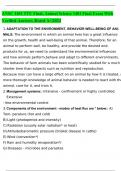
ANSC 1401 TTU Final, Animal Science 1401 Final Exam With Verified Answers |Rated A+|2024 ADAPTATION TO THE ENVIRONMENT, BEHAVIOR WELL-BEING OF ANI- MALS: The environment in which an animal lives has a great influence on the growth, health and well-being of that animal. Therefore, for an animal to perform well, be healthy, and provide the desired end-products for us, we need to understand the environmental influences and how animals perform,behave and adapt to different environments. The behavior of farm animals has been scientifically studied for a much shorter time than subjects such as nutrition and reproduction. Because man can have a large effect on an animal by how it is treated, a more thorough knowledge of animal behavior is needed to react with the animal, care for it, and train it. Management systems:: Intensive - confinement or highly controlled. Extensive less environmental control Components of the environment - modes of heat flux are * below:: A) Tem- perature (hot and cold) Light (photoperiod and intensity) Radiation (usually solar radiation* or heat) Altitude/barometric pressure (brisket disease in cattle) Wind (convection*) Rain and humidity (evaporation*) Diseases - microbes and parasites Nutrition Soil, plants and flooring (conduction*) I Noise K) Polution Thermoneutral zone (TNZ) or comfort zone: range of temperatures where heat produced and heat loss from the body are about the same. Temperatures below TNZ cause an increase in intake and reduced blood flow to extremities to minimize heat loss: A) Temperatures below TNZ cause an increase in intake and reduced blood flow to extremities to minimize heat loss When ET is below the TNZ, the animal is below its lower critical temperature (LCT). LCT can be affected by animal intake, insulation from its hair coat, and whether the animal is wet or dry. Temperatures above INZ cause a decrease in intake, feed conversion, repro- ductive performance, and physical activity, while increasing perspiration, and H20 intake.: 1) When EET is above the TNZ, the animal is above its upper critical temperature (UCT)
École, étude et sujet
- Établissement
- ANSC 1401 TTU
- Cours
- ANSC 1401 TTU
Infos sur le Document
- Publié le
- 4 mai 2024
- Nombre de pages
- 37
- Écrit en
- 2023/2024
- Type
- Examen
- Contient
- Questions et réponses
Sujets
- ansc 1401 ttu
- thermoneutral z
- reproductive efficiency
- 5 factors influencing rep
- 5 factors influenci
- ada
-
5 factors influencing reproductive efficiency
-
how does reproductive efficiency affect maintenanc

Document également disponible en groupe