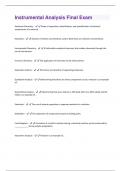
Instrumental Analysis Final Exam Questions and Answers with complete solution
Analytical Chemistry - Study of separation, identification, and quantification of chemical components of a material. Standards - Solution of known concentration used to determine an unknown concentration. Instrumental Chemistry - A field within analytical chemistry that studies chemicals through the use of instruments. Forensic Chemistry - The application of chemistry to law enforcement. Separation Science - The theory and practice of separating molecules. Qualitative Analysis - Determining that there are three components in your mixture is an example of... Quantitative Analysis - Determining that your mixture is 10% lead, 24% iron, 60% cobalt and 6% nickel is an example of... Extraction - The use of solvent properties to separate materials in a solution. Distillation - The separation of components based on boiling point. Centrifugation - Formation of a solid in solution during a chemical reaction can be enhanced by ____________ during sample preparation. Volumetric Analysis - Titration is an example of...Calibration Curve - When the instrumental response of an unknown sample is compared to responses of various concentrations of the standard solution, that method of standardization is known as... Analyte - The object of interest in a solution is also known as the... Chromatography - A column used to separate components of a mixture Chromatogram - The output of chromatography column Adsorption - Solute adsorbed onto surface of solid stationary phase. Retention Time - The time that it takes for mixture components to separate Equilibrium - When everything in a system is balanced Intermolecular Forces - The forces between molecules - hydrogen bonding, dipole moments Diffusion - The movement of particles from an area of high concentration to an area of low concentration; net transport of solute from high to low Stationary Phase - The portion of a column that remains in place Mobile Phase - The liquid or gas that moves the components of a mixture along the stationary phase Convex Isotherms - Are caused by a saturated stationary phase. Concave Isotherms - Are caused by an analyte retained too long by the stationary phase.Column Resolution - Is the measure of a column's ability to separate two analyses. Eluent - Fluid entering the column is called the... Eluate - Fluid emerging from the column is called the... Eddy Diffusion - Tells us the multiple flow paths of the analyte in a packed column. Van Deemter Equation - Tells us how the column and flow rate affect plate height. The larger the plate height, the better the separation will be. - False The smaller the plate height, the better the separation will be. - True The smaller the number of plates, the better the separation will be. - False The larger the number of plates, the better the separation will be. - True Electromagnetic Spectrum - Describes the distribution of energies of electromagnetic radiation. Molar Absorptivity - Defines how much radiation is absorbed at a given concentration and wavelength. Beer's Law - Shows the relationship that describes the correlation between an analyses concentration and its signal response, A=Elc
Written for
- Institution
- Instrumental Analysis
- Course
- Instrumental Analysis
Document information
- Uploaded on
- May 17, 2024
- Number of pages
- 5
- Written in
- 2023/2024
- Type
- Exam (elaborations)
- Contains
- Questions & answers
Subjects

Also available in package deal