Sensation and Perception AP Psych Exam Questions and Complete Solutions
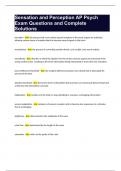
Sensation and Perception AP Psych Exam Questions and Complete Solutions sensation - Ans: the process that occurs when special receptors in the sense organs are activated, allowing various forms of outside stimuli to become neural signals in the brain transduction - Ans: the process of converting outside stimuli, such as light, into neural activity synesthesia - Ans: disorder in which the signals from the various sensory organs are processed in the wrong cortical areas, resulting in the sense information being interpreted as more than one sensation jnd or Difference threshold - Ans: the smallest difference between two stimuli that is detectable 50 percent of the time absolute threshold - Ans: the lowest level of stimulation that a person can consciously detect 50 percent of the time the stimulation is present habituation - Ans: tendency of the brain to stop attending to constant, unchanging information sensory adaptation - Ans: tendency of sensory receptor cells to become less responsive to a stimulus that is unchanging brightness - Ans: determined by the amplitude of the wave color/hue - Ans: determined by the length of the wave saturation - Ans: refers to the purity of the color What is the correct order of light passing through the eye? - Ans: cornea-iris controls the pupil-lens-retina where its transformed into nerve impulses-optic nerve cornea - Ans: bends light waves so the image can be focused on the retina iris - Ans: muscles control the size of the pupil pupil - Ans: iris opening that changes size depending on the amount of light in the environment lens - Ans: changes shape to bring objects into focus retina - Ans: contains photoreceptor cells fovea - Ans: central area of retina; greatest density of photoreceptors optic nerve - Ans: sends visual information to the brain blind spot (optic disc) - Ans: where the optic nerve leaves the eye; there are no photoreceptor cells here visual accomadation - Ans: the change in thickness of the lens as the eye focuses on objects that are far away or close rods - Ans: visual sensory receptors found at the back of the retina, responsible for color vision and sharpness off vision blind spot - Ans: area in the retina where the axons of the three layers of retinal cells exit the eye too form the optic nerve, insensitive to light dark adaptation - Ans: the recovery of the eye's sensitivity to visual stimuli in darkness after exposure to bright lights light adaptation - Ans: the recovery of the eye's sensitivity to visual stimuli in light after exposure to darkness trichromatic theory - Ans: theory of color vision that proposed three types of cones: red, blue, and green after images - Ans: images that occur when a visual sensation persists for a brief time even after the original stimulus is removed opponent-process theory - Ans: theory of color vision that proposes four primary colors with cones arranges in pairs: red-green and blue-yellow monochrome color blindness - Ans: where people have either no cones or have cones that are not working at all- shades of grey hertz (Hz) - Ans: cycles or waves per second, a measurement of frequency; wavelengths are interpreted as pitch where amplitude is interpreted as volume pinna - Ans: the visible , external part of the ear auditory canal - Ans: short tunnel that runs from the pinna to the eardrum cochlea - Ans: snail-shaped structure of the inner ear that is filled with fluid auditory nerve - Ans: bundle of axons from the hair cells in the inner ear What is the order of sound through the ear? - Ans: Sound enters through the pinna and vibrates the eardrum, which then vibrates the hammer, anvil, and stirrup, which in turn vibrate the oval window. This causes the fluid in the cochlea to vibrate, which vibrates the basilar membrane, which then causes the organ of Corti to move up and bend its hair cells, which send signals about hearing to the brain. pitch - Ans: psychological experience of sound that corresponds to the frequency of the sound waves; higher frequencies are perceived as higher pitches place theory - Ans: theory of pitch that states that different pitches are experienced by the stimulation of hair cells in different locations on the organ of Corti frequency theory - Ans: theory of pitch that states that pitch is related to the speed of vibrations in the basilar membrane volley principle - Ans: theory of pitch that states that frequencies from about 400 Hz to 4000 Hz cause the hair cells (auditory neurons) to fire in a volley pattern, or take turns in firing gustation - Ans: the sensation of a taste Who proposed that there are four primary tastes? Five? - Ans: Hans Henning; Lindemann olfaction (olfactory sense) - Ans: the sensation of smell olfactory receptor cells - Ans: each have about a dozen little hairs, or cilia Where do olfactory receptors go in the brain? - Ans: olfactory bulbs olfactory bulbs - Ans: areas of the brain located just above the sinus cavity and just below the frontal lobes that receive information from the olfactory receptor cells somesthetic sense - Ans: the body senses consisting of the skin senses, the kinesthetic sense, and the vestibular senses skin senses - Ans: the sensations of touch, pressure, temperature, and pain. kinesthetic sense - Ans: sense of the location of body parts in relation to the ground and each other vestibular senses - Ans: the sensations of movement, balance, and body position; innermost chamber of the ear sensory conflict theory - Ans: an explanation of motion sickness in which the information from the eyes conflicts with the information from the vestibular senses, resulting in dizziness, nausea, and other physical discomfort perception - Ans: the method by which the sensations experienced at any given moment are interpreted and organized in some meaningful fashion size constancy - Ans: the tendency to interpret an object as always being the same actual size, regardless of its distance. shape constancy - Ans: the tendency to interpret the shape of an object as being constant even when its shape changes on the retina brightness constancy - Ans: the tendency to perceive the apparent brightness of an object as the same even when the light conditions change figure-ground - Ans: the tendency to perceive objects, or figures, as existing on a background reversible figures - Ans: visual illusions in which the figure and ground can be reversed proximity - Ans: the tendency to perceive objects that are close to each other as part of the same grouping similarity - Ans: the tendency to perceive things that look similar to each other as being part of the same group closure - Ans: the tendency to complete figures that are incomplete continuity - Ans: the tendency to perceive things as simply as possible with a continuous pattern rather than with a complex, broken-up pattern contiguity - Ans: the tendency to perceive two things that happen close together in time as being related depth perception - Ans: the ability to perceive the world in three dimensions monocular cues (pictorial depth cues) - Ans: cues for perceiving depth based on one eye only binocular cues - Ans: cues for perceiving depth based on both etes linear perspective - Ans: the tendency for parallel lines to appear to converge on each other relative size - Ans: perception that occurs when objects that a person expects to be a certain size appear to be small and are, therefore, assumed to be much farther away Overlap (interposition) - Ans: the assumption that an object that appears to be blocking part of another object is in front of the second object and closer to the viewer aerial perspective - Ans: the haziness that surrounds objects that are farther away from the viewer, causing the distance to be perceived as greater texture gradient - Ans: the tendency for textured surfaces to appear to become smaller and finer as distance from the viewer icreases motion parallax - Ans: the perception of motion of objects in which close objects appear to move more quickly than objects that are farther away accommodation - Ans: as a monocular clue, the brain's use of information about the changing thickness of the lens of the eye in response to looking at objects that are close or far away; also a muscular cue convergence-bi - Ans: the rotation of the two eyes in their sockets to focus on a single object, resulting in greater convergence for closer objects and lesser convergence if objects are distant; also a muscular cue binocular disparity - Ans: the difference in images between the two eyes, which is greater for objects that are close and smaller for distant objects Muller-Lyer illusion - Ans: illusion of line length that is distorted by inward-turning or outward-turning corners on the ends of the lines, causing lines of equal length to appear to be different perceptual set (expectancy) - Ans: the tendency to perceive things a certain way because previous experiences or expectations influence those perceptions top-down processing - Ans: the use of pre-existing knowledge to organize individual features into a unified whole bottom-up processing - Ans: the analysis of the smaller features to build up to a complete perception parapsychology - Ans: the study of ESP, ghosts, and other subjects that do not normally fall into the realm of ordinary psychology telepathy - Ans: refers to the claimed abilityto read another person's thoughts clairvoyance - Ans: refers to the supposed ability to "see" things that are not actually present precognition - Ans: the supposed ability to know something in advance of its occurrence or to predict a future event
Written for
- Institution
- Sensation and perception
- Course
- Sensation and perception
Document information
- Uploaded on
- May 25, 2024
- Number of pages
- 7
- Written in
- 2023/2024
- Type
- Exam (elaborations)
- Contains
- Questions & answers
Subjects
-
sensation and perception ap psych exam questions a

Also available in package deal