Lean Six Sigma Yellow Belt Measure Correct 100%
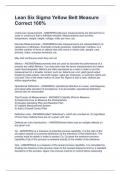
continuous measurement - ANSWERContinuous measurements are derived from a scale or continuum that is infinitely-divisible. Measurements such as time, temperature, weight, height, voltage, miles per hour, etc. Discrete Measurements - ANSWERDiscrete measurements are representations of categories or attributes. Examples include good/bad, male/female, red/blue, or a discrete number of items or objects that only come in whole units: people, cars, animals, cities, computer terminals, etc. May look continuous when they are not Metrics - ANSWERMeasurements that are used to describe the performance of a process are called Metrics. You may even hear the terms measurement and metric used interchangeably. Metrics are often expressed as a ratio in order to put the measurement in a broader context, such as: defects per unit, yield (good output divided by total output), net profit margin, sales per employee, or warranty claims per unit sold. One of the basic metrics of Lean Six Sigma is also a ratio: defects per million opportunities. Operational Definitions - ANSWERAn operational definition is a clear, unambiguous, and observable standard of acceptance. If at all possible, operational definitions should also be measurable The Process of Measurement - ANSWER1) Identify What to Measure
Written for
- Institution
- Lean Six Sigma Yellow Belt Measure
- Module
- Lean Six Sigma Yellow Belt Measure
Document information
- Uploaded on
- May 28, 2024
- Number of pages
- 2
- Written in
- 2023/2024
- Type
- Exam (elaborations)
- Contains
- Questions & answers
Subjects
-
lean six sigma yellow belt measure correct 100
-
lean six sigma yellow belt measure 2024
-
continuous measurement answercontinuous measurem
-
discrete measurements answerdiscrete measurement

Also available in package deal