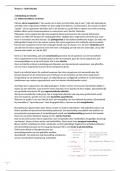
Medical Embryology Exam Questions With 100% Correct Answers
Medical Embryology Exam Questions With 100% Correct Answers Embryology - answer- Comes from the Greek word embryon which means the unborn - Studies prenatal development of gametes, fertilization and development of embryos and fetuses - The study of animal development from the phase of an organism between fertilization and birth Embryology wans to answer two fundamental questions - answer1. How does the fertilized egg give rise to the adult body 2. How does the adult body produce another body Pre-natal development (before birth) - answer- Embryonic development - Fetal development Human development process include - answer1. Gene regulation 2. Differentiation 3. Morphogenesis Cellular events associated with human development include - answer- Cell division - Cell migration - Cell rearrangement - Differentiation - Programmed cell death - Growth Spatial anatomy - answer- Coronal plane - divides front and back - Sagittal plane - divides left and right - Transverse - divides top and bottom Ontogenetic development - answer- Progress somewhat linearly 1. Gametogenesis: the formation of mature eggs and sperm (1N = haploid) 2. Fertilization: fusing of sperm and egg to form a zygote (2N = diploid) 3. Cleavage: rapid mitotic cell division of zygote (early embryo) to form the multicellular embryo 4. Morphogenesis: gastrulation that form initial primary germ layers + organogenesis A. Cell and tissue differentiation: cellular interactions that regulate gene activity and lead to specialized cell types B. Pattern and polarity: the development of tissues and organs is a reflection of having symmetry 5. Growth and maturation: the fetus grows and development continues which persists throughout life. Post-embryonic development is characterized by growth and sexual maturation, gametogenesis, fertilization Embryology in medicine - answer- Divide the 9 month human into three trimesters - Most critical stages of development occur during the 1st trimester - Abnormal development when things go wrong. Research. Embryology applications of research - answer- Studying development process through genetic control (Morphogens) - Links to cell signaling inductions and consequences for when things go wrong - Study of genetic diseases and mutations - Links to stem cell research - Prenatal therapies - Understanding the influence of environmental factors on development (Teratology) Gametogenesis - answerThe process of formation and genetic/phenotypic maturation of gametes Gametogenesis divided into four phases - answer1. Extraembryonic origin of Primordial Germ Cells (PGCs) and their migration to the gonads 2. An increase in the number of PGCs by Mitosis 3. A reduction in chromosomal materials by Meiosis 4. Structural and functional maturation of gametes (oogenesis, spermatogenesis) Phase differences between males and females - answerThe first phase of gametogenesis is identical in males and females, where as distinct differences exist between the male and female patterns in the last three phases. Primordial germ cells (PGCs) - answer- Earliest recognizable precursor of gametes (seen 24 days after fertilization) - Arise outside of the gonads (in endodermal layer of yolk sack - has high glycogen and alkaline phosphatase content) - Stem Cells like - Location of PGCs in 16-somite human embryo (midsagittal section) - Migrate into the gonads during early embryonic development Phase 1: origin of the PGCs - answer- Originate in the epiblast prior to gastrulation - Requires inductive signaling - Moved to an extraembryonic region (yolk sac) where they are determined - PGCs re-enter the embryo and migrate to the developing gonads (genital ridges) Phase 1: the arduous journey - answerBetween 4-6 weeks the PGCs: - Exit the yolk sac - Enter hindgut epithelium - And then migrate through the dorsal mesentery - Until they reach the primordia of the gonads How do PGCs migrate and know where to go - answer1. Amoeboid movements during initial migration 2. Cytoplasmic processes link adjacent PGCs 3. Chemoattractants secreted by genital ridges 4. Migration by extending pseudopod (integrin-fibronectin interactions) 5. Follow extracellular matrix "roadways" lined with fibronectin Sacrococcygeal teratoma (SCT) - answer- Unusual tumor in the newborn located at the base of tailbone - More common in females then males - Usually not malignant but very large - Cured by surgery after birth (occasionally causes trouble before birth) - SCT is usually discovered by blood test performed on mother at 16 weeks showing high alpha fetoprotein amount -Sonogram is usually performed because uterus is larger then it should be - Mirror syndrome (maternal complic
Written for
- Institution
- Medical Embryology
- Course
- Medical Embryology
Document information
- Uploaded on
- May 29, 2024
- Number of pages
- 31
- Written in
- 2023/2024
- Type
- Exam (elaborations)
- Contains
- Questions & answers
Subjects
-
medical embryology exam questions with 100 correc