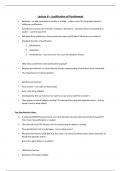
Lecture 8 – Justification of Punishment
• Bentham – to add more pain to society is wicked – unless it acts for the greater benefit –
utilitarian justification:
• Punishment corrects the criminal’s motives in the future – prevents future criminality (if it
works! – and if it doesn’t?)
• But apart from utilitarians, does punishment need justification? What are our reasons?
• Standard theories of justification:
1. Retributivist
2. Utilitarian
3. Humanitarian – but this turns into a sort of utilitarian theory
• Why does punishment need justification anyway?
• Because punishment is a harm done by society compounding a harm done by an individual.
• The importance of criminal policies
• Retributivist theories:
• Very ancient – the code of Hammurabi
• Such rules bring stability
• Developed by the Lex Talionis (“an eye for an eye and a tooth for a tooth”)
• They express a moral/religious feeling. The demand for equal and opposite action – but by
whom? And to what effect?
Two Retributivist ideas:
1. A criminal DESERVES punishment up to the demands of justice (the punishment should FIT
the crime). No justification is needed.
2. The criminal must PAY the price for his actions (pay his debt to society)
• Thus punishment mirrors damages – but in what sense?
• Retributivist theories LOOK BACK at the crime. For every (Criminal) action there should be an
equal and opposite action.
• But is this right? What is its effect?
• Utilitarian theories:
• Bentham’s Principle of Utility
• Bentham – to add more pain to society is wicked – unless it acts for the greater benefit –
utilitarian justification:
• Punishment corrects the criminal’s motives in the future – prevents future criminality (if it
works! – and if it doesn’t?)
• But apart from utilitarians, does punishment need justification? What are our reasons?
• Standard theories of justification:
1. Retributivist
2. Utilitarian
3. Humanitarian – but this turns into a sort of utilitarian theory
• Why does punishment need justification anyway?
• Because punishment is a harm done by society compounding a harm done by an individual.
• The importance of criminal policies
• Retributivist theories:
• Very ancient – the code of Hammurabi
• Such rules bring stability
• Developed by the Lex Talionis (“an eye for an eye and a tooth for a tooth”)
• They express a moral/religious feeling. The demand for equal and opposite action – but by
whom? And to what effect?
Two Retributivist ideas:
1. A criminal DESERVES punishment up to the demands of justice (the punishment should FIT
the crime). No justification is needed.
2. The criminal must PAY the price for his actions (pay his debt to society)
• Thus punishment mirrors damages – but in what sense?
• Retributivist theories LOOK BACK at the crime. For every (Criminal) action there should be an
equal and opposite action.
• But is this right? What is its effect?
• Utilitarian theories:
• Bentham’s Principle of Utility