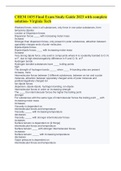
CHEM 210 Final Exam Reactions, 2024.
P450
[O]
Breaks a double bond (even phenyl) to have add an oxygen that is bonded to each
carbon of a double bond
Rh/ Pt
Dehydrogenation to form a double bond
Br2
FeBr3 (cat)
Adds a Br in the place of a hydrogen
BH2-H
Breaks triple OR double bond and adds H or BH2 to those carbons
H2
NaNH3
Trans partial reduction of triple to double bonds
H2
Lindrar's catalyst
Cis partial reduction of triple to double bonds
H2, Pd/C or PtO2
Full hydrogenation of all double and triple bonds to a single bond
syn addition
(1)O3
(2) Reductive workup (Zn, C2S, PPh3)
Breaks double bond and puts oxygen at either end but leaves H
Phenyl groups not cleaved
(1)O3
(2) Oxidative workup (H2O2)
Breaks double bond and puts oxygens at either end + transforms H into OH
Phenyl groups not cleaved
m-CPBA
alkene to epoxide
Adds an oxygen that is bonded to each carbon of a double bond
OsO4
NaHSO3 workup
Breaks double bonds and adds OHs
KC4H9O
Good Base for E2
, Tosylate (TsO-)
Triflate (TfO-)
Mesylate (MsO-)
OsO4
NaHSO3 workup
Breaks double bonds and adds OHs
KHnO4 +NaOH
H2O
Syn addition of 2 OH groups
Lewis Acid
accepts a pair of nonbonding electrons
Lewis Base
Source of nbe pair
carbocation
Open shell carbon w positive charge
carboanion
Negatively charged carbon
hydrogen bond donor
strongly electronegative atom such as N, O, or F
hydrogen bond acceptor
electronegative atom with long electron pairs
Bronsted Acid
Molecule that provides H+
Bronsted Base
Molecule with a lone pair of nbe that accepts H+
P450
[O]
Breaks a double bond (even phenyl) to have add an oxygen that is bonded to each
carbon of a double bond
Rh/ Pt
Dehydrogenation to form a double bond
Br2
FeBr3 (cat)
Adds a Br in the place of a hydrogen
BH2-H
Breaks triple OR double bond and adds H or BH2 to those carbons
H2
NaNH3
Trans partial reduction of triple to double bonds
H2
Lindrar's catalyst
Cis partial reduction of triple to double bonds
H2, Pd/C or PtO2
Full hydrogenation of all double and triple bonds to a single bond
syn addition
(1)O3
(2) Reductive workup (Zn, C2S, PPh3)
Breaks double bond and puts oxygen at either end but leaves H
Phenyl groups not cleaved
(1)O3
(2) Oxidative workup (H2O2)
Breaks double bond and puts oxygens at either end + transforms H into OH
Phenyl groups not cleaved
m-CPBA
alkene to epoxide
Adds an oxygen that is bonded to each carbon of a double bond
OsO4
NaHSO3 workup
Breaks double bonds and adds OHs
KC4H9O
Good Base for E2
, Tosylate (TsO-)
Triflate (TfO-)
Mesylate (MsO-)
OsO4
NaHSO3 workup
Breaks double bonds and adds OHs
KHnO4 +NaOH
H2O
Syn addition of 2 OH groups
Lewis Acid
accepts a pair of nonbonding electrons
Lewis Base
Source of nbe pair
carbocation
Open shell carbon w positive charge
carboanion
Negatively charged carbon
hydrogen bond donor
strongly electronegative atom such as N, O, or F
hydrogen bond acceptor
electronegative atom with long electron pairs
Bronsted Acid
Molecule that provides H+
Bronsted Base
Molecule with a lone pair of nbe that accepts H+