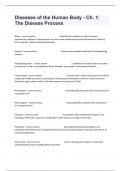
Diseases of the Human Body - Ch. 1: The Disease Process Simplified Test Questions And Verified Answers.
Illness - correct answer describes the condition of a person who is experiencing a disease; it encompasses the way in whic individuals perceive themselves as suffering from a disease - highly individual & personal Disease - correct answer known by its medical classification & distinguishing features Predisposing factor - correct answer a condition or situation that may make a person more at risk or susceptible to diease (heredity, age, gender, environment, lifestyle) Chromosome - correct answer in human cells, a linear structure in the nucleus composed of DNA & proteins & bearing part of the genetic information of the cell. EAch human cell (except for egg or sperm cells) has 46 chromosomes, occurring in 23 pairs Homozygous - correct answer possessing identical genes from each parent for a particular trait Heterozygous - correct answer possessing different genes from each parent for a particular trait Genotype - correct answer description of the combination of genes of an individual, either with respect to a single trait or with respect to a larger set of traits Phenotype - correct answer observable physical characteristics of an individual, determined by the combined influences of the individual's genetic makeup & the effects of environmental factors Amino acid - correct answer any of a large group of organic compounds constituting the primary building blocks of protein Inflammation - correct answer the body's immunologic response to tissue damage caused by the invasion of foreign bodies, microorganisms, or harmful chemicals (may result from trauama, physical agents, chemical agents, allergens, pathogenic organisms) Pathogenic - correct answer capable of causing disease Fungi - correct answer includes yeasts & molds that may be present in the soil, air, & water. Fungal diseases (called mycoses) usually develop slowly, are resistant to treatment, & are rarely fatal. Rickettsiae - correct answer group of bacteria-like organisms live parasitically inside living cells; transmitted through bites from infected lice, fleas, ticks, mosquitoes, & mites Protozoa - correct answer single-celled organisms that have animal-like characteristics (ex: malaria, African sleeping sickness) Viruses - correct answer the smalles microorganisms, independent of host cells, difficult to isolate, & few respond to drug therapy. Viruses may remain dormant in a host for long periods before becoming active. Bacteria - correct answer single-celled organisms; classified according to shape Parasites - correct answer group of host-requiring organisms that include external & internal parasites (ex: lice, mites, worms) Syncope - correct answer transient loss of consciousness due to inadequate blood flow to the brain Antiemetic - correct answer drug or other agent used to prevent or stop vomiting Analgesic - correct answer drug or other agent used to relieve pain Hypoxemia - correct answer decreased oxygen in arterial blood Neoplasm - correct answer new & abnormal formation of tissue. Abnormal tissue may form a tumor. Metastasis - correct answer movement of bacteria or body cells, especially cancer cells, from one part of the body to the other, typically by way of the circulatory system Antigen - correct answer any substance that, when introduced into the body, causes the production of a specific antibody by the immune system Antibody - correct answer protein substance produced by the body's immune system in response to & interacting with a specific antigen Urticaria - correct answer vascular reaction of the skin characterized by the temporary eruption of wheals; hives Anaphylaxis - correct answer allergic reaction of the body to a foreign bod yor other substance; sometimes used to refer exclusively to a sudden, unusually severe, & possibly life-threatening allergic reaction Pruritis - correct answer severe itching Erythema - correct answer diffused redness of the skin due to dilation of the superficial capillaries Edema - correct answer excessive accumulation of fluid in bodily tissues; may be localized or general Stridor - correct answer harsh, high0pitched soudn during respiration due to osbstruction of air passages Diuretic - correct answer drug or agent that promotes the secretion of urine Idiopathic - correct answer of unknown cause Iatrogenic - correct answer caused by treatment; for instance, an infection caused by a failure of surgical antiseptic precations Sequela - correct answer condition that is a result of a past disease (ex: paralyis from having polio)
Written for
- Institution
- I HUMAN
- Course
- I HUMAN
Document information
- Uploaded on
- June 13, 2024
- Number of pages
- 4
- Written in
- 2023/2024
- Type
- Exam (elaborations)
- Contains
- Questions & answers
Subjects
-
diseases of the human body ch 1 the disease pr

Also available in package deal