Chemical equilibrium
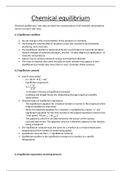
Chemical equilibrium is the state at which the concentrations of all reactants and products
remain constant with time.
6.1 Equilibrium condition
No net change in the concentrations of the products or reactants.
Increasing the concentration of products causes the reaction to go backwards,
producing more reactants.
The equilibrium position is determined by the concentration of reactants/products,
relative energies of reactants/products, and the “relative degree of organization” of
reactants and products.
Nature tries to achieve minimum energy and maximum disorder.
The rates of reaction also come into play as some reaction may appear to be in
equilibrium but simply take more time to react. (Example: Haber process)
6.2 Equilibrium constant
Law of mass action:
- jA + kB lC + mD
- Equilibrium expression:
C l Dm
K= j k
A B
- K constant is known as Equilibrium Constant
- Guldberg and Waage found this relationship through empirical scientific
observations.
Characteristics of equilibrium expression:
- The equilibrium equation for a reaction written in reverse is the reciprocal of the
original equilibrium expression.
- When the balanced equation for a reaction is multiplied by a factor “n”, the
equilibrium equation for the new reaction is the original expression raised to the
“n”th power. Thus Knew = (Koriginal)n
- The apparent units for K are determined by the powers of the various
concentration terms. The apparent units for K therefore depend on the reaction
being considered.
The equilibrium constant stays the same for a reaction at a certain temperature,
independent of the number of moles being added.
Equilibrium concentration =/= Equilibrium constant.
Equilibrium position is the equilibrium constant of a reaction at a specific
temperature.
6.3 Equilibrium expressions involving pressure
Chemical equilibrium is the state at which the concentrations of all reactants and products
remain constant with time.
6.1 Equilibrium condition
No net change in the concentrations of the products or reactants.
Increasing the concentration of products causes the reaction to go backwards,
producing more reactants.
The equilibrium position is determined by the concentration of reactants/products,
relative energies of reactants/products, and the “relative degree of organization” of
reactants and products.
Nature tries to achieve minimum energy and maximum disorder.
The rates of reaction also come into play as some reaction may appear to be in
equilibrium but simply take more time to react. (Example: Haber process)
6.2 Equilibrium constant
Law of mass action:
- jA + kB lC + mD
- Equilibrium expression:
C l Dm
K= j k
A B
- K constant is known as Equilibrium Constant
- Guldberg and Waage found this relationship through empirical scientific
observations.
Characteristics of equilibrium expression:
- The equilibrium equation for a reaction written in reverse is the reciprocal of the
original equilibrium expression.
- When the balanced equation for a reaction is multiplied by a factor “n”, the
equilibrium equation for the new reaction is the original expression raised to the
“n”th power. Thus Knew = (Koriginal)n
- The apparent units for K are determined by the powers of the various
concentration terms. The apparent units for K therefore depend on the reaction
being considered.
The equilibrium constant stays the same for a reaction at a certain temperature,
independent of the number of moles being added.
Equilibrium concentration =/= Equilibrium constant.
Equilibrium position is the equilibrium constant of a reaction at a specific
temperature.
6.3 Equilibrium expressions involving pressure