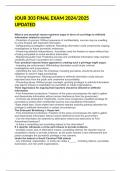
JOUR 303 FINAL EXAM 2024/2025
UPDATED
What is one practical reason reporters argue in favor of a privilege to withhold
information related to sources?
- Protection of sources: Without assurance of confidentiality, sources may be unwilling
to come forward with important information.
- Safeguarding investigative methods: Revealing information could compromise ongoing
investigations or future journalistic endeavors.
- Preserving editorial independence: Journalists need the freedom to report without fear
of being compelled to reveal sensitive information.
- Maintaining public trust: Protecting sources and confidential information helps maintain
credibility and trust in journalism as a whole.
Four practical reasons those opposed to creating such a privilege might argue:
- Impeding law enforcement: Withholding information could hinder criminal
investigations and prosecutions.
- Upholding the rule of law: No individual, including journalists, should be above the
obligation to assist in legal proceedings
- Ensuring transparency: Allowing journalists to withhold information could obscure
important facts from the public and undermine accountability.
- Preventing abuse: Without proper oversight, granting privileges to withhold information
may lead to misuse or exploitation by journalists or media organizations.
Three legal bases for arguing that reporters should be allowed to withhold
information
- First Amendment protections: Freedom of the press encompasses the right to gather
and disseminate information without undue interference from the government.
- Common law protections: Historically, courts have recognized a qualified privilege for
journalists to protect their confidential sources and unpublished information.
-State shield laws: Some states have enacted statutes explicitly granting reporters the
privilege to withhold information in certain circumstances
The three-part Branzburg v. Hayes test
- First Amendment protections: Freedom of the press encompasses the right to gather
and disseminate information without undue interference from the government
- Can the information be obtained by alternative means less destructive to First
Amendment freedoms?
- Is there a compelling and overriding interest in the information?
If a reporter witnesses a crime and refuses to provide evidence
- probable cause, lack of alternative means, compelling interest, the reporter may be
compelled to testify or provide evidence, as the public interest in law enforcement and
justice outweighs the journalist's privilege in this scenario.
Under the federal or South Carolina FOIA statute
- Any individual, organization, or entity can make a_____ , including citizens, journalists,
businesses, and non-profit organizations.
UPDATED
What is one practical reason reporters argue in favor of a privilege to withhold
information related to sources?
- Protection of sources: Without assurance of confidentiality, sources may be unwilling
to come forward with important information.
- Safeguarding investigative methods: Revealing information could compromise ongoing
investigations or future journalistic endeavors.
- Preserving editorial independence: Journalists need the freedom to report without fear
of being compelled to reveal sensitive information.
- Maintaining public trust: Protecting sources and confidential information helps maintain
credibility and trust in journalism as a whole.
Four practical reasons those opposed to creating such a privilege might argue:
- Impeding law enforcement: Withholding information could hinder criminal
investigations and prosecutions.
- Upholding the rule of law: No individual, including journalists, should be above the
obligation to assist in legal proceedings
- Ensuring transparency: Allowing journalists to withhold information could obscure
important facts from the public and undermine accountability.
- Preventing abuse: Without proper oversight, granting privileges to withhold information
may lead to misuse or exploitation by journalists or media organizations.
Three legal bases for arguing that reporters should be allowed to withhold
information
- First Amendment protections: Freedom of the press encompasses the right to gather
and disseminate information without undue interference from the government.
- Common law protections: Historically, courts have recognized a qualified privilege for
journalists to protect their confidential sources and unpublished information.
-State shield laws: Some states have enacted statutes explicitly granting reporters the
privilege to withhold information in certain circumstances
The three-part Branzburg v. Hayes test
- First Amendment protections: Freedom of the press encompasses the right to gather
and disseminate information without undue interference from the government
- Can the information be obtained by alternative means less destructive to First
Amendment freedoms?
- Is there a compelling and overriding interest in the information?
If a reporter witnesses a crime and refuses to provide evidence
- probable cause, lack of alternative means, compelling interest, the reporter may be
compelled to testify or provide evidence, as the public interest in law enforcement and
justice outweighs the journalist's privilege in this scenario.
Under the federal or South Carolina FOIA statute
- Any individual, organization, or entity can make a_____ , including citizens, journalists,
businesses, and non-profit organizations.