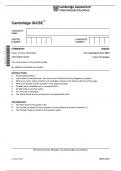
Exam (elaborations) GCSE CHEMISTRY4398
Answer all questions. ● Use a black or dark blue pen. You may use an HB pencil for any diagrams or graphs. ● Write your name, centre number and candidate number in the boxes at the top of the page. ● Write your answer to each question in the space provided. ● Do not use an erasable pen or correction fluid. ● Do not write on any bar codes. ● You may use a calculator. ● You should show all your working and use appropriate units. INFORMATION ● The total mark for this paper is 80. ● The number of marks for each question or part question is shown in brackets [ ]. ● The Periodic Table is printed in the question paper. *0123456789* © UCLES 2020 [Turn over This document has 16 pages. Any blank pages are indicated. Cambridge IGCSE™ 2 © UCLES /04/SP/23 1 Element X can undergo the following physical changes. gaseous X liquid X solid X 2 4 3 1 Fig. 1.1 (a) (i) Name each of the numbered physical changes shown in Fig. 1.1. 1 ........................................................................................................................................ 2 ........................................................................................................................................ 3 ........................................................................................................................................ 4 ........................................................................................................................................ [4] (ii) One difference between boiling and evaporation is the rate at which the processes occur. State one other difference between boiling and evaporation. ........................................................................................................................................... ...................................................................................................................................... [1] (b) Describe the separation, arrangement and motion of particles of element X in the solid state. separation ................................................................................................................................. arrangement ............................................................................................................................. motion ....................................................................................................................................... [3] (c) Element X is a Group III metal. It burns in air to form an oxide X2O3. Write a symbol equation for this reaction. .............................................................................................................................................. [2] [Total: 10] 3 © UCLES /04/SP/23 [Turn over 2 Magnesium, calcium and strontium are Group II elements. (a) Complete Table 2.1 to show the electronic configuration of a calcium atom. Table 2.1 shell 1st 2nd 3rd 4th number of electrons [1] (b) Describe how the electronic configuration of a strontium atom is: (i) similar to the electronic configuration of a calcium atom ........................................................................................................................................... ...................................................................................................................................... [1] (ii) different from the electronic configuration of a calcium atom. ........................................................................................................................................... ...................................................................................................................................... [1] (c) Calcium reacts with cold water to form two products: • a colourless gas, P, which ‘pops’ with a lighted splint • a weakly alkaline solution, Q, which turns milky when carbon dioxide is bubbled through it. (i) Name gas P. ...................................................................................................................................... [1] (ii) Identify the ion responsible for making solution Q alkaline. ...................................................................................................................................... [1] (iii) Suggest the pH of solution Q. ...................................................................................................................................... [1] (iv) Write a symbol equation for the reaction of calcium with cold wate
Written for
- Institution
- GCSE CHEMISTRY4398
- Module
- GCSE CHEMISTRY4398
Document information
- Uploaded on
- July 4, 2024
- Number of pages
- 16
- Written in
- 2023/2024
- Type
- Exam (elaborations)
- Contains
- Questions & answers
Subjects
-
chemistry 062004 paper 4 theory extended

Also available in package deal