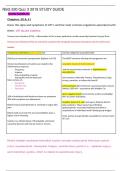
NSG 530 Quiz 3 2019 STUDY GUIDE
Study Guide #3
Chapters 30 & 31
Know the signs and symptoms of UTI’s and the most common organisms associated with
them. UTI (acute cystitis)
Urinary tract infections (UTIs) – inflammation of the urinary epithelium usually caused by bacteria from gut flora.
Urinary tract infections (UTIs) are commonly caused by the retrograde movement of bacteria into the urethra and
bladder.
Urinary tract infections (acute cystitis) S/S Common Organism associated with
Elderly are commonly asymptomatic (highest risk UTI) The MOST common infecting microorganisms are
Clinical manifestations of cystitis are related to the uropathic strains of Escherichia coli
inflammatory response:
• Frequency and the second most common is Staphylococcus
• Urgency saprophyticus.
• Dysuria (painful urination
• Suprapubic and low back pain Less common: Klebsiella, Proteus, Pseudomonas, fungi,
More serious s/s viruses, parasites, or tubercular baccilli
• Hematuria
• Cloudy urine Schistosomiasis Most Common cause of parasitic invasion
• Flank pain (infects >200 mill – association with bladder Ca)
Gram-negative bacilli move into the urethra and bladder
10% of individuals with bacteriuria have no symptoms then to ureter and kidney.
30% with symptoms are abacteriuric
Uropthic stains of E. coli have type-1 fiimbrae bind to
Elderly may be asymptomatic or confused or vague abd latex catheters. These stains have P fimbrae
pain. (pyelonephritis- associated fimbriae) and bind to
uropithelium of individuals with P blood group antigen.
Elderly with recurrent UTIs and comorbidities have a
higher risk of mortality Some women are genetically susceptible to certain strains
of E coli
Cystitis is an inflammation of the bladder commonly
caused by bacteria and may be acute or chronic.
Painful bladder syndrome/interstitial cystitis includes nonbacterial infectious cystitis
(viral, mycobacterial, chlamydial, fungal), noninfectious cystitis (i.e., radiation injury),
and interstitial cystitis, which is related to autoimmune injury.
,NSG 530 Quiz 3 2019 STUDY GUIDE
Types of incontinence
Type Description
Urge incontinence (Most common in older adults) Involuntary loss of urine associated with abrupt &
strong desire to void (urgency), often associated
with involuntary contractions of detrusor; when
associated with neurologic disorder, this called
detrusor hyperreflexia; when no neurologic
disorder exists, this called detrusor instability, may
be associated with decreased bladder wall
compliance
Stress incontinence (most common in women <60 Involuntary loss of urine during coughing,
& men who have had prostate surgery) sneezing, laughing or other physical activity
associated with increased abdominal pressure
Overflow incontinence Underactive bladder (UAB) Involuntary loss of urine with overdistention of
is a condition in which the duration or strength of bladder; associated with neurologic lesions below
contraction is inadequate to empty the bladder, S1, polyneuropathies, and urethral obstruction
resulting in distention and overflow incontinence. (e.g. enlarged prostate)
Mixed incontinence (most common in older Combination of both stress and urge incontinence
woman)
Functional incontinence Involuntary loss of urine attributable to dementia
or immobility
Pyelonephritis s/s Glomerulonephritis s/s
Acute pyelonephritis s/s: (an infection of one Acute glomerulonephritis: commonly results
, NSG 530 Quiz 3 2019 STUDY GUIDE
or both upper urinary tracts) Pyelonephritis is an from inflammatory damage to the glomerular
acute or chronic inflammation of the renal pelvis filtration membrane as a consequence of immune
often related to obstructive uropathies and may reactions after a streptococcal infection.
cause abscess formation and scarring with an Primary glomerular injury,
alteration in renal function. Including: Immunologic responses, Ischemia, Free
(e.g. ureter, renal pelvis, & interstitial) radicals, Drugs, Toxins, Vascular disorder, Infection
Causes: Glomerulonephritis – 15 yr old – caused post-strep
• Kidney stones infection
• Vesicoureteral reflux Secondary glomerular injury is a consequence of
• Pregnancy systemic diseases, including: Diabetes mellitus,
• Neurogenic bladder HTN, Bacterial toxins, Systemic lupus
• Instrumentation
erythematosus, CHF, HIV - related kidney disease
• Female sexual trauma
Most common causes: an antigen-antibody
Microorganisms: E. coli, Proteus or Pseudomonas
complex. Immune complex deposition in the
S/S:
glomerular capillaries & inflammatory damage.
Onset is usually acute: fever, chills, & flank or groin
S/S: May be sudden; silent, mild, moderate, or
pain.
severe in symptoms Sever or progressive
Similar to UTI S/S:
glomerular disease causes: oliguria (urine output
• Frequency
of 30ml hour or less), HTN, Renal failure
• Dysuria
Gross hematuria, edema, & HTN
• Costovertebral tenderness
Two major symptoms distinctive of more severe
Older adults’ nonspecific symptoms: low-grade
glomerulonephritis are: (1) hematuria with red
fever & malaise
blood cell casts (2) proteinuria exceeding 3 to
5g/day with albumin (macroalbuminuria) as the
Most common condition associated with
major protein.
development of acute pyelonephritis is urinary
Diabetic nephropathy is the most common cause
tract obstruction
of glomerular injury progressing to chronic kidney
disease.
Chronic Pyelonephritis a persistent or
recurrent infection of the kidney leading to scarring
Chronic glomerulonephritis: encompasses
several glomerular diseases with a progressive
of one or more kidneys.
course leading to chronic kidney failure.
Study Guide #3
Chapters 30 & 31
Know the signs and symptoms of UTI’s and the most common organisms associated with
them. UTI (acute cystitis)
Urinary tract infections (UTIs) – inflammation of the urinary epithelium usually caused by bacteria from gut flora.
Urinary tract infections (UTIs) are commonly caused by the retrograde movement of bacteria into the urethra and
bladder.
Urinary tract infections (acute cystitis) S/S Common Organism associated with
Elderly are commonly asymptomatic (highest risk UTI) The MOST common infecting microorganisms are
Clinical manifestations of cystitis are related to the uropathic strains of Escherichia coli
inflammatory response:
• Frequency and the second most common is Staphylococcus
• Urgency saprophyticus.
• Dysuria (painful urination
• Suprapubic and low back pain Less common: Klebsiella, Proteus, Pseudomonas, fungi,
More serious s/s viruses, parasites, or tubercular baccilli
• Hematuria
• Cloudy urine Schistosomiasis Most Common cause of parasitic invasion
• Flank pain (infects >200 mill – association with bladder Ca)
Gram-negative bacilli move into the urethra and bladder
10% of individuals with bacteriuria have no symptoms then to ureter and kidney.
30% with symptoms are abacteriuric
Uropthic stains of E. coli have type-1 fiimbrae bind to
Elderly may be asymptomatic or confused or vague abd latex catheters. These stains have P fimbrae
pain. (pyelonephritis- associated fimbriae) and bind to
uropithelium of individuals with P blood group antigen.
Elderly with recurrent UTIs and comorbidities have a
higher risk of mortality Some women are genetically susceptible to certain strains
of E coli
Cystitis is an inflammation of the bladder commonly
caused by bacteria and may be acute or chronic.
Painful bladder syndrome/interstitial cystitis includes nonbacterial infectious cystitis
(viral, mycobacterial, chlamydial, fungal), noninfectious cystitis (i.e., radiation injury),
and interstitial cystitis, which is related to autoimmune injury.
,NSG 530 Quiz 3 2019 STUDY GUIDE
Types of incontinence
Type Description
Urge incontinence (Most common in older adults) Involuntary loss of urine associated with abrupt &
strong desire to void (urgency), often associated
with involuntary contractions of detrusor; when
associated with neurologic disorder, this called
detrusor hyperreflexia; when no neurologic
disorder exists, this called detrusor instability, may
be associated with decreased bladder wall
compliance
Stress incontinence (most common in women <60 Involuntary loss of urine during coughing,
& men who have had prostate surgery) sneezing, laughing or other physical activity
associated with increased abdominal pressure
Overflow incontinence Underactive bladder (UAB) Involuntary loss of urine with overdistention of
is a condition in which the duration or strength of bladder; associated with neurologic lesions below
contraction is inadequate to empty the bladder, S1, polyneuropathies, and urethral obstruction
resulting in distention and overflow incontinence. (e.g. enlarged prostate)
Mixed incontinence (most common in older Combination of both stress and urge incontinence
woman)
Functional incontinence Involuntary loss of urine attributable to dementia
or immobility
Pyelonephritis s/s Glomerulonephritis s/s
Acute pyelonephritis s/s: (an infection of one Acute glomerulonephritis: commonly results
, NSG 530 Quiz 3 2019 STUDY GUIDE
or both upper urinary tracts) Pyelonephritis is an from inflammatory damage to the glomerular
acute or chronic inflammation of the renal pelvis filtration membrane as a consequence of immune
often related to obstructive uropathies and may reactions after a streptococcal infection.
cause abscess formation and scarring with an Primary glomerular injury,
alteration in renal function. Including: Immunologic responses, Ischemia, Free
(e.g. ureter, renal pelvis, & interstitial) radicals, Drugs, Toxins, Vascular disorder, Infection
Causes: Glomerulonephritis – 15 yr old – caused post-strep
• Kidney stones infection
• Vesicoureteral reflux Secondary glomerular injury is a consequence of
• Pregnancy systemic diseases, including: Diabetes mellitus,
• Neurogenic bladder HTN, Bacterial toxins, Systemic lupus
• Instrumentation
erythematosus, CHF, HIV - related kidney disease
• Female sexual trauma
Most common causes: an antigen-antibody
Microorganisms: E. coli, Proteus or Pseudomonas
complex. Immune complex deposition in the
S/S:
glomerular capillaries & inflammatory damage.
Onset is usually acute: fever, chills, & flank or groin
S/S: May be sudden; silent, mild, moderate, or
pain.
severe in symptoms Sever or progressive
Similar to UTI S/S:
glomerular disease causes: oliguria (urine output
• Frequency
of 30ml hour or less), HTN, Renal failure
• Dysuria
Gross hematuria, edema, & HTN
• Costovertebral tenderness
Two major symptoms distinctive of more severe
Older adults’ nonspecific symptoms: low-grade
glomerulonephritis are: (1) hematuria with red
fever & malaise
blood cell casts (2) proteinuria exceeding 3 to
5g/day with albumin (macroalbuminuria) as the
Most common condition associated with
major protein.
development of acute pyelonephritis is urinary
Diabetic nephropathy is the most common cause
tract obstruction
of glomerular injury progressing to chronic kidney
disease.
Chronic Pyelonephritis a persistent or
recurrent infection of the kidney leading to scarring
Chronic glomerulonephritis: encompasses
several glomerular diseases with a progressive
of one or more kidneys.
course leading to chronic kidney failure.