Photosynthesis
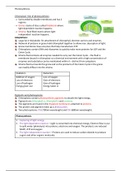
Chloroplast: Site of photosynthesis
® Surrounded by double membrane and has 2
regions:
® Grana: stacks of discs called thylakoids where
light dependent reaction happens.
® Stroma: fluid filled matrix where light
independent reaction happens.
Adaptations:
Large SA in thylakoids: for attachment of chlorophyll, electron carriers and enzymes.
Network of proteins in grana hold chlorophyll together to allow max. absorption of light.
Grana membrane have enzymes that help manufacture ATP.
Chloroplasts contain DNA and ribosomes to quickly make more proteins for LDP and the
Calvin Cycle.
Stroma fluid contains all enzymes needed to carry out the Calvin Cycle – the fluid is
membrane-bound in chloroplast so a chemical environment with a high concentration of
enzymes and substrates can be maintained within it – distinct from cytoplasm.
Stroma fluid surrounds the grana and so the products of the Calvin Cycle in the grana
can readily diffuse into the stroma.
Oxidation Reduction
Addition of oxygen Loss of oxygen
Loss of electrons Gain of electrons
Loss of hydrogen Gain of hydrogen
Energy given out Energy taken in
Pigments and photosystems
Chloroplasts contain photosynthetic pigments to absorb the light energy.
Pigments are chlorophyll a, chlorophyll b and carotene.
The pigments are found in the thylakoid membranes attached to proteins.
The protein and pigment make up a photosystem.
Two photosystems: PSI (700nm wavelength) and PSII (680nm wavelength).
Photosynthesis
1. Capturing of light energy.
2. The light dependent reaction – Light is converted into chemical energy. Electron flow is use
to split water (photolysis) into protons, electrons and oxygen. The products are reduced
NADP, ATP and oxygen.
3. The light independent reaction – Protons are used to reduce carbon dioxide to produce
sugars and other organic molecules.
Chloroplast: Site of photosynthesis
® Surrounded by double membrane and has 2
regions:
® Grana: stacks of discs called thylakoids where
light dependent reaction happens.
® Stroma: fluid filled matrix where light
independent reaction happens.
Adaptations:
Large SA in thylakoids: for attachment of chlorophyll, electron carriers and enzymes.
Network of proteins in grana hold chlorophyll together to allow max. absorption of light.
Grana membrane have enzymes that help manufacture ATP.
Chloroplasts contain DNA and ribosomes to quickly make more proteins for LDP and the
Calvin Cycle.
Stroma fluid contains all enzymes needed to carry out the Calvin Cycle – the fluid is
membrane-bound in chloroplast so a chemical environment with a high concentration of
enzymes and substrates can be maintained within it – distinct from cytoplasm.
Stroma fluid surrounds the grana and so the products of the Calvin Cycle in the grana
can readily diffuse into the stroma.
Oxidation Reduction
Addition of oxygen Loss of oxygen
Loss of electrons Gain of electrons
Loss of hydrogen Gain of hydrogen
Energy given out Energy taken in
Pigments and photosystems
Chloroplasts contain photosynthetic pigments to absorb the light energy.
Pigments are chlorophyll a, chlorophyll b and carotene.
The pigments are found in the thylakoid membranes attached to proteins.
The protein and pigment make up a photosystem.
Two photosystems: PSI (700nm wavelength) and PSII (680nm wavelength).
Photosynthesis
1. Capturing of light energy.
2. The light dependent reaction – Light is converted into chemical energy. Electron flow is use
to split water (photolysis) into protons, electrons and oxygen. The products are reduced
NADP, ATP and oxygen.
3. The light independent reaction – Protons are used to reduce carbon dioxide to produce
sugars and other organic molecules.