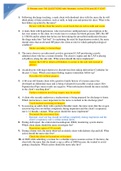
WC EMT CH 18 Actual Full Exam Questions With Correct Answers Success Guaranteed.
A 40-year-old patient without a history of seizures experiences a generalized (tonic-clonic) seizure. The LEAST likely cause of this seizure is: Select one: A. a brain tumor. B. a serious infection. C. intracranial bleeding. D. epilepsy. - correct answer D. epilepsy. A patient who is experiencing aphasia is: Select one: A. usually conscious but has slurred speech. B. experiencing a right hemispheric stroke. C. not able to swallow without choking. D. unable to produce or understand speech. - correct answer D. unable to produce or understand speech. A patient who is possibly experiencing a stroke is NOT eligible for thrombolytic (fibrinolytic) therapy if he or she: Select one: A. has a GCS score that is less than 8. B. has bleeding within the brain. C. has had a prior heart attack. D. is older than 60 years of age - correct answer B. has bleeding within the brain. A patient with an altered mental status is: Select one: A. typically alert but is confused as to preceding events. B. usually able to be aroused with a painful stimulus. C. not thinking clearly or is incapable of being aroused. D. completely unresponsive to all forms of stimuli - correct answer C. not thinking clearly or is incapable of being aroused. Components of the Cincinnati Prehospital Stroke Scale include: Select one: A. facial droop, speech, and pupil size. B. arm drift, speech, and facial droop. C. arm drift, memory, and grip strength. D. speech, pupil reaction, and memory. - correct answer B. arm drift, speech, and facial droop. Febrile seizures: Select one: A. often result in permanent brain damage. B. occur when a child's fever rises slowly. C. are usually benign but should be evaluated. D. are also referred to as absence seizures. - correct answer C. are usually benign but should be evaluated. Individuals with chronic alcoholism are predisposed to intracranial bleeding and hypoglycemia secondary to abnormalities in the: Select one: A. brain. B. kidneys. C. liver. D. pancreas. - correct answer C. liver. Muscle control and body coordination are controlled by the: Select one: A. cerebral cortex. B. cerebrum. C. brain stem. D. cerebellum. - correct answer D. cerebellum. Status epilepticus is characterized by: Select one: A. prolonged seizures without a return of consciousness. B. profound tachycardia and total muscle flaccidity. C. an absence seizure that is not preceded by an aura. D. generalized seizures that last less than 5 minutes. - correct answer A. prolonged seizures without a return of consciousness. The most basic functions of the body, such as breathing, blood pressure, and swallowing, are controlled by the: Select one: A. cerebral cortex. B. brain stem. C. cerebrum. D. cerebellum. - correct answer B. brain stem. The MOST significant risk factor for a hemorrhagic stroke is: Select one: A. heavy exertion. B. hypertension. C. diabetes mellitus. D. severe stress. - correct answer B. hypertension. The spinal cord exits the cranium through the: Select one: A. cauda equina. B. vertebral foramen. C. foramen lamina. D. foramen magnum. - correct answer D. foramen magnum. The three major parts of the brain are the: Select one: A. cerebrum, cerebellum, and brain stem. B. midbrain, cerebellum, and spinal cord. C. brain stem, midbrain, and spinal cord. D. cerebellum, medulla, and occiput. - correct answer A. cerebrum, cerebellum, and brain stem. When assessing for arm drift of a patient with a suspected stroke, you should: Select one: A. ask the patient to hold his or her arms up with the palms down. B. expect to see one arm slowly drift down to the patient's side. C. ask the patient to close his or her eyes during the assessment. D. observe movement of the arms for approximately 2 minutes - correct answer C. ask the patient to close his or her eyes during the assessment. When caring for a patient with documented hypoglycemia, you should be MOST alert for: Select one: A. an acute stroke. B. respiratory distress. C. a seizure. D. a febrile convulsion - correct answer C. a seizure. Which of the following clinical signs is MOST suggestive of a ruptured aneurysm? Select one: A. Sudden, severe headache B. Unilateral hemiparesis C. Nasal discharge of blood D. Confusion and weakness - correct answer A. Sudden, severe headache Which of the following conditions would MOST likely affect the entire brain? Select one: A. Blocked cerebral artery in the frontal lobe B. Ruptured cerebral artery in the occipital lobe C. Reduced blood supply to the left hemisphere D. Respiratory failure or cardiopulmonary arrest - correct answer D. Respiratory failure or cardiopulmonary arrest Which of the following findings should concern the EMT the MOST when assessing a patient who complains of a headache? Select one: A. Slow onset of symptoms B. History of migraines C. Sinus congestion D. Neck stiffness or pain - correct answer D. Neck stiffness or pain Which of the following is characteristic of a focal-onset aware seizure? Select one: A. Normal level of consciousness B. No change in vision, smell, or taste C. Absence of breathing D. Generalized twitching of all muscles - correct answer A. Normal level of consciousness Which of the following MOST accurately describes the cause of an ischemic stroke? Select one: A. Narrowing of a carotid artery B. Rupture of a cerebral artery C. Blockage of a cerebral artery D. Acute atherosclerotic disease - correct answer C. Blockage of a cerebral artery
Written for
- Institution
- WC.
- Course
- WC.
Document information
- Uploaded on
- July 27, 2024
- Number of pages
- 6
- Written in
- 2023/2024
- Type
- Exam (elaborations)
- Contains
- Questions & answers
Subjects

Also available in package deal