100% satisfaction guarantee Immediately available after payment Both online and in PDF No strings attached 4.6 TrustPilot
logo-home
Exam (elaborations)

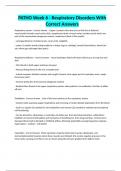
PATHO Week 6 - Respiratory Disorders With Correct Answers

Rating
-
Sold
-
Pages
16
Grade
A+
Uploaded on
31-07-2024
Written in
2023/2024

Respiratory system - Correct Answer - Upper: (contains flora that acts as first line of defense) nose/mouth (includes nasal cavity cilia), nasopharynx (back of nasal cavity; includes tonsils which are part of the mononuclear phagocyte system), oropharynx (back of the mouth) - Laryngeal pharynx: includes larynx, vocal cords, epiglottis - Lower: (is sterile) trachea (kept stable by c-shape rings or cartilage), bronchi/bronchioles, alveoli (air-sacs where gas exchange takes place) Respiratory defenses - Correct Answer - Nasal turbinates (lined with hairs/cilia/mucus to trap dust and dirt) - Cilia (found in both upper and lower airways) - Mucosal lining (found in the ovo-/nasopharynx) - Irritant receptors (initiates sneezes and coughs) (sneeze: from upper part of respiratory tract; cough: from lower part) - Immune protection (mononuclear phagocyte system) - Resident flora (found in the upper respiratory system; when patient is on antibiotics, this flora is killed off too) Ventilation - Correct Answer - One of the two functions of the respiratory system - Involves both acquiring oxygen (inspiration) and removing of carbon dioxide (expiration) from the blood - Goal is to acquire O2 needed for cell metabolism and remove CO2 needed to maintain pH and optimal cell functioning - Can be altered by: obstruction or restriction of airflow (ex. from bronchoconstriction, suffocation); inhibition of neuronal stimulation and mechanics of breathing (ex. from drug overdose, cervical nerve damage) (these lead to blocked or inhibited airflow ultimately potentially causing hypoxemia, hypoxia, hypercapnia acidosis cell death) Inspiration - Correct Answer Chest expansion using the intercostal muscles, diaphragm, and sternocleidomastoid muscles (when these muscles are initiated, this creates negative pressure in the chest cavity, causing air to flow in (as air moves along the pressure gradient from high to low)) Expiration - Correct Answer Relaxation of the diaphragm and external intercostal muscles Pul

Show more Read less
Institution
Respiratory Disorders
Course
Respiratory Disorders


Whoops! We can’t load your doc right now. Try again or contact support.

Written for

Institution
Respiratory Disorders
Course
Respiratory Disorders

Document information

Uploaded on
July 31, 2024
Number of pages
16
Written in
2023/2024
Type
Exam (elaborations)
Contains
Questions & answers

Subjects

Get to know the seller

Seller avatar
Reputation scores are based on the amount of documents a seller has sold for a fee and the reviews they have received for those documents. There are three levels: Bronze, Silver and Gold. The better the reputation, the more your can rely on the quality of the sellers work.
Lydiah247 West Virgina University
View profile
Follow You need to be logged in order to follow users or courses
Sold
32
Member since
2 year
Number of followers
10
Documents
2867
Last sold
3 weeks ago
SHINE

Welcome to my page- you are able to get revision questions,Summary notes and Exams that help you pass .

2.2

5 reviews

5
1
4
0
3
1
2
0
1
3

Trending documents

Recently viewed by you

Why students choose Stuvia

Created by fellow students, verified by reviews

Quality you can trust: written by students who passed their tests and reviewed by others who've used these notes.

Didn't get what you expected? Choose another document

No worries! You can instantly pick a different document that better fits what you're looking for.

Pay as you like, start learning right away

No subscription, no commitments. Pay the way you're used to via credit card and download your PDF document instantly.

Student with book image

“Bought, downloaded, and aced it. It really can be that simple.”

Alisha Student

Frequently asked questions