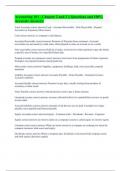
Accounting 101 - Chapter 2 and 3 || Questions and 100%
Accurate Answers.
Asset Accounts correct answers Cash - Accounts Receivable - Note Receivable - Prepaid
Accounts (or Expenses) More Assets
Cash correct answers A company's cash balance
Accounts Receivable correct answers Promises of Payment from customers. Accounts
receivables are increased by credit sales; often phrased as sales on account or on a credit
Note receivable correct answers Held by a lender; a borrower's written promise to pay the lender
a specific sum of money on a specified future date.
Prepaid accounts (or expenses) correct answers Asset arise from prepayment of future expenses.
Examples are prepaid insurance and prepaid rent,
More assets correct answers Supplies, equipment, buildings, land, note receivable, prepaid
insurance
Liability Accounts correct answers Accounts Payable - Notes Payable - Unearned revenue -
Accrued Liabilities
Account Payable correct answers Promises to pay later, usually arising from purchase of
inventory or other assets
Notes Payable correct answers with promissory note to pay a future amount
Unearned revenue correct answers revenue collected before it is earned/before services or goods
are provided.
Accrued liabilities correct answers amounts owed that are not yet paid. Examples are wages
payable, taxes payable and interest payable
Equity Accounts correct answers Equity - Common stock - Dividends - Revenue - Expenses
Equity correct answers an owner's claim on a company's assets is called equity or owner's equity
Common stock correct answers When an owner invests in a company in exchange for stock the
company increases both assets and equity.
Dividends correct answers When a company pays dividends, it decreases both company assets
and total equity (decreases equity)
, Revenue correct answers Amounts received from sales of products and services to customers.
Revenue increases equity (increases equity).
Expenses correct answers Costs of providing products and services. Expenses decrease equity
(increases equity).
Debits correct answers The left side of an account is considered the debit side or Dr.
Credits correct answers The right side of an account is considered the credit side or Cr.
Double-entry accounting transaction rules correct answers At least two accounts are involved,
with at least one debit and one credit,
Total amount debited must equal total amount credited.
Net increases or decreases correct answers on one side have equal net effects on the other side
Left side correct answers is the normal balance side for assets.
Right side correct answers is the normal balance side for liabilities and equity
Expanding Accounting Equation correct answers See Study Guide
Normal Balances correct answers See Study Guide
Recording Transactions correct answers account - general ledger - ledger - chart of accounts - list
of all accounts in the ledger - General Journal - T-account
An account correct answers is a record of increases and decreases in a specific asset, liability,
equity, revenue, or expense
The general ledger or simple ledger correct answers (referred to as the books) is a record of all
accounts and their balances for an account system
The chart of accounts correct answers is a list of all accounts in the ledger with their
identification numbers.
General Journal correct answers is where you record each transaction
A T-account represents correct answers a ledger account and is used to show the effects of one or
more transaction,
Four steps in processing transactions are as follows correct answers identify - analyze - record
journal entry - post entry to ledger
Identify correct answers transactions and source documents
Accurate Answers.
Asset Accounts correct answers Cash - Accounts Receivable - Note Receivable - Prepaid
Accounts (or Expenses) More Assets
Cash correct answers A company's cash balance
Accounts Receivable correct answers Promises of Payment from customers. Accounts
receivables are increased by credit sales; often phrased as sales on account or on a credit
Note receivable correct answers Held by a lender; a borrower's written promise to pay the lender
a specific sum of money on a specified future date.
Prepaid accounts (or expenses) correct answers Asset arise from prepayment of future expenses.
Examples are prepaid insurance and prepaid rent,
More assets correct answers Supplies, equipment, buildings, land, note receivable, prepaid
insurance
Liability Accounts correct answers Accounts Payable - Notes Payable - Unearned revenue -
Accrued Liabilities
Account Payable correct answers Promises to pay later, usually arising from purchase of
inventory or other assets
Notes Payable correct answers with promissory note to pay a future amount
Unearned revenue correct answers revenue collected before it is earned/before services or goods
are provided.
Accrued liabilities correct answers amounts owed that are not yet paid. Examples are wages
payable, taxes payable and interest payable
Equity Accounts correct answers Equity - Common stock - Dividends - Revenue - Expenses
Equity correct answers an owner's claim on a company's assets is called equity or owner's equity
Common stock correct answers When an owner invests in a company in exchange for stock the
company increases both assets and equity.
Dividends correct answers When a company pays dividends, it decreases both company assets
and total equity (decreases equity)
, Revenue correct answers Amounts received from sales of products and services to customers.
Revenue increases equity (increases equity).
Expenses correct answers Costs of providing products and services. Expenses decrease equity
(increases equity).
Debits correct answers The left side of an account is considered the debit side or Dr.
Credits correct answers The right side of an account is considered the credit side or Cr.
Double-entry accounting transaction rules correct answers At least two accounts are involved,
with at least one debit and one credit,
Total amount debited must equal total amount credited.
Net increases or decreases correct answers on one side have equal net effects on the other side
Left side correct answers is the normal balance side for assets.
Right side correct answers is the normal balance side for liabilities and equity
Expanding Accounting Equation correct answers See Study Guide
Normal Balances correct answers See Study Guide
Recording Transactions correct answers account - general ledger - ledger - chart of accounts - list
of all accounts in the ledger - General Journal - T-account
An account correct answers is a record of increases and decreases in a specific asset, liability,
equity, revenue, or expense
The general ledger or simple ledger correct answers (referred to as the books) is a record of all
accounts and their balances for an account system
The chart of accounts correct answers is a list of all accounts in the ledger with their
identification numbers.
General Journal correct answers is where you record each transaction
A T-account represents correct answers a ledger account and is used to show the effects of one or
more transaction,
Four steps in processing transactions are as follows correct answers identify - analyze - record
journal entry - post entry to ledger
Identify correct answers transactions and source documents