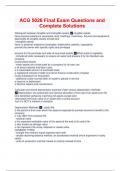
ACG 5026 Final Exam Questions and
Complete Solutions
Distinguish between tangible and intangible assets ✅-tangible assets
have physical substance (examples: land, buildings, machinery, fixtures and equipment)
depreciate all tangible assets except land
-intangible assets
have no physical substance (examples: trademarks, patents, copyrights)
provide the owner with specific rights and privileges
account for the purchase and sale of long-lived assets ✅What costs to capitalize
- include all costs necessary to acquire an asset and prepare it for its intended use,
including
Constructed Assets
- when assets are constructed by a company for its own use
o all direct material and labor costs
o a reasonable amount of overhead costs
o capitalized interest of debt incurred to finance construction (maybe)
Costs Subsequent to Acquisition
- additional costs incurred after an asset is placed in service
o improve or betterment
o Routine repairs and maintenance
Calculate and record depreciation expense under various depreciation methods
✅Depreciation: the systematic and rational allocation of the cost of an asset over the
time benefited (achieves matching) All assets except land
-decreases the book value of an asset with a contra account
-but it is NOT a method of valuation
Depreciation Methods ✅- useful life
o the period of time over which the asset is expected to provide economic benefit to the
company
o may differ from physical life
- residual value
o the expected realizable value of the asset at the end of its useful life
o also knows as salvage value
o can represent the scrap, disposal or resale value
COMMON TYPES
- straight-line method: equal expense each year
- double-declining-balance method: an accelerated method (more expensive in early
years)
- units-of-production method: based on activity instead of time
, Describe accounting treatment of Research and Development expenditures ✅- Prior to
1974, most companies capitalized research and development costs, then amortized the
cost to future periods
- The FASB stated in SFAS 2 that, because "future benefits" were uncertain, companies
should expense all R&D costs, unless they were related to tangible assets (like
buildings and equipment) that had multi-year lives
- Companies complied with the standard, but for several years many companies actually
reduced their R&D activities, because of concern for excess expense on the income
statement
- R&D are generally expensed as incurred
Account for intangible assets ✅- intangible assets are characterized by
o lack of physical substance
o high uncertainty about future benefits
- cost is amortized (same process as depreciation for tangible assets) over the useful
life (or the legal life, if less) but not to exceed 40 years. An exception is Goodwill, which
is no longer amortized
- under IFRS, revaluation of intangibles is an option, but not a requirement. Under US
GAAP, revaluation is not an option
- Problems with accounting for intangibles
o Benefits provided by intangibles are uncertain and difficult to quantify
o Useful life often impossible to estimate with confidence
Explain how Goodwill arises and how it is accounted for ✅- Goodwill: the excess of the
purchase price paid over the fair value of its identifiable net assets to buy an entire
company
o Net Assets = Assets - liabilities assumed
- can only be purchased not internally developed
- cannot be separated from the acquired company or sold separately
- has an indefinite life
- never amortized
- subject to impairment of value
Identify and account for current liabilities ✅- require payment within a year
- usually non-interest-bearing so companies seek to maximize the use of these as a
source of financing
- examples: accounts payable, accrued liabilities, deferred performance liabilities, short-
term interest-bearing debt, current maturities of long-term debt
Account for contingent liabilities (warrantees or lawsuits) ✅- not all liabilities are certain
- criteria to be met before recognizing
o potential obligation must be probable, and
o the amount must be reasonably estimable
- recognition creates an accrual
o increase to a liability and an expense
- obligations that are reasonably possible
Complete Solutions
Distinguish between tangible and intangible assets ✅-tangible assets
have physical substance (examples: land, buildings, machinery, fixtures and equipment)
depreciate all tangible assets except land
-intangible assets
have no physical substance (examples: trademarks, patents, copyrights)
provide the owner with specific rights and privileges
account for the purchase and sale of long-lived assets ✅What costs to capitalize
- include all costs necessary to acquire an asset and prepare it for its intended use,
including
Constructed Assets
- when assets are constructed by a company for its own use
o all direct material and labor costs
o a reasonable amount of overhead costs
o capitalized interest of debt incurred to finance construction (maybe)
Costs Subsequent to Acquisition
- additional costs incurred after an asset is placed in service
o improve or betterment
o Routine repairs and maintenance
Calculate and record depreciation expense under various depreciation methods
✅Depreciation: the systematic and rational allocation of the cost of an asset over the
time benefited (achieves matching) All assets except land
-decreases the book value of an asset with a contra account
-but it is NOT a method of valuation
Depreciation Methods ✅- useful life
o the period of time over which the asset is expected to provide economic benefit to the
company
o may differ from physical life
- residual value
o the expected realizable value of the asset at the end of its useful life
o also knows as salvage value
o can represent the scrap, disposal or resale value
COMMON TYPES
- straight-line method: equal expense each year
- double-declining-balance method: an accelerated method (more expensive in early
years)
- units-of-production method: based on activity instead of time
, Describe accounting treatment of Research and Development expenditures ✅- Prior to
1974, most companies capitalized research and development costs, then amortized the
cost to future periods
- The FASB stated in SFAS 2 that, because "future benefits" were uncertain, companies
should expense all R&D costs, unless they were related to tangible assets (like
buildings and equipment) that had multi-year lives
- Companies complied with the standard, but for several years many companies actually
reduced their R&D activities, because of concern for excess expense on the income
statement
- R&D are generally expensed as incurred
Account for intangible assets ✅- intangible assets are characterized by
o lack of physical substance
o high uncertainty about future benefits
- cost is amortized (same process as depreciation for tangible assets) over the useful
life (or the legal life, if less) but not to exceed 40 years. An exception is Goodwill, which
is no longer amortized
- under IFRS, revaluation of intangibles is an option, but not a requirement. Under US
GAAP, revaluation is not an option
- Problems with accounting for intangibles
o Benefits provided by intangibles are uncertain and difficult to quantify
o Useful life often impossible to estimate with confidence
Explain how Goodwill arises and how it is accounted for ✅- Goodwill: the excess of the
purchase price paid over the fair value of its identifiable net assets to buy an entire
company
o Net Assets = Assets - liabilities assumed
- can only be purchased not internally developed
- cannot be separated from the acquired company or sold separately
- has an indefinite life
- never amortized
- subject to impairment of value
Identify and account for current liabilities ✅- require payment within a year
- usually non-interest-bearing so companies seek to maximize the use of these as a
source of financing
- examples: accounts payable, accrued liabilities, deferred performance liabilities, short-
term interest-bearing debt, current maturities of long-term debt
Account for contingent liabilities (warrantees or lawsuits) ✅- not all liabilities are certain
- criteria to be met before recognizing
o potential obligation must be probable, and
o the amount must be reasonably estimable
- recognition creates an accrual
o increase to a liability and an expense
- obligations that are reasonably possible