HMFRO Chapter 24
Test: Analyzing the
Incident with 100%
correct answers
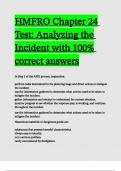
In Step 2 of the APIE process, responders:
perform tasks determined in the planning stage and direct actions to mitigate
the incident.
use the information gathered to determine what actions need to be taken to
mitigate the incident.
gather information and attempt to understand the current situation.
monitor progress to see whether the response plan is working, and continue
throughout the incident
use the information gathered to determine what actions need to be taken to
mitigate the incident.
Hazardous materials or dangerous goods are:
substances that possess harmful characteristics.
always easy to identify.
not a serious problem.
rarely encountered by firefighters.
, substances that possess harmful characteristics.
Breathing hazardous materials in through the nose or mouth is defined as:
ingestion.
inhalation.
absorption.
injection
inhalation.
A chemical that burns or destroys living tissue is an example of:
energy release.
corrosivity.
chronic exposure.
toxicity.
corrosivity.
Acute health effects are:
long-term effects that may take years to appear.
short-term effects that may take years to appear.
short-term effects that appear within hours or days.
lethal but take a long time to show up.
short-term effects that appear within hours or days.
Which statement about gases is most accurate?
Gases have an undefined shape and keep expanding if uncontained.
Gases do not present a breathing/inhalation hazard.
It is quite easy to contain gases for mitigation purposes.
It is easiest and safest to detect gases by sense of smell.
Gases have an undefined shape and keep expanding if uncontained.
Test: Analyzing the
Incident with 100%
correct answers
In Step 2 of the APIE process, responders:
perform tasks determined in the planning stage and direct actions to mitigate
the incident.
use the information gathered to determine what actions need to be taken to
mitigate the incident.
gather information and attempt to understand the current situation.
monitor progress to see whether the response plan is working, and continue
throughout the incident
use the information gathered to determine what actions need to be taken to
mitigate the incident.
Hazardous materials or dangerous goods are:
substances that possess harmful characteristics.
always easy to identify.
not a serious problem.
rarely encountered by firefighters.
, substances that possess harmful characteristics.
Breathing hazardous materials in through the nose or mouth is defined as:
ingestion.
inhalation.
absorption.
injection
inhalation.
A chemical that burns or destroys living tissue is an example of:
energy release.
corrosivity.
chronic exposure.
toxicity.
corrosivity.
Acute health effects are:
long-term effects that may take years to appear.
short-term effects that may take years to appear.
short-term effects that appear within hours or days.
lethal but take a long time to show up.
short-term effects that appear within hours or days.
Which statement about gases is most accurate?
Gases have an undefined shape and keep expanding if uncontained.
Gases do not present a breathing/inhalation hazard.
It is quite easy to contain gases for mitigation purposes.
It is easiest and safest to detect gases by sense of smell.
Gases have an undefined shape and keep expanding if uncontained.