100% satisfaction guarantee Immediately available after payment Both online and in PDF No strings attached 4,6 TrustPilot
logo-home
Exam (elaborations)

RMI 211 MSU Exam 1 Complete Answers

Rating
-
Sold
-
Pages
4
Grade
A
Uploaded on
16-08-2024
Written in
2024/2025

RMI 211 MSU Exam 1 Complete Answers Peril: Cause of a potential loss. Hazard: A condition that increases the frequency or severity of potential losses. Chance of Loss: The likelihood that a specific event will take place. Pure Risk: A scenario where only the outcomes of either loss or no loss exist. Objective Probability: The relative frequency of an event occurring over the long term, based on the assumption that there are infinitely many observations and that the underlying conditions remain unchanged. Subjective Probability: An individual's personal assessment of the likelihood of loss occurring. Speculative Risk: A situation where there is a possibility of either gaining profit or experiencing a loss. Objective Risk (Degree of Risk): The measure of the variation between actual losses and expected losses. Subjective Risk: The uncertainty that arises from an individual’s mental state or condition. Diversifiable Risk: A risk affecting only specific individuals or small groups (e.g., car theft). It is often referred to as nonsystematic or particular risk. Enterprise Risk: This term encompasses all significant risks a business may face, including pure risk, speculative risk, strategic risk, operational risk, and financial risk. Nondiversifiable Risk: A risk that impacts a large population or the entire economy. Direct Loss: A financial loss that directly results from the physical damage, destruction, or theft of property. Indirect Loss: A financial loss that occurs as a secondary result of direct physical damage. Retention: When an individual or business accepts part or all of the losses that may arise from a specific risk. - Active Retention: When they are aware of the risk. - Passive Retention: When they are unaware of the risk. Risk Control: (Definition still needed to complete) Risk Transfer: The process whereby a pure risk is shifted from the insured to the insurer, who generally has better financial stability. Law of Large Numbers: A principle that states as the number of exposure units increases, the actual loss experience will more closely align with the expected loss experience. Fortuitous Loss: An unforeseen and unexpected loss that happens by chance. Adverse Selection: The phenomenon where individuals with a higher-than-average risk of loss seek insurance at standard rates. Indemnity: Insurance that aims to restore individuals to their previous financial state after a loss. Expense Loading: The total amount required to cover expenses, which includes commissions, administrative costs, state premium taxes, acquisition expenses, and allowances for contingencies and profit. Risk Management: The process of identifying potential loss exposures that an organization faces and selecting the most effective strategies to manage them. Loss Exposure: Any circumstance where there is potential for a loss to occur, regardless of whether it actually happens (e.g., manufacturing facilities susceptible to damage from earthquakes or floods). Pre-Loss Risk Management Objective: To prepare for financial losses, minimize anxiety, and fulfill legal obligations. Post-Loss Risk Management Objective: To ensure the firm’s survival, maintain operations, achieve stability and continued growth, and reduce societal impacts. Loss Severity: The expected magnitude of potential losses that may arise. Loss Frequency ️refers to the probable number of losses that may occur during some given time period Maximum Possible Loss ️the worst loss that could happen to the firm during its lifetime Maximum Probable Loss ️the worst loss that is likely to happen Captive Insurer ️insurer owned by a parent firm for the purpose of insuring the parent firm's loss exposures Insurance ️protection against possible financial loss Manuscript Policy ️an insurance policy that is specifically drafted according to terms negotiated between a specific insured (or group of insureds) and an insurer High Frequency ️Many insurance claims Low Frequency ️Few insurance claims High Exposure ️high probability of loss Hard Markets ️high premiums Soft Markets ️low premiums, easy to get insurance Underwriting Cycle ️cyclical pattern in underwriting stringency, premium levels, and profitability Surplus ️difference between insurer's assets and its liabilities

Show more Read less
Institution
RMI 211 MSU Exm 1 Complete Answer
Course
RMI 211 MSU Exm 1 Complete Answer

Content preview

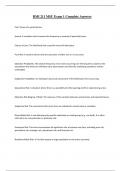
RMI 211 MSU Exam 1 Complete Answers


Peril: Cause of a potential loss.


Hazard: A condition that increases the frequency or severity of potential losses.


Chance of Loss: The likelihood that a specific event will take place.


Pure Risk: A scenario where only the outcomes of either loss or no loss exist.


Objective Probability: The relative frequency of an event occurring over the long term, based on the
assumption that there are infinitely many observations and that the underlying conditions remain
unchanged.


Subjective Probability: An individual's personal assessment of the likelihood of loss occurring.


Speculative Risk: A situation where there is a possibility of either gaining profit or experiencing a loss.


Objective Risk (Degree of Risk): The measure of the variation between actual losses and expected losses.


Subjective Risk: The uncertainty that arises from an individual’s mental state or condition.


Diversifiable Risk: A risk affecting only specific individuals or small groups (e.g., car theft). It is often
referred to as nonsystematic or particular risk.


Enterprise Risk: This term encompasses all significant risks a business may face, including pure risk,
speculative risk, strategic risk, operational risk, and financial risk.


Nondiversifiable Risk: A risk that impacts a large population or the entire economy.
Written for

Institution
RMI 211 MSU Exm 1 Complete Answer
Course
RMI 211 MSU Exm 1 Complete Answer

Document information

Uploaded on
August 16, 2024
Number of pages
4
Written in
2024/2025
Type
Exam (elaborations)
Contains
Questions & answers

Subjects

Get to know the seller

Seller avatar
Reputation scores are based on the amount of documents a seller has sold for a fee and the reviews they have received for those documents. There are three levels: Bronze, Silver and Gold. The better the reputation, the more your can rely on the quality of the sellers work.
CertifiedGrades Chamberlain College Of Nursing
View profile
Follow You need to be logged in order to follow users or courses
Sold
144
Member since
3 year
Number of followers
61
Documents
8740
Last sold
2 weeks ago
High Scores

Hi there! Welcome to my online tutoring store, your ultimate destination for A+ rated educational resources! My meticulously curated collection of documents is designed to support your learning journey. Each resource has been carefully revised and verified to ensure top-notch quality, empowering you to excel academically. Feel free to reach out to consult with me on any subject matter—I'm here to help you thrive!

3.9

38 reviews

5
21
4
6
3
2
2
3
1
6

Trending documents

Recently viewed by you

Why students choose Stuvia

Created by fellow students, verified by reviews

Quality you can trust: written by students who passed their exams and reviewed by others who've used these notes.

Didn't get what you expected? Choose another document

No worries! You can immediately select a different document that better matches what you need.

Pay how you prefer, start learning right away

No subscription, no commitments. Pay the way you're used to via credit card or EFT and download your PDF document instantly.

Student with book image

“Bought, downloaded, and aced it. It really can be that simple.”

Alisha Student

Frequently asked questions