Research Methods
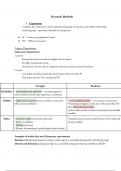
1. Experiments
- Compare data from two or more experimental groups to look for a cause-effect relationship
- Control group → provides a baseline for comparison
● IV → what you manipulate/control
● DV → What you measure
2 types of Experiments:
Laboratory Experiments
Location
- Setting where the researcher has high levels of control
- Ex: light, temperature, noise…
- Ex locations: schools, clinics, hospitals, universities, private research institutes
Control
- Controlled variables are kept the same between all levels of the IV
- This makes sure the IV is causing the DV
Strength Weakness
Reliability • Standardized and replicable → each participant in
each condition has the same experience, consistency
Validity • High levels of control increase validity as cause and • Low ecological validity → not realistic environment
effect can be established • if participants figure out the aim of the study they will
show demand characteristics
• pilot studies can be conducted to identify uncontrolled
variables
Ethics • Consent is taken (not always informed) • deception may be used to hide the aim of the study and
• Right to withdraw increase validity
• Debrief at the end
• Respect the participant’s psychological state of mind
Examples of studies that used Laboratory experiments:
Pozzulo et al: asked participants to observe video clips in a controlled setting before identifying target
Dement and Kleitman: participants slept in a controlled setting and woke up in REM or nREM
, Field Experiments
Location
- Real-world setting
- IV manipulated
- DV measured
- There may be uncontrolled variables
- Ex locations: Street, workplace, supermarket, sports event, public transport
Control
- Researchers still try to maintain control over other variables but it's much harder
- Uncontrolled, situational variables make it much harder to draw firm conclusions
Strength Weakness
Reliabilit • Results are compared with control group → provides a • Less control over extraneous variables
y baseline for comparison • Difficult to standardize and replicate
Validity • High ecological validity → more natural environment
• Results are generalizable
• Reduces demand characteristics → unaware they are observed
Ethics • No consent as participants often do not know the
are taking part in the research
• Participants are deceived
• No right to withdraw + no debriefing
Examples of studies that used field experiments:
Piliavin et al: Carried out an experiment on an express train between two NY stations, researchers
manipulated the type of victim, condition, and whether help was offered or not
, Experimental designs:
→ how participants are allocated to the different levels of the IV
Independent measures design
→ experimental design where each participant takes part in a different condition of the IV
- Participants are put into 2 or more different groups, this depends on the levels of the IV
- These groups are called the experimental and control group
- The control group provides a baseline to which the researcher can compare data
- Each condition has a different group of participants
Strength Weakness
Independent Validity Validity
measures • Prevents order effects • more people needed → time consuming
design → participants take part in 1 condition only • participant variables may affect the results
• reduces demand characteristics
→ prevents participants from finding out the aim of the study
RANDOM ALLOCATION → eliminates participant variables by randomly allocating participants
to different conditions
Studies that used independent measures designs:
Andrade: randomly allocated participants to the doodle or non-doodle condition
Piliavin et al: tested participants with either an ill or drunk victim
, Repeated measures design
→ An experimental design in which each participant takes part in every level of the IV
- The same group of participants provides data for all levels of the IV
- Participant variables cannot affect the validity of data as participants take part in all conditions
Strength Weakness
Repeated measures Validity Validity
design • Participant variables are reduced • Risk of demand characteristics → threat validity
• Fewer people needed • Risk of order effects
COUNTERBALANCING → used to prevent order effects (ABBA method)
Studies that used repeated measures designs:
Dement and Kleitman: compared recall of dreams from REM and nREM sleep for each participant
Perry et al: All participants were tested with and without OT
Matched pairs design
→ An experimental design in which participants are matched in pairs based on variables that could
affect the results. One member of each pair takes part in a different level if the IV
- Each participant in the experimental group will be matched with a participant in the control group
- Every participant in the experimental group will have a person in the control group who’s similar to
them on key variables (Ex: handedness, gender, socioeconomic status, or age)
Strength Weakness
Matched pairs Validity Validity
design • reduced participant variables • difficult to match people accurately
• reduced order effects • time-consuming to match pairs
• if one participant drops out you lose two participants' da
Studies that used matched pairs designs:
Bandura: Children were matched on aggression levels
Baron-Cohen: 14 participants in G4 were matched on IQ with G1 HFA/AS participants
1. Experiments
- Compare data from two or more experimental groups to look for a cause-effect relationship
- Control group → provides a baseline for comparison
● IV → what you manipulate/control
● DV → What you measure
2 types of Experiments:
Laboratory Experiments
Location
- Setting where the researcher has high levels of control
- Ex: light, temperature, noise…
- Ex locations: schools, clinics, hospitals, universities, private research institutes
Control
- Controlled variables are kept the same between all levels of the IV
- This makes sure the IV is causing the DV
Strength Weakness
Reliability • Standardized and replicable → each participant in
each condition has the same experience, consistency
Validity • High levels of control increase validity as cause and • Low ecological validity → not realistic environment
effect can be established • if participants figure out the aim of the study they will
show demand characteristics
• pilot studies can be conducted to identify uncontrolled
variables
Ethics • Consent is taken (not always informed) • deception may be used to hide the aim of the study and
• Right to withdraw increase validity
• Debrief at the end
• Respect the participant’s psychological state of mind
Examples of studies that used Laboratory experiments:
Pozzulo et al: asked participants to observe video clips in a controlled setting before identifying target
Dement and Kleitman: participants slept in a controlled setting and woke up in REM or nREM
, Field Experiments
Location
- Real-world setting
- IV manipulated
- DV measured
- There may be uncontrolled variables
- Ex locations: Street, workplace, supermarket, sports event, public transport
Control
- Researchers still try to maintain control over other variables but it's much harder
- Uncontrolled, situational variables make it much harder to draw firm conclusions
Strength Weakness
Reliabilit • Results are compared with control group → provides a • Less control over extraneous variables
y baseline for comparison • Difficult to standardize and replicate
Validity • High ecological validity → more natural environment
• Results are generalizable
• Reduces demand characteristics → unaware they are observed
Ethics • No consent as participants often do not know the
are taking part in the research
• Participants are deceived
• No right to withdraw + no debriefing
Examples of studies that used field experiments:
Piliavin et al: Carried out an experiment on an express train between two NY stations, researchers
manipulated the type of victim, condition, and whether help was offered or not
, Experimental designs:
→ how participants are allocated to the different levels of the IV
Independent measures design
→ experimental design where each participant takes part in a different condition of the IV
- Participants are put into 2 or more different groups, this depends on the levels of the IV
- These groups are called the experimental and control group
- The control group provides a baseline to which the researcher can compare data
- Each condition has a different group of participants
Strength Weakness
Independent Validity Validity
measures • Prevents order effects • more people needed → time consuming
design → participants take part in 1 condition only • participant variables may affect the results
• reduces demand characteristics
→ prevents participants from finding out the aim of the study
RANDOM ALLOCATION → eliminates participant variables by randomly allocating participants
to different conditions
Studies that used independent measures designs:
Andrade: randomly allocated participants to the doodle or non-doodle condition
Piliavin et al: tested participants with either an ill or drunk victim
, Repeated measures design
→ An experimental design in which each participant takes part in every level of the IV
- The same group of participants provides data for all levels of the IV
- Participant variables cannot affect the validity of data as participants take part in all conditions
Strength Weakness
Repeated measures Validity Validity
design • Participant variables are reduced • Risk of demand characteristics → threat validity
• Fewer people needed • Risk of order effects
COUNTERBALANCING → used to prevent order effects (ABBA method)
Studies that used repeated measures designs:
Dement and Kleitman: compared recall of dreams from REM and nREM sleep for each participant
Perry et al: All participants were tested with and without OT
Matched pairs design
→ An experimental design in which participants are matched in pairs based on variables that could
affect the results. One member of each pair takes part in a different level if the IV
- Each participant in the experimental group will be matched with a participant in the control group
- Every participant in the experimental group will have a person in the control group who’s similar to
them on key variables (Ex: handedness, gender, socioeconomic status, or age)
Strength Weakness
Matched pairs Validity Validity
design • reduced participant variables • difficult to match people accurately
• reduced order effects • time-consuming to match pairs
• if one participant drops out you lose two participants' da
Studies that used matched pairs designs:
Bandura: Children were matched on aggression levels
Baron-Cohen: 14 participants in G4 were matched on IQ with G1 HFA/AS participants