Tholen, UTA Microbiology exam 1 (ch 1,2,3,7) | Questions And Answers Latest {2024-
2025} A+ Graded | 100% Verified
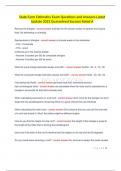
Microbiology - The study of microscopic organisms. Have ubiquitous nature (everywhere), some
beneficial, some neutral, some pathogenic (disease-causing)
Antoine van Leeuwenhoek - Father of microbiology. Invented a microscope strong enough to view
microbes "animalcules".
Giralamo Fracastoro - Regarded as first person to formally postulate that disease was spread by tiny
invisible seminaria "seeds of contagion".
Robert Hooke - First to observe cells.
Louis Pasteur - A French chemist, this man discovered that heat could kill bacteria that otherwise spoiled
liquids including milk, wine, and beer. Showed that microbial strains were unique, performed
fermentation, and began the development of pasteurization and vaccines.
Robert Koch - Developed the culture plate method to identify pathogens. First to connect microbe with
a specific disease. Discovered causative agent for anthrax, cholera, and tuberculosis.
Taxonomy - The scientific study of how living things are classified
Carolus Linneaus - The "Father of Taxonomy". He came up with our modern day system of classification
called Binomial Nomenclature. Most famous early taxonomists. Divided 3 kingdoms animal, plant, and
mineral. Sublevels: kingdom, class, order, family, genus, species
Phylogeny - The evolutionary history of a species or group of related species.
Ernst Haeckel - Father of ecology. Proposed another kingdom, protista, later monera.
2025} A+ Graded | 100% Verified
Microbiology - The study of microscopic organisms. Have ubiquitous nature (everywhere), some
beneficial, some neutral, some pathogenic (disease-causing)
Antoine van Leeuwenhoek - Father of microbiology. Invented a microscope strong enough to view
microbes "animalcules".
Giralamo Fracastoro - Regarded as first person to formally postulate that disease was spread by tiny
invisible seminaria "seeds of contagion".
Robert Hooke - First to observe cells.
Louis Pasteur - A French chemist, this man discovered that heat could kill bacteria that otherwise spoiled
liquids including milk, wine, and beer. Showed that microbial strains were unique, performed
fermentation, and began the development of pasteurization and vaccines.
Robert Koch - Developed the culture plate method to identify pathogens. First to connect microbe with
a specific disease. Discovered causative agent for anthrax, cholera, and tuberculosis.
Taxonomy - The scientific study of how living things are classified
Carolus Linneaus - The "Father of Taxonomy". He came up with our modern day system of classification
called Binomial Nomenclature. Most famous early taxonomists. Divided 3 kingdoms animal, plant, and
mineral. Sublevels: kingdom, class, order, family, genus, species
Phylogeny - The evolutionary history of a species or group of related species.
Ernst Haeckel - Father of ecology. Proposed another kingdom, protista, later monera.