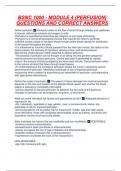
BSNC 1000 - MODULE 4 (PERFUSION)
QUESTIONS AND CORRECT ANSWERS
Define perfusion ✅-Perfusion refers to the flow of blood through arteries and capillaries
to tissues, delivering nutrients and oxygen to cells.
-Perfusion is quantified as blood flow per kilogram of unit mass (ml/min/kg).
-Perfusion is a normal physiological process that requires the heart to generate
sufficient cardiac output to transport blood through patent blood vessels for distribution
in the tissues throughout the body.
-It is influenced by volume of blood pumped from the heart per minute, the radius of the
blood vessels, the viscosity of the blood, velocity of flow, and blood pressure.
Maintaining cardiovascular health essential to optimal perfusion.
-The process of perfusion can be thought of as falling into two general categories:
central perfusion and tissue perfusion. Central perfusion is generated by cardiac
output—the amount of blood pumped by the heart each minute. Tissue perfusion refers
to the volume of blood that flows through target tissues.
-An understanding of the concept of perfusion assists the nurse in assessing various
determinants of perfusion, identifying individuals at risk of impaired perfusion,
recognizing when a patient is experiencing an impairment of perfusion, and responding
with appropriate interventions.
Define the scope of perfusion ✅-The extent of tissue damage from impaired perfusion
depends on the size and location of the affected blood vessel, and whether the blood
supply is reduced or completely interrupted.
-Various degrees of reduced perfusion lie between the two ends of the spectrum.
Changes in perfusion can be temporary, long‐term, or permanent.
What are some individual risk factors and populations at risk? ✅-Adequate perfusion is
required for life.
-ALL individuals, regardless of age, gender, race, or socioeconomic status, are
potentially at risk for impaired perfusion.
-Some populations are at greater risk for impairment: middle‐ age and older adults,
some ethnicities, those with congenital abnormalities (such as infants), and those who
experience trauma (such as young adults).
State individual risk factors that are modifiable and non-modifiable: ✅MODIFIABLE:
-smoking (nicotine vasoconstricts)
-elevated serum lipids (contribute to atherosclerosis)
-obesity (increases the risk of type 2 diabetes and atherosclerosis)
-diabetes mellitus (increases risk of atherosclerosis)
-hypertension (increases the work of the myocardium)
NON-MODIFIABLE:
-age (risk increases with age)
QUESTIONS AND CORRECT ANSWERS
Define perfusion ✅-Perfusion refers to the flow of blood through arteries and capillaries
to tissues, delivering nutrients and oxygen to cells.
-Perfusion is quantified as blood flow per kilogram of unit mass (ml/min/kg).
-Perfusion is a normal physiological process that requires the heart to generate
sufficient cardiac output to transport blood through patent blood vessels for distribution
in the tissues throughout the body.
-It is influenced by volume of blood pumped from the heart per minute, the radius of the
blood vessels, the viscosity of the blood, velocity of flow, and blood pressure.
Maintaining cardiovascular health essential to optimal perfusion.
-The process of perfusion can be thought of as falling into two general categories:
central perfusion and tissue perfusion. Central perfusion is generated by cardiac
output—the amount of blood pumped by the heart each minute. Tissue perfusion refers
to the volume of blood that flows through target tissues.
-An understanding of the concept of perfusion assists the nurse in assessing various
determinants of perfusion, identifying individuals at risk of impaired perfusion,
recognizing when a patient is experiencing an impairment of perfusion, and responding
with appropriate interventions.
Define the scope of perfusion ✅-The extent of tissue damage from impaired perfusion
depends on the size and location of the affected blood vessel, and whether the blood
supply is reduced or completely interrupted.
-Various degrees of reduced perfusion lie between the two ends of the spectrum.
Changes in perfusion can be temporary, long‐term, or permanent.
What are some individual risk factors and populations at risk? ✅-Adequate perfusion is
required for life.
-ALL individuals, regardless of age, gender, race, or socioeconomic status, are
potentially at risk for impaired perfusion.
-Some populations are at greater risk for impairment: middle‐ age and older adults,
some ethnicities, those with congenital abnormalities (such as infants), and those who
experience trauma (such as young adults).
State individual risk factors that are modifiable and non-modifiable: ✅MODIFIABLE:
-smoking (nicotine vasoconstricts)
-elevated serum lipids (contribute to atherosclerosis)
-obesity (increases the risk of type 2 diabetes and atherosclerosis)
-diabetes mellitus (increases risk of atherosclerosis)
-hypertension (increases the work of the myocardium)
NON-MODIFIABLE:
-age (risk increases with age)