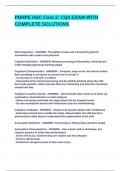
PDHPE HSC Core 2: CQ4 EXAM WITH
COMPLETE SOLUTIONS
Skill acquisition - ANSWER- The ability to learn and consistently perform
movements with control and precision
Cognitive Definition - ANSWER- Mental processing of information, thinking and
understanding (planning/ learning stage)
Cognitive Characteristics - ANSWER- - Frequent, large errors: the learner knows
that something is wrong but is unsure how to correct it
- An increase in 'self talk' is evident
- Characterised by mental processing and the athlete thinking about the skill,
their body position, which muscles they are contracting and what the movement
should look like.
Cognitive Coaches should - ANSWER- - Demonstrate what needs to be done e.g.
explanation, demonstration or video analysis
- Allow rest breaks and break the steps down into the simplest terms
- Do not overload the learner with information (can be overwhelming)
Cognitive Feedback - ANSWER- - Needs to be positive (helps with confidence)
- External (received from outside the body), delayed (after the skill has been
performed) to allow them to understand the requirements of the skill
Associative Definition - ANSWER- Connecting or linking ideas (practice stage)
Associative Characteristics - ANSWER- - Has a basic skill or technique, but
requires practice to refine their performance
- Errors still occur, however they are smaller and less frequent
- Fluency will develop
- Performers recognise some of their own errors
, Associative Coaches should - ANSWER- - Add another environmental situation
e.g. game-like situation
Associative Feedback - ANSWER- - Learners are able to provide themselves with
internal feedback
- Still benefits from feedback concerning technique from the coach
Autonomous Definition - ANSWER- Being in full control of actions so they
become automatic (elite)
Autonomous Characteristics - ANSWER- - Actions are automatic, they no longer
need to think
- Speed, accuracy and efficiency increase
- Movement is now more properly sequenced and performed instinctively
- Performers can spare attention can be devoted elsewhere (e.g. tactics)
Autonomous Coaches should - ANSWER- -Practice in more difficult game-like
situations e.g. adding defender or competition simulations
Autonomous Feedback - ANSWER- - They are able to provide their own feedback
as they know what the movement feels like and can thus rely on their body's
proprioceptive (relates to stimuli) mechanisms
PE.C.H.A.P - ANSWER- Prior Experience
Confidence
Heredity
Ability
Personality
Prior Experience - ANSWER- Is the transfer of skill from one context to another
allowing the athlete to lean new similar skills faster than those with no PE. e.g. a
forward roll progressing to a forward flip
Confidence - ANSWER- Is the belief's in ones own ability. It is developed through
successes e.g. scoring a goal.
Confidence- types of confidence - ANSWER- - People who fail in practicing it can
affect their confidence levels which will decrease the level of skills with it
COMPLETE SOLUTIONS
Skill acquisition - ANSWER- The ability to learn and consistently perform
movements with control and precision
Cognitive Definition - ANSWER- Mental processing of information, thinking and
understanding (planning/ learning stage)
Cognitive Characteristics - ANSWER- - Frequent, large errors: the learner knows
that something is wrong but is unsure how to correct it
- An increase in 'self talk' is evident
- Characterised by mental processing and the athlete thinking about the skill,
their body position, which muscles they are contracting and what the movement
should look like.
Cognitive Coaches should - ANSWER- - Demonstrate what needs to be done e.g.
explanation, demonstration or video analysis
- Allow rest breaks and break the steps down into the simplest terms
- Do not overload the learner with information (can be overwhelming)
Cognitive Feedback - ANSWER- - Needs to be positive (helps with confidence)
- External (received from outside the body), delayed (after the skill has been
performed) to allow them to understand the requirements of the skill
Associative Definition - ANSWER- Connecting or linking ideas (practice stage)
Associative Characteristics - ANSWER- - Has a basic skill or technique, but
requires practice to refine their performance
- Errors still occur, however they are smaller and less frequent
- Fluency will develop
- Performers recognise some of their own errors
, Associative Coaches should - ANSWER- - Add another environmental situation
e.g. game-like situation
Associative Feedback - ANSWER- - Learners are able to provide themselves with
internal feedback
- Still benefits from feedback concerning technique from the coach
Autonomous Definition - ANSWER- Being in full control of actions so they
become automatic (elite)
Autonomous Characteristics - ANSWER- - Actions are automatic, they no longer
need to think
- Speed, accuracy and efficiency increase
- Movement is now more properly sequenced and performed instinctively
- Performers can spare attention can be devoted elsewhere (e.g. tactics)
Autonomous Coaches should - ANSWER- -Practice in more difficult game-like
situations e.g. adding defender or competition simulations
Autonomous Feedback - ANSWER- - They are able to provide their own feedback
as they know what the movement feels like and can thus rely on their body's
proprioceptive (relates to stimuli) mechanisms
PE.C.H.A.P - ANSWER- Prior Experience
Confidence
Heredity
Ability
Personality
Prior Experience - ANSWER- Is the transfer of skill from one context to another
allowing the athlete to lean new similar skills faster than those with no PE. e.g. a
forward roll progressing to a forward flip
Confidence - ANSWER- Is the belief's in ones own ability. It is developed through
successes e.g. scoring a goal.
Confidence- types of confidence - ANSWER- - People who fail in practicing it can
affect their confidence levels which will decrease the level of skills with it