RUNNING HEAD: RESEARCH PROPOSAL 1
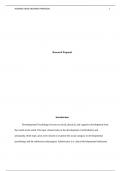
Research Proposal
Introduction
Developmental Psychology focuses on social, physical, and cognitive development from
the womb to the tomb. The topic chosen looks at the development of self-identity and
personality. Both topic areas were chosen to examine the social category in developmental
psychology and the adolescent subcategory. Adolescence is a critical developmental milestone;
, Research Proposal 2
puberty starts, cognitive functions increase to include abstract reasoning, and self-identity
development is crucial. Analyzing external factors that influence a child's development and
measuring their effect on self-identity and personality traits are critical components of adolescent
development. These key developmental milestones define adolescence and traits that will evolve
into adulthood and still be seen in later life. For instance, if a child has a traumatic childhood
during adolescence, this can have a profound impact on social relationships, depression, and
anxiety.
Literature Review
According to Liu et al. (2023), there is a link between positive parenting practices and
harmful parenting practices in association with anxiety and depression. The article states that
harsher parental discipline techniques can lead to anxiety. In addition, the article mentions that
children who perceive themselves as rejected by parental figures can lead to maladjustment and,
in the long run, psychological disorders (like anxiety and depression). These analyses focus on
the potential impact of negative parenting styles (focusing on discipline and rejection). The
article by Liu et al. (2023) also mentions that other factors, including school, home,
neighborhood, and friends, play a crucial role in a child's development. In addition to the
parenting style, teacher-student relationships present an impact by influencing harshness more on
the maternal side over the father side. The central hole in the article is best seen in the lack of
definition of what constitutes disciplinary harshness and the individual analysis correlations
between the types of harshness and anxiety and depression rates.
The article by Lippold (2018) analyzes the impact of parenting styles and their influence
on alcohol and drug use in adolescence. According to Lippold (2018), early adolescence marks a
shift from being more with parents than peers to being with peers more than parents. This peer
Research Proposal
Introduction
Developmental Psychology focuses on social, physical, and cognitive development from
the womb to the tomb. The topic chosen looks at the development of self-identity and
personality. Both topic areas were chosen to examine the social category in developmental
psychology and the adolescent subcategory. Adolescence is a critical developmental milestone;
, Research Proposal 2
puberty starts, cognitive functions increase to include abstract reasoning, and self-identity
development is crucial. Analyzing external factors that influence a child's development and
measuring their effect on self-identity and personality traits are critical components of adolescent
development. These key developmental milestones define adolescence and traits that will evolve
into adulthood and still be seen in later life. For instance, if a child has a traumatic childhood
during adolescence, this can have a profound impact on social relationships, depression, and
anxiety.
Literature Review
According to Liu et al. (2023), there is a link between positive parenting practices and
harmful parenting practices in association with anxiety and depression. The article states that
harsher parental discipline techniques can lead to anxiety. In addition, the article mentions that
children who perceive themselves as rejected by parental figures can lead to maladjustment and,
in the long run, psychological disorders (like anxiety and depression). These analyses focus on
the potential impact of negative parenting styles (focusing on discipline and rejection). The
article by Liu et al. (2023) also mentions that other factors, including school, home,
neighborhood, and friends, play a crucial role in a child's development. In addition to the
parenting style, teacher-student relationships present an impact by influencing harshness more on
the maternal side over the father side. The central hole in the article is best seen in the lack of
definition of what constitutes disciplinary harshness and the individual analysis correlations
between the types of harshness and anxiety and depression rates.
The article by Lippold (2018) analyzes the impact of parenting styles and their influence
on alcohol and drug use in adolescence. According to Lippold (2018), early adolescence marks a
shift from being more with parents than peers to being with peers more than parents. This peer