100% tevredenheidsgarantie Direct beschikbaar na je betaling Lees online óf als PDF Geen vaste maandelijkse kosten 4,6 TrustPilot
logo-home
Tentamen (uitwerkingen)

CCJ 4700 Exam 1 Questions and Answers well Explained Latest 2024/2025 Update 100% Correct.

Beoordeling
-
Verkocht
-
Pagina's
7
Cijfer
A+
Geüpload op
15-09-2024
Geschreven in
2024/2025

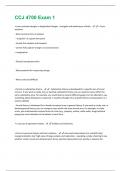
• cross-sectional designs vs longitudinal designs - strengths and weaknesses of both - > Crosssectional - Most common form of analysis - "snapshot" at a given time point - Usually the simplest and cheapest - Cannot fully capture change or social processes > Longitudinal - Directly incorporates time - More powerful for measuring change - More costly and difficult • formal vs substantive theory - - Substantive theory is developed for a specific area of social concern. If you want to study, test, or develop substantive theory, you can examine cases within the same substantive area. For example, you could observe several different gangs, but not attempt to say something about delinquency in general. It could be thought of as shared theories among experts in a certain subfield. - Formal theory is developed for a broad conceptual area in general theory. If you want to study, test, or develop general theory, you can compare cases within the same formal area. For example, to study crime, you could examine various forms of crime (e.g., property, violent, white collar, drugs) without paying too much attention to the details of each form. • 2 sources of agreement reality - Tradition and Authority • Errors in personal inquiry and their solutions - Inaccurate observation (sol: scientific obs), overgeneralization (sol: high value of large samples and replication - repeating a study, checking to see whether similar results are obtained each time), selective observation (sol: specify in advance thenumber and kind of observations to be made), illogical reasoning, ideology and politics (sol: stay objective) • 4 purposes of research - Exploration, description, explanation, application • 2 types of support that must present before scientists can agree on the reality of something - Logical and Empirical • Gambler's fallacy - - An illustration of illogic in day-to-day reasoning - According to this fallacy, a consistent run of good or bad luck is presumed to foreshadow its opposite. • Type I and Type II error - Type I error - conclude a relationship exists when in fact it doesn't Type II error - conclude there is no relationship when in fact there is one • Theory - definition - A set of interconnected statements or propositions that explain how two or more events or factors are related to one another • Hypothesis - definition - An explanation about the nature of things derived from a theory. It's a statement of something that will be observed in the real world if the theory is correct. • 3 conditions that must be met in order for a statement to be considered a hypothesis - Hypotheses have three parts: 1. Expectation about reality 2. Based on a theory 3. Testable• Independent and dependent variables -Be able to identify them in a hypothesis. - Independent variable (IV) - considered the "cause" in a cause-effect relationship; variation in independent variables are independent/not associated with variation in other variables (predictor variable) Dependent variable (DV) - considered the "effect" in a cause-effect relationship; variation in dependent variables are dependent/contingent upon variation in independent variables (thing you're trying to predict) • 4 different longitudinal designs - Time-series study - looks at changes within some general population over time. (ex: UCR) Panel study - observations made on the same set of people on two or more occasions (ex: NCVS) Cohort study - examine more specific populations as they age over time. Typically, cohorts are age groups. Case study - one individual, follow up for many years, detailed information • Attributes and variables - definitions; be able to identify them - Attributes - characteristics or qualities that describe some object For Example - attributes of grad students: smart, geeky, dominates at Halo, exceptional time management skills, sleep deprived, loner Variables - logical groupings of attributes Example(s): gender, prior record, psychopathy, low self-control • Inductive reasoning - - Specific to general - Uses the logical model in which general principles are developed from specific observations. Having noted that teenagers and crime victims are less supportive of police than older people and non-victims are, you might conclude that people with more direct police contact are less supportive of police and explain why. That would be an example of induction. • Deductive reasoning - - General to specific - a mode of inquiry using the logical model in which specific expectations of hypotheses are developed on the basis of general principles. Starting from the general principle that all deans are meanies, youmight anticipate that your current one wont let you change courses. That anticipation would be the deduction. • Nomothetic explanation - Tries to identify a relatively few number of the most important factors presumed to cause some class of outcomes - Importance of parsimony and probability • Idiographic explanation - Seeks to identify many causes or associations to generate a complete understanding of a particular instance - Exhaustive list of all factors involved - scope is limited • ecological fallacy - Erroneously drawing conclusions about individuals based solely on the observation of groups. • Individualistic fallacy - The individualistic fallacy may distort the way people (esp. beginning students of CJ) initially approach research problems to criminal justice. It causes trouble with reconciling general patterns of attitudes and actions with individual exceptions they may know of. • Scientific realism - Bridges ideographic and nomothetic approaches to explanation by seeking to understand how casual mechanisms operate in specific contexts. Rather than trying to exclude or otherwise control possible outside influences, scientific realism studies how much influences are involved in cause-and-effect relationships. • Retrospective studies - - A common way of approximating observations over time. - Research that ask people to recall their pasts. • Different units of analysis - be able to identify correct unit in a hypothesis - The "what" or "who" being studied. - Individual people - Groups (ex: juvenile gangs) - Organizations (ex: a probation dept.)- Social artifacts (ex: crime reports) • individuals vs aggregates - Aggregates are groups of units - people, prisons, courtrooms, or stolen autos, for example. Although criminal justice professionals are usually most concerned with individual units, social science searches for patterns that are reflected in aggregations of units. For ex, a probation officer focuses on probation clients as individuals, while a social scientist focuses on groups of probation clients, or aggregates. • Difference between ethics and morality - Ethical - conforming to the standards of conduct of a given profession or group. The dif. Is the matter of agreement among members of a group. Moral - a person's standards of behavior or beliefs concerning what is and is not acceptable for them to do. (Morals are typically agreed on amongst society?) • Different common ethical concerns - No harm to participants Voluntary participation Anonymity and confidentiality Deception Analysis and reporting Legal liability

Meer zien Lees minder
Instelling
CCJ 4700
Vak
CCJ 4700


Oeps! We kunnen je document nu niet laden. Probeer het nog eens of neem contact op met support.

Geschreven voor

Instelling
CCJ 4700
Vak
CCJ 4700

Documentinformatie

Geüpload op
15 september 2024
Aantal pagina's
7
Geschreven in
2024/2025
Type
Tentamen (uitwerkingen)
Bevat
Vragen en antwoorden

Onderwerpen

Voorbeeld van de inhoud

CCJ 4700 Exam 1
• cross-sectional designs vs longitudinal designs - strengths and weaknesses of both - > Cross-
sectional

- Most common form of analysis

- "snapshot" at a given time point

- Usually the simplest and cheapest

- Cannot fully capture change or social processes

> Longitudinal


- Directly incorporates time


- More powerful for measuring change


- More costly and difficult


• formal vs substantive theory - - Substantive theory is developed for a specific area of social
concern. If you want to study, test, or develop substantive theory, you can examine cases within the
same substantive area. For example, you could observe several different gangs, but not attempt to say
something about delinquency in general. It could be thought of as shared theories among experts in a
certain subfield.

- Formal theory is developed for a broad conceptual area in general theory. If you want to study, test, or
develop general theory, you can compare cases within the same formal area. For example, to study
crime, you could examine various forms of crime (e.g., property, violent, white collar, drugs) without
paying too much attention to the details of each form.


• 2 sources of agreement reality - Tradition and Authority


• Errors in personal inquiry and their solutions - Inaccurate observation (sol: scientific obs),
overgeneralization (sol: high value of large samples and replication - repeating a study, checking to see
whether similar results are obtained each time), selective observation (sol: specify in advance the

, number and kind of observations to be made), illogical reasoning, ideology and politics (sol: stay
objective)


• 4 purposes of research - Exploration, description, explanation, application


• 2 types of support that must present before scientists can agree on the reality of something -
Logical and Empirical


• Gambler's fallacy - - An illustration of illogic in day-to-day reasoning

- According to this fallacy, a consistent run of good or bad luck is presumed to foreshadow its opposite.


• Type I and Type II error - Type I error - conclude a relationship exists when in fact it doesn't

Type II error - conclude there is no relationship when in fact there is one


• Theory - definition - A set of interconnected statements or propositions that explain how two or
more events or factors are related to one another


• Hypothesis - definition - An explanation about the nature of things derived from a theory. It's a
statement of something that will be observed in the real world if the theory is correct.


• 3 conditions that must be met in order for a statement to be considered a hypothesis -
Hypotheses have three parts:


1. Expectation about reality


2. Based on a theory


3. Testable

Maak kennis met de verkoper

Seller avatar
De reputatie van een verkoper is gebaseerd op het aantal documenten dat iemand tegen betaling verkocht heeft en de beoordelingen die voor die items ontvangen zijn. Er zijn drie niveau’s te onderscheiden: brons, zilver en goud. Hoe beter de reputatie, hoe meer de kwaliteit van zijn of haar werk te vertrouwen is.
ACADEMICMATERIALS City University New York
Bekijk profiel
Volgen Je moet ingelogd zijn om studenten of vakken te kunnen volgen
Verkocht
570
Lid sinds
2 jaar
Aantal volgers
186
Documenten
10590
Laatst verkocht
1 week geleden

4.1

96 beoordelingen

5
53
4
12
3
21
2
3
1
7

Recent door jou bekeken

Waarom studenten kiezen voor Stuvia

Gemaakt door medestudenten, geverifieerd door reviews

Kwaliteit die je kunt vertrouwen: geschreven door studenten die slaagden en beoordeeld door anderen die dit document gebruikten.

Niet tevreden? Kies een ander document

Geen zorgen! Je kunt voor hetzelfde geld direct een ander document kiezen dat beter past bij wat je zoekt.

Betaal zoals je wilt, start meteen met leren

Geen abonnement, geen verplichtingen. Betaal zoals je gewend bent via iDeal of creditcard en download je PDF-document meteen.

Student with book image

“Gekocht, gedownload en geslaagd. Zo makkelijk kan het dus zijn.”

Alisha Student

Veelgestelde vragen