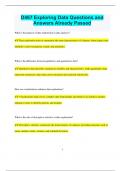
D467 Exploring Data Questions and
Answers Already Passed
What is the purpose of data exploration in data analysis?
✔✔ Data exploration aims to summarize the main characteristics of a dataset, often using visual
methods to uncover patterns, trends, and anomalies.
What is the difference between qualitative and quantitative data?
✔✔ Qualitative data describes categorical variables and characteristics, while quantitative data
represents numerical values that can be measured and analyzed statistically.
How can visualizations enhance data exploration?
✔✔ Visualizations help convey complex data relationships and trends in an intuitive manner,
making it easier to identify patterns and insights.
What is the role of descriptive statistics in data exploration?
✔✔ Descriptive statistics summarize the main features of a dataset, providing measures such as
mean, median, mode, variance, and standard deviation.
1
, What are some common methods for detecting outliers in a dataset?
✔✔ Common methods include using box plots, z-scores, and IQR (interquartile range) analysis
to identify data points that deviate significantly from the rest.
How can data cleaning impact the exploration process?
✔✔ Data cleaning improves the accuracy and quality of the data, ensuring that the insights
drawn from exploration are reliable and meaningful.
What is the importance of data normalization in data analysis?
✔✔ Data normalization ensures that different scales of measurement do not skew the analysis,
allowing for a more accurate comparison of variables.
What techniques can be used to handle missing data in a dataset?
✔✔ Techniques include imputation, deletion, and using algorithms that support missing values,
ensuring that analysis remains robust.
What is a correlation matrix, and how is it used in data exploration?
✔✔ A correlation matrix is a table that shows the correlation coefficients between multiple
variables, helping to identify relationships and dependencies in the data.
2
Answers Already Passed
What is the purpose of data exploration in data analysis?
✔✔ Data exploration aims to summarize the main characteristics of a dataset, often using visual
methods to uncover patterns, trends, and anomalies.
What is the difference between qualitative and quantitative data?
✔✔ Qualitative data describes categorical variables and characteristics, while quantitative data
represents numerical values that can be measured and analyzed statistically.
How can visualizations enhance data exploration?
✔✔ Visualizations help convey complex data relationships and trends in an intuitive manner,
making it easier to identify patterns and insights.
What is the role of descriptive statistics in data exploration?
✔✔ Descriptive statistics summarize the main features of a dataset, providing measures such as
mean, median, mode, variance, and standard deviation.
1
, What are some common methods for detecting outliers in a dataset?
✔✔ Common methods include using box plots, z-scores, and IQR (interquartile range) analysis
to identify data points that deviate significantly from the rest.
How can data cleaning impact the exploration process?
✔✔ Data cleaning improves the accuracy and quality of the data, ensuring that the insights
drawn from exploration are reliable and meaningful.
What is the importance of data normalization in data analysis?
✔✔ Data normalization ensures that different scales of measurement do not skew the analysis,
allowing for a more accurate comparison of variables.
What techniques can be used to handle missing data in a dataset?
✔✔ Techniques include imputation, deletion, and using algorithms that support missing values,
ensuring that analysis remains robust.
What is a correlation matrix, and how is it used in data exploration?
✔✔ A correlation matrix is a table that shows the correlation coefficients between multiple
variables, helping to identify relationships and dependencies in the data.
2