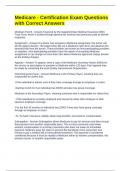
Medicare - Certification Exam Questions
with Correct Answers
Medicare Part B - Answer-Financed by the Supplementary Medical Insurance (SMI)
Trust Fund, which is funded through general tax revenue and premiums paid by benefit
recipients.
Assignment - Answer-If a doctor has accepted a Medicare assignment, the doctor will
bill the patient directly. The patient then fills out a Medicare claim form and attaches the
itemized bills from the doctor. These providers are known as Non-participating providers
or suppliers. Non-participating providers have the option of accepting Medicare
assignment or can charge no more than 15% above Medicare approved charge (known
as the limiting charge).
Appeals - Answer-To appeal, send a copy of the Medicare Summary Notice (MSN) for
the service or prescription in question to Medicare within 120 days. Fast appeals may
be made by contacting the local Quality Improvement Organization.
Determining the Payor - Answer-Medicare is the Primary Payor, meaning they are
responsible for claims first:
-If the individual is retired, even if they have coverage through an employer o runion.
-Starting month 31 if an individual has ESRD and also has group coverage.
Medicare is the Secondary Payor, meaning someone else is responsible for claims first:
- If the individual is currently employed and insured by either their employer or their
spouse's employer coverage.
-For the first 30 months an individual has ESRD if they also have group coverage
through an employer or union.
-To "no-fault" insurance, liability, black lung benefits, and workers' compensation.
Subrogation - Answer-Subrogation allows Medicare to pay for services and then recoup
that payment from another responsible party. This is most commonly used when
workers compensation or a primary insurance plan does not make an immediate
payment. Medicare pays the claim to prevent the beneficiary from using their own
money to pay a medical bill or being denied treatment. The payment is considered
conditional because it must be repaid to Medicare either by workers compensation, the
primary insurer, or another responsible payer.
,Medicare Administration - Answer-Medicare is administered by the center for Medicare
and Medicaid Services (CMS). The CMS contracts with intermediaries, private regional
organizations who act as the middle man and enroll providers, process Medicare
claims, and investigate fraud.
Who establishes regional policy guidelines? - Answer-MACs establish regional policy
guidelines, called Local Coverage Determinations (LCSDs).
What is a Prospective Payment System (PPS)? - Answer-A Prospective Payment
System (PPS) is a method of reimbursement in which Medicare payment is made based
on a predetermined, fixed amount. The payment amount for a particular service is
derived based on the classification system of that service (for example, diagnosis-
related groups for inpatient hospital services).
What is the SSA? - Answer-the Social Security Administration (SSA) enrolls individuals
in Medicare and processes any premium payments.
Diagnosis-Related Groups (DRG) - Answer-is a system of coding hospital procedures
and services for predetermined Medicare payments. They are used to classify hospital
patients on the basis of diagnosis consisting of distinct groupings. The payment amount
linked to a fixed amount based on the average treatment cost of patients in the "group."
When a patient is assigned to a DRG, Medicare pays a predetermined amount to the
hospital regardless of what is actually needed for the patient's care. Patients may be
assigned to a group based on:
- Patient's age, gender
-Principal Diagnosis
-Treatment given (surgery, rehab, etc.)
-Zip code
Utilization Review Committee - Answer-The Utilization Review Committee is designed
to safeguard against payment for unnecessary or inappropriate medical care given to
Medicare recipients. It is responsible for evaluating each admission and ensuring that
the admission is necessary and appropriate. Participating hospitals must establish a
utilization review committee to ensure the requirements of Medicare are fulfilled in
relation to medical necessity, quality of care, appropriateness of treatment, etc. A QIU is
used for hospitals that do not establish a Utilization Review committee.
Peer Review Organizations - Answer-Peer Review Organizations are medical
professionals selected by the government to audit the quality of care received by
Medicare Patients.
Quality Improvement Organization - Answer-A Quality Improvement Organization is a
group of health care experts, practicing doctors, and consumers organized to improve
the quality health care delivered to people across America. QIOs work under the
direction of the Centers for Medicare & Medicaid Services to assist Medicare providers
,with quality improvement and to review quality concerns for the protection of
beneficiaries and the Medicare Trust Fund
QIOs have binding authority in regard to its review of hospital activities and is
responsible for: - Answer--Monitoring appropriateness, effectiveness, and quality of care
provided to Medicare Patients.
-Review complains regarding the quality of care given by hospitals (inpatient,
outpatient ,and ER), ambulatory surgical centers, home health agencies, skilled nursing
facilities, Medicate private fee-for-service plans, etc.
-Provide "best practices" and assist with improvement of physicians, hospitals, nursing
homes, home health agencies, etc.
-Improving quality of care for beneficiaries.
-Protecting the integrity of the Medicare Trust Fund by ensuring that Medicare pays only
for services and goods that are reasonable and necessary and that are provided in the
most appropriate setting.
-Protecting beneficiaries from violations of the emergency Medical Treatment and Labor
Act (EMTALA)
Original Medicare - Answer-Original Medicare provides hospital and medical expense
insurance protection people age or older, those who suffer from Chronic Kidney or End
Stage Renal disease (ESRD), Amyotrophic Lateral Sclerosis (ALS) or Lou Gehrig's
disease, and under certain circumstances, those receiving Social Security Disability
Benefits. The Original Medicare plan consists of two parts: Medicare Part A and
Medicare Part B.
Medicare Part A: Hospital Coverage: Covers the following: - Answer--Inpatient care in
hospitals
-Skilled nursing facilities (if hospitalized before entering)
-Drugs administered as part of inpatient treatment
Medicare Part B: Medical (Physician) Insurance: Covers the following: - Answer--
Outpatient medical services
-Preventative care
Medicare Expansion - Answer-Medicare now also includes Part C, managed care or
Medicare Advantage, and Part D, Prescription Drug Coverage. Medicare Savings
Programs (MSPs) receive funds from Medicaid to assist individuals in paying Medicare
premiums. Some MSPs pay a portion of Medicare Part A and B deductibles and
coinsurance.
Medicare Part C (Medicare Advantage) Managed Care : Covers the following: -
Answer--A all-encompassing alternative to Parts A and B utilizing HMOs, PPOs, Private
Fee-For-Services
-Medicare Part D; In , federal legislation expanded Medicare to include Prescription
Drug Insurance
, Medicare Select, Medicare Supplements, Medigap - Answer-Medigap policies (A, B, C,
D, F, G, K, L, M, N) and Medicare Select policies are Medicare Supplements which
involve private insurers and additional premiums. These are NOT part of Medicare.
Original Medicare Enrollment
There are three enrollment periods for Medicare Part A and Medicare Part B: - Answer--
Initial Enrollment: includes the three months leading up to your the birthday, the month
of your 65th birthday, and the three months after your the birthday. 7 months in total.
-Annual, general or open enrollment is January 1st through March 31st
-Special enrollment Period (SEP) Typically, a late enrollment penalty does not apply if
enrollment is made during the special enrollment period. Those receiving Social
Security Disability for at least twenty-four months, those experiencing the disabling
onset of Lou Gehrig's disease, or those with End Stage Renal Disease may also qualify
for a SEP> There is an 8-month SEP that begins upon retirement or termination of
group health coverage, whichever occurs first, if you delayed enrollment due to a group
health coverage. however, A person can enroll anytime they or their spouse, are
working and the person is covered by an employer or union-sponsored group health
plan.
Automatic Part A and Part B Enrollment: - Answer--On the first day of the month a
person reaches age 65 and is eligible to receive or is currently receiving Social Security
or Railroad Retirement Board benefits.
-After 24 months of receiving Social Security disability (coverage would start month 25)
-The month of Lou Gehrig's disease disability onset
-Those enrolled in Part A will automatically be enrolled in Part B unless the individual
declines the coverage
Part A Enrollment: - Answer--Those not eligible for premium-free Part A coverage must
apply during their initial enrollment period or a special enrollment period to avoid a 10%
premium increase penalty.
-Enrollment in Part B coverage must happen during the initial enrollment period or a
special enrollment period to avoid a 10% premium increase penalty for each year the
enrollment is postponed.
-Those who do not sign up during the initial enrollment period may sign up during the
general enrollment period but may face a 10% premium penalty for each year the
enrollment was postponed.
-For coverage to begin on the first day of the month in which an individual turns age
they must enroll during the 3 months leading up to their birthday month
-If the individual's birthday is on the first day of the month, and they enroll during the 3
months leading up to their birthday, coverage will begin on the first day of the month
prior.
-A person who has Part A coverage and TRICARE must have Part B coverage in order
to keep their TRICARE coverage, unless the service member is on active duty. Prior to
with Correct Answers
Medicare Part B - Answer-Financed by the Supplementary Medical Insurance (SMI)
Trust Fund, which is funded through general tax revenue and premiums paid by benefit
recipients.
Assignment - Answer-If a doctor has accepted a Medicare assignment, the doctor will
bill the patient directly. The patient then fills out a Medicare claim form and attaches the
itemized bills from the doctor. These providers are known as Non-participating providers
or suppliers. Non-participating providers have the option of accepting Medicare
assignment or can charge no more than 15% above Medicare approved charge (known
as the limiting charge).
Appeals - Answer-To appeal, send a copy of the Medicare Summary Notice (MSN) for
the service or prescription in question to Medicare within 120 days. Fast appeals may
be made by contacting the local Quality Improvement Organization.
Determining the Payor - Answer-Medicare is the Primary Payor, meaning they are
responsible for claims first:
-If the individual is retired, even if they have coverage through an employer o runion.
-Starting month 31 if an individual has ESRD and also has group coverage.
Medicare is the Secondary Payor, meaning someone else is responsible for claims first:
- If the individual is currently employed and insured by either their employer or their
spouse's employer coverage.
-For the first 30 months an individual has ESRD if they also have group coverage
through an employer or union.
-To "no-fault" insurance, liability, black lung benefits, and workers' compensation.
Subrogation - Answer-Subrogation allows Medicare to pay for services and then recoup
that payment from another responsible party. This is most commonly used when
workers compensation or a primary insurance plan does not make an immediate
payment. Medicare pays the claim to prevent the beneficiary from using their own
money to pay a medical bill or being denied treatment. The payment is considered
conditional because it must be repaid to Medicare either by workers compensation, the
primary insurer, or another responsible payer.
,Medicare Administration - Answer-Medicare is administered by the center for Medicare
and Medicaid Services (CMS). The CMS contracts with intermediaries, private regional
organizations who act as the middle man and enroll providers, process Medicare
claims, and investigate fraud.
Who establishes regional policy guidelines? - Answer-MACs establish regional policy
guidelines, called Local Coverage Determinations (LCSDs).
What is a Prospective Payment System (PPS)? - Answer-A Prospective Payment
System (PPS) is a method of reimbursement in which Medicare payment is made based
on a predetermined, fixed amount. The payment amount for a particular service is
derived based on the classification system of that service (for example, diagnosis-
related groups for inpatient hospital services).
What is the SSA? - Answer-the Social Security Administration (SSA) enrolls individuals
in Medicare and processes any premium payments.
Diagnosis-Related Groups (DRG) - Answer-is a system of coding hospital procedures
and services for predetermined Medicare payments. They are used to classify hospital
patients on the basis of diagnosis consisting of distinct groupings. The payment amount
linked to a fixed amount based on the average treatment cost of patients in the "group."
When a patient is assigned to a DRG, Medicare pays a predetermined amount to the
hospital regardless of what is actually needed for the patient's care. Patients may be
assigned to a group based on:
- Patient's age, gender
-Principal Diagnosis
-Treatment given (surgery, rehab, etc.)
-Zip code
Utilization Review Committee - Answer-The Utilization Review Committee is designed
to safeguard against payment for unnecessary or inappropriate medical care given to
Medicare recipients. It is responsible for evaluating each admission and ensuring that
the admission is necessary and appropriate. Participating hospitals must establish a
utilization review committee to ensure the requirements of Medicare are fulfilled in
relation to medical necessity, quality of care, appropriateness of treatment, etc. A QIU is
used for hospitals that do not establish a Utilization Review committee.
Peer Review Organizations - Answer-Peer Review Organizations are medical
professionals selected by the government to audit the quality of care received by
Medicare Patients.
Quality Improvement Organization - Answer-A Quality Improvement Organization is a
group of health care experts, practicing doctors, and consumers organized to improve
the quality health care delivered to people across America. QIOs work under the
direction of the Centers for Medicare & Medicaid Services to assist Medicare providers
,with quality improvement and to review quality concerns for the protection of
beneficiaries and the Medicare Trust Fund
QIOs have binding authority in regard to its review of hospital activities and is
responsible for: - Answer--Monitoring appropriateness, effectiveness, and quality of care
provided to Medicare Patients.
-Review complains regarding the quality of care given by hospitals (inpatient,
outpatient ,and ER), ambulatory surgical centers, home health agencies, skilled nursing
facilities, Medicate private fee-for-service plans, etc.
-Provide "best practices" and assist with improvement of physicians, hospitals, nursing
homes, home health agencies, etc.
-Improving quality of care for beneficiaries.
-Protecting the integrity of the Medicare Trust Fund by ensuring that Medicare pays only
for services and goods that are reasonable and necessary and that are provided in the
most appropriate setting.
-Protecting beneficiaries from violations of the emergency Medical Treatment and Labor
Act (EMTALA)
Original Medicare - Answer-Original Medicare provides hospital and medical expense
insurance protection people age or older, those who suffer from Chronic Kidney or End
Stage Renal disease (ESRD), Amyotrophic Lateral Sclerosis (ALS) or Lou Gehrig's
disease, and under certain circumstances, those receiving Social Security Disability
Benefits. The Original Medicare plan consists of two parts: Medicare Part A and
Medicare Part B.
Medicare Part A: Hospital Coverage: Covers the following: - Answer--Inpatient care in
hospitals
-Skilled nursing facilities (if hospitalized before entering)
-Drugs administered as part of inpatient treatment
Medicare Part B: Medical (Physician) Insurance: Covers the following: - Answer--
Outpatient medical services
-Preventative care
Medicare Expansion - Answer-Medicare now also includes Part C, managed care or
Medicare Advantage, and Part D, Prescription Drug Coverage. Medicare Savings
Programs (MSPs) receive funds from Medicaid to assist individuals in paying Medicare
premiums. Some MSPs pay a portion of Medicare Part A and B deductibles and
coinsurance.
Medicare Part C (Medicare Advantage) Managed Care : Covers the following: -
Answer--A all-encompassing alternative to Parts A and B utilizing HMOs, PPOs, Private
Fee-For-Services
-Medicare Part D; In , federal legislation expanded Medicare to include Prescription
Drug Insurance
, Medicare Select, Medicare Supplements, Medigap - Answer-Medigap policies (A, B, C,
D, F, G, K, L, M, N) and Medicare Select policies are Medicare Supplements which
involve private insurers and additional premiums. These are NOT part of Medicare.
Original Medicare Enrollment
There are three enrollment periods for Medicare Part A and Medicare Part B: - Answer--
Initial Enrollment: includes the three months leading up to your the birthday, the month
of your 65th birthday, and the three months after your the birthday. 7 months in total.
-Annual, general or open enrollment is January 1st through March 31st
-Special enrollment Period (SEP) Typically, a late enrollment penalty does not apply if
enrollment is made during the special enrollment period. Those receiving Social
Security Disability for at least twenty-four months, those experiencing the disabling
onset of Lou Gehrig's disease, or those with End Stage Renal Disease may also qualify
for a SEP> There is an 8-month SEP that begins upon retirement or termination of
group health coverage, whichever occurs first, if you delayed enrollment due to a group
health coverage. however, A person can enroll anytime they or their spouse, are
working and the person is covered by an employer or union-sponsored group health
plan.
Automatic Part A and Part B Enrollment: - Answer--On the first day of the month a
person reaches age 65 and is eligible to receive or is currently receiving Social Security
or Railroad Retirement Board benefits.
-After 24 months of receiving Social Security disability (coverage would start month 25)
-The month of Lou Gehrig's disease disability onset
-Those enrolled in Part A will automatically be enrolled in Part B unless the individual
declines the coverage
Part A Enrollment: - Answer--Those not eligible for premium-free Part A coverage must
apply during their initial enrollment period or a special enrollment period to avoid a 10%
premium increase penalty.
-Enrollment in Part B coverage must happen during the initial enrollment period or a
special enrollment period to avoid a 10% premium increase penalty for each year the
enrollment is postponed.
-Those who do not sign up during the initial enrollment period may sign up during the
general enrollment period but may face a 10% premium penalty for each year the
enrollment was postponed.
-For coverage to begin on the first day of the month in which an individual turns age
they must enroll during the 3 months leading up to their birthday month
-If the individual's birthday is on the first day of the month, and they enroll during the 3
months leading up to their birthday, coverage will begin on the first day of the month
prior.
-A person who has Part A coverage and TRICARE must have Part B coverage in order
to keep their TRICARE coverage, unless the service member is on active duty. Prior to