Unjust Laws
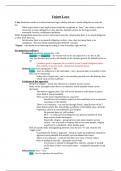
A key distinction needs to be drawn between legal validity and one’s moral obligation to obey the
law.
While unjust laws in any legal system should be recognised as “laws”, the extent to which a
citizen has a moral obligation to obey that law depends on how far the legal system
reasonably resolves coordination problems.
While disregarding unjust laws as laws may lead to anarchy, denying that there is no moral obligation
to obey them does not.
Just because there is no general obligation to obey a law, does not mean there is no
compliance. The two remain fundamentally different concepts.
“Unjust” = not based on or behaving according to what is morally right and fair.”
Are unjust laws still law?
Traditional natural law perspective = No:
Aquinas and Augustine – lex inuesta non est lex (an unjust law is no law at all).
Any law that does not work to the benefit of the common good is by default no law at
all.
Common good is important but in relation to one’s moral obligation rather
than validity of the law itself – distinction should be drawn.
Updated natural law perspective = No:
Finnis – laws are subjective to the individual – one’s personal take on morality is how
laws can be interpreted.
In the case of unjust laws, one’s own morality prevails over the arbitrary laws
which claim to have authority.
Criticisms of this approach:
Rooted in religion – seems less relevant in a modern secular society.
Rests on the assumption that there is an objective moral standard which can be
discerned.
This theory suggests that a law will not be treated as valid unless it passes
some kind of moral threshold.
What are the moral requirements for a just law?
Would have to be entirely objective and would have to be a universal
consensus on the identity.
There is no consensus – can see this through Finnis’ identification of the 7
basic human goods: life, knowledge, sociability of friendship, play, aesthetic
experience, practical reasonableness, and religion.
He presents these as ‘self-evident’.
BUT – is really just concealing his own personal opinion of what
these values should encompass.
Especially religion – going back to point about modern secular
society – not everyone is religious and so for many people, religion
would not be considered a basic human good.
Risk of insufficiently distinguishing between what the law “is” and what the law
“ought to be”.
Exacerbated by Finnis’s approach – trying to make the traditional natural law
approach more palatable but actually just exacerbated the issues.
There is no consensus – everyone has their own view of moral values.
Risk of leading to anarchy – dismantle social order.
If everyone is entitled to disregard law entirely, consider it invalid,
on the basis of their own moral values – completely dismantle social
order.
Soft positivist view = Yes:
Hart – law is a question of social fact.
A key distinction needs to be drawn between legal validity and one’s moral obligation to obey the
law.
While unjust laws in any legal system should be recognised as “laws”, the extent to which a
citizen has a moral obligation to obey that law depends on how far the legal system
reasonably resolves coordination problems.
While disregarding unjust laws as laws may lead to anarchy, denying that there is no moral obligation
to obey them does not.
Just because there is no general obligation to obey a law, does not mean there is no
compliance. The two remain fundamentally different concepts.
“Unjust” = not based on or behaving according to what is morally right and fair.”
Are unjust laws still law?
Traditional natural law perspective = No:
Aquinas and Augustine – lex inuesta non est lex (an unjust law is no law at all).
Any law that does not work to the benefit of the common good is by default no law at
all.
Common good is important but in relation to one’s moral obligation rather
than validity of the law itself – distinction should be drawn.
Updated natural law perspective = No:
Finnis – laws are subjective to the individual – one’s personal take on morality is how
laws can be interpreted.
In the case of unjust laws, one’s own morality prevails over the arbitrary laws
which claim to have authority.
Criticisms of this approach:
Rooted in religion – seems less relevant in a modern secular society.
Rests on the assumption that there is an objective moral standard which can be
discerned.
This theory suggests that a law will not be treated as valid unless it passes
some kind of moral threshold.
What are the moral requirements for a just law?
Would have to be entirely objective and would have to be a universal
consensus on the identity.
There is no consensus – can see this through Finnis’ identification of the 7
basic human goods: life, knowledge, sociability of friendship, play, aesthetic
experience, practical reasonableness, and religion.
He presents these as ‘self-evident’.
BUT – is really just concealing his own personal opinion of what
these values should encompass.
Especially religion – going back to point about modern secular
society – not everyone is religious and so for many people, religion
would not be considered a basic human good.
Risk of insufficiently distinguishing between what the law “is” and what the law
“ought to be”.
Exacerbated by Finnis’s approach – trying to make the traditional natural law
approach more palatable but actually just exacerbated the issues.
There is no consensus – everyone has their own view of moral values.
Risk of leading to anarchy – dismantle social order.
If everyone is entitled to disregard law entirely, consider it invalid,
on the basis of their own moral values – completely dismantle social
order.
Soft positivist view = Yes:
Hart – law is a question of social fact.