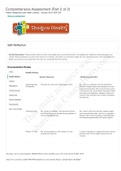
I HUMAN CASE STUDY FLORENCE BLACKMAN
Latest Versions 2024 GRADED A+
Think about the clinical presentation that you would expect for each diagnosis. What signs & symptoms did the patient
present with that were consistent with/expected for that diagnosis? (Include history findings (HPI, ROS, SH, FH, PMH),
physical exam findings, and diagnostic tests). What history/signs/symptoms/diagnostics would you expect for that diagnosis
that was lacking?
DIAGNOSIS: Unstable Angina
Pertinent Positives List the FindingsRationale
Subjective findings
(HPI, ROS, PMFSH) • Constriction in middle of chest
• Chest discomfort started during exercise.
• Pain radiating to left arm
• Shortness of breath
• History of hypertension
• History of hyperlipidemia
• History of smoking
• Diagnosis of coronary artery disease
• Stressful work environment
• Family history of heart disease • These symptoms that the patient experienced are associated with unstable
angina. The risk factors also
align with the diagnosis of unstable angina.
Objective findings
(Physical Exam & Diagnostics) • Lipid profile showed a cholesterol level of 200 and an HDL of 45
• No evidence of cardiomegaly seen on CXR
• No evidence of ischemia seen on 12 lead ECG
• Troponin was not elevated
• TEE showed no evidence of structural or functional abnormality
• CK-MB was not elevated
• BMP was normal
• CBC was normal • The findings of the lipid profile show an elevated cholesterol and unchanged
HDL after six months of lipid lowering therapy. This finding can contribute to the cause of unstable angina. The other
diagnostics showed negative findings which rules out other diagnoses.
Pertinent Negatives
Subjective findings
(HPI, ROS, PMFSH) • Pain was not relieved by rest but started during rest.
• Chest pain lasted for 10 minutes • Unstable angina is known to occur with exertion and cease with
rest, so this is an abnormal finding when considering
this diagnosis.
• The chest discomfort that occurs with unstable angina lasts for 2-5 minutes, so this is an abnormal finding for this
diagnosis.
Latest Versions 2024 GRADED A+
Think about the clinical presentation that you would expect for each diagnosis. What signs & symptoms did the patient
present with that were consistent with/expected for that diagnosis? (Include history findings (HPI, ROS, SH, FH, PMH),
physical exam findings, and diagnostic tests). What history/signs/symptoms/diagnostics would you expect for that diagnosis
that was lacking?
DIAGNOSIS: Unstable Angina
Pertinent Positives List the FindingsRationale
Subjective findings
(HPI, ROS, PMFSH) • Constriction in middle of chest
• Chest discomfort started during exercise.
• Pain radiating to left arm
• Shortness of breath
• History of hypertension
• History of hyperlipidemia
• History of smoking
• Diagnosis of coronary artery disease
• Stressful work environment
• Family history of heart disease • These symptoms that the patient experienced are associated with unstable
angina. The risk factors also
align with the diagnosis of unstable angina.
Objective findings
(Physical Exam & Diagnostics) • Lipid profile showed a cholesterol level of 200 and an HDL of 45
• No evidence of cardiomegaly seen on CXR
• No evidence of ischemia seen on 12 lead ECG
• Troponin was not elevated
• TEE showed no evidence of structural or functional abnormality
• CK-MB was not elevated
• BMP was normal
• CBC was normal • The findings of the lipid profile show an elevated cholesterol and unchanged
HDL after six months of lipid lowering therapy. This finding can contribute to the cause of unstable angina. The other
diagnostics showed negative findings which rules out other diagnoses.
Pertinent Negatives
Subjective findings
(HPI, ROS, PMFSH) • Pain was not relieved by rest but started during rest.
• Chest pain lasted for 10 minutes • Unstable angina is known to occur with exertion and cease with
rest, so this is an abnormal finding when considering
this diagnosis.
• The chest discomfort that occurs with unstable angina lasts for 2-5 minutes, so this is an abnormal finding for this
diagnosis.