MBA 706 – Marketing answers
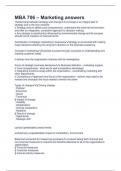
Relationship between strategy and change✔✔o Change is an integral part of
strategy and is the only certainty
o Strategy aims to define core competencies, understand the external environment,
and offer an integrative, consistent approach to decision making.
o Any strategy is significantly influenced by environmental change and its success
should not be measure in financial terms.
Contribution of strategic marketing to business✔✔strategy is concerned with making
major decisions affecting the long-term direction or the business sustaining
Concept of marketing✔✔business success through a process of understanding and
meeting customer needs
it defines how the organization interacts with its marketplace
Focus of strategic business decisions✔✔o Business definition - marketing myopia
o Core competencies - what we do well (competitive advantage)
o Integrating functions areas within the organization - coordinating marketing with
other departments
o Consistency of approach and focus of the organization - actions may need to be
revised and changed; the focus needs to remain the same
Types of change✔✔§ Driving change
· Political
· Economic
· Social
· Technical
§ Impact of change
· Volatility
· Globalization
· Intense competition
· Redefine
§ Result of change
· Opportunity
· Strategic drift
cyclical (predictable) yearly trends
evolutionary (unpredictable) impact of competition, environment
Balanced scorecard for measuring success✔✔o involves taking both financial and
non-financial measures to examine the benefits delivered to all of the organization's
stakeholders
§ Financial measures
§ Customer measures
§ Internal activity measures
, Innovation and learning measures
becomes the basis for evaluating the strategy
Purpose of marketing strategy✔✔o to simplify managerial decision making when it
comes to marketing decisions
o Must lead to action, not be a substitute for it
o Should establish the organizations marketing mix (4Ps)
§ Product
§ Price
§ Promotion
§ Place
Macro-environmental forces that can affect a business✔✔o Political/legal
o Economic
o Social/cultural
o Technological
o PEST or STEP
Business Orientations✔✔A company's orientation defines its fundamental business
philosophy, highlighting what is perceived as the primary route to success
There are 4 major orientations -
Production Orientation
Product orientation
sales orientation
market orientation
Strategic Management✔✔strategic activities - budgeting, long-range planning,
strategic planning, strategic management
strategic analysis - environmental/culture and stakeholders/resources and
capabilities
strategic choice - options, evaluating options, selecting strategy
strategic implementation - managing change, organizing structure and design,
planning
Macro- environmental forces that can affect a business✔✔PEST
Examples of macro-environmental forces✔✔Political/legal issues
§ Taxation policy
§ Monopoly controls
§ Employment law
o Economic
§ Interest rates
§ Inflation rates
§ Money supply
§ Unemployment
o Social/cultural issues
§ Age profiles
Relationship between strategy and change✔✔o Change is an integral part of
strategy and is the only certainty
o Strategy aims to define core competencies, understand the external environment,
and offer an integrative, consistent approach to decision making.
o Any strategy is significantly influenced by environmental change and its success
should not be measure in financial terms.
Contribution of strategic marketing to business✔✔strategy is concerned with making
major decisions affecting the long-term direction or the business sustaining
Concept of marketing✔✔business success through a process of understanding and
meeting customer needs
it defines how the organization interacts with its marketplace
Focus of strategic business decisions✔✔o Business definition - marketing myopia
o Core competencies - what we do well (competitive advantage)
o Integrating functions areas within the organization - coordinating marketing with
other departments
o Consistency of approach and focus of the organization - actions may need to be
revised and changed; the focus needs to remain the same
Types of change✔✔§ Driving change
· Political
· Economic
· Social
· Technical
§ Impact of change
· Volatility
· Globalization
· Intense competition
· Redefine
§ Result of change
· Opportunity
· Strategic drift
cyclical (predictable) yearly trends
evolutionary (unpredictable) impact of competition, environment
Balanced scorecard for measuring success✔✔o involves taking both financial and
non-financial measures to examine the benefits delivered to all of the organization's
stakeholders
§ Financial measures
§ Customer measures
§ Internal activity measures
, Innovation and learning measures
becomes the basis for evaluating the strategy
Purpose of marketing strategy✔✔o to simplify managerial decision making when it
comes to marketing decisions
o Must lead to action, not be a substitute for it
o Should establish the organizations marketing mix (4Ps)
§ Product
§ Price
§ Promotion
§ Place
Macro-environmental forces that can affect a business✔✔o Political/legal
o Economic
o Social/cultural
o Technological
o PEST or STEP
Business Orientations✔✔A company's orientation defines its fundamental business
philosophy, highlighting what is perceived as the primary route to success
There are 4 major orientations -
Production Orientation
Product orientation
sales orientation
market orientation
Strategic Management✔✔strategic activities - budgeting, long-range planning,
strategic planning, strategic management
strategic analysis - environmental/culture and stakeholders/resources and
capabilities
strategic choice - options, evaluating options, selecting strategy
strategic implementation - managing change, organizing structure and design,
planning
Macro- environmental forces that can affect a business✔✔PEST
Examples of macro-environmental forces✔✔Political/legal issues
§ Taxation policy
§ Monopoly controls
§ Employment law
o Economic
§ Interest rates
§ Inflation rates
§ Money supply
§ Unemployment
o Social/cultural issues
§ Age profiles