BNSF PRACTICE TEST 1 QUESTIONS
WITH REVISED AND UPDATED
ANSWERS
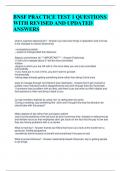
what is cognitive dissonance? - Answer-you have two things in opposition and one has
to be changed to reduce dissonance
--contradictory beliefs
---easier to change belief than behavior
Steps to commitment (4) ***IMPORTANT*** - Answer-Publicness
-if i tell a lot of people about it I will be more committed
Volition
-degree to which you are OK with it, the more likely you are to be committed
Irreversibility
-if you have put in a lot of time, you don't want to go back
Incrementally
-taking steps towards getting something done rather than doing it all at once
ways to manage through commitment (just read back) - Answer-Don't get involved in
protest; have individual outline disagreements and work through them by his/herself.
If someone has a problem with an idea, ask them to go and write out their objects and
find solutions to them and bring it back to you
Co-opt members implicitly by using "we" or calling them by name.
During a meeting, say something like "John and I thought this was the direction we
should take with this project"
Make aspects of job (other than just salary) salient
point out the positives of the job such as short commute time, freedom to telecommute
and flexible hours so that employees don't get stuck on the fact that the pay is low and
they are having problems with a co-worker
What is framing? - Answer-frames are filters that force us to look at the world from a
particular, limited perspective
-sometimes frame focuses on benefit and sometimes it focuses on loss
What is social influence? - Answer-relationship based influences. key to getting people
to do things.
, How does making an emotional connection help? - Answer-letting others know you care
about them
Letting others know you can relate to them
Letting others know you are like them
Ex: Presidential candidates
What is social information? - Answer-Social information is information that I gained from
others (referents) that the person considers to be relevant
Information can be gathered through conversations, observations, and interactions
How does social information influence individuals? - Answer-Makes certain aspects
stand out
-Influences attitudes about salient aspects
-Influences behaviors
-Influences how one rationalizes behavior
What is the principle of social proof - Answer-We figure out what is correct by watching
what others do
-- this happens a lot as a kid. thinking about what is safe vs not safe
Increasing effect of social proof (flip over) - Answer-Number of people
The more people doing something, the more compelling the behavior
Uncertainty
When a situation is uncertain or ambiguous, we are more likely to look to others for
cues (social referencing)
Pluralistic ignorance (bystander effect)
Why? Personal responsibility of individual reduced and if others not alarmed, we
shouldn't be
Similarity
We like those who are more similar (referents) and look to them more
Similar-to-me effect
Isolation
When away from familiar surroundings we are more vulnerable to messages from
others.
Ex. Boot camp/retreat
Propinquity - Answer-How close in space are you to people and how often do you
encounter them because of this
The person in the office next to you - you know pretty well
Doesn't have to be a lot of knowledge of someone
Like them more if you see them on elevator everyday
What is impression management? - Answer-the way we try to control perceptions other
have of us
WITH REVISED AND UPDATED
ANSWERS
what is cognitive dissonance? - Answer-you have two things in opposition and one has
to be changed to reduce dissonance
--contradictory beliefs
---easier to change belief than behavior
Steps to commitment (4) ***IMPORTANT*** - Answer-Publicness
-if i tell a lot of people about it I will be more committed
Volition
-degree to which you are OK with it, the more likely you are to be committed
Irreversibility
-if you have put in a lot of time, you don't want to go back
Incrementally
-taking steps towards getting something done rather than doing it all at once
ways to manage through commitment (just read back) - Answer-Don't get involved in
protest; have individual outline disagreements and work through them by his/herself.
If someone has a problem with an idea, ask them to go and write out their objects and
find solutions to them and bring it back to you
Co-opt members implicitly by using "we" or calling them by name.
During a meeting, say something like "John and I thought this was the direction we
should take with this project"
Make aspects of job (other than just salary) salient
point out the positives of the job such as short commute time, freedom to telecommute
and flexible hours so that employees don't get stuck on the fact that the pay is low and
they are having problems with a co-worker
What is framing? - Answer-frames are filters that force us to look at the world from a
particular, limited perspective
-sometimes frame focuses on benefit and sometimes it focuses on loss
What is social influence? - Answer-relationship based influences. key to getting people
to do things.
, How does making an emotional connection help? - Answer-letting others know you care
about them
Letting others know you can relate to them
Letting others know you are like them
Ex: Presidential candidates
What is social information? - Answer-Social information is information that I gained from
others (referents) that the person considers to be relevant
Information can be gathered through conversations, observations, and interactions
How does social information influence individuals? - Answer-Makes certain aspects
stand out
-Influences attitudes about salient aspects
-Influences behaviors
-Influences how one rationalizes behavior
What is the principle of social proof - Answer-We figure out what is correct by watching
what others do
-- this happens a lot as a kid. thinking about what is safe vs not safe
Increasing effect of social proof (flip over) - Answer-Number of people
The more people doing something, the more compelling the behavior
Uncertainty
When a situation is uncertain or ambiguous, we are more likely to look to others for
cues (social referencing)
Pluralistic ignorance (bystander effect)
Why? Personal responsibility of individual reduced and if others not alarmed, we
shouldn't be
Similarity
We like those who are more similar (referents) and look to them more
Similar-to-me effect
Isolation
When away from familiar surroundings we are more vulnerable to messages from
others.
Ex. Boot camp/retreat
Propinquity - Answer-How close in space are you to people and how often do you
encounter them because of this
The person in the office next to you - you know pretty well
Doesn't have to be a lot of knowledge of someone
Like them more if you see them on elevator everyday
What is impression management? - Answer-the way we try to control perceptions other
have of us