CEPS – STARS TEST QUESTIONS
AND ANSWERS
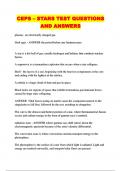
plasma - an electrically charged gas.
Dark ages - ANSWER the period before any luminescence
A star is a hot ball of gas, usually hydrogen and helium, that conducts nuclear
fusion.
A supernova is a tremendous explosion that occurs when a star collapses.
Shell - the layers of a star, beginning with the heaviest components at the core
and ending with the lightest at the surface.
A nebula is a huge cloud of dust and gas in space.
Black holes are regions of space that exhibit tremendous gravitational forces
caused by huge stars collapsing.
ANSWER: Tidal forces acting on matter cause the component nearest to the
singularity to fall first, followed by the rest, resulting in elongation.
The core is the densest and hottest portion of a star, where thermonuclear fusion
occurs and radiant energy in the form of gamma rays is emitted.
radiation zone - ANSWER where gamma rays shift (slow) down the
electromagnetic spectrum because of the zone's density differential.
The convection zone is where convection currents transport energy to the
photosphere.
The photosphere is the surface of a star from which light is radiated. Light and
energy are emitted outwardly, and sunspots/solar flares are present.
AND ANSWERS
plasma - an electrically charged gas.
Dark ages - ANSWER the period before any luminescence
A star is a hot ball of gas, usually hydrogen and helium, that conducts nuclear
fusion.
A supernova is a tremendous explosion that occurs when a star collapses.
Shell - the layers of a star, beginning with the heaviest components at the core
and ending with the lightest at the surface.
A nebula is a huge cloud of dust and gas in space.
Black holes are regions of space that exhibit tremendous gravitational forces
caused by huge stars collapsing.
ANSWER: Tidal forces acting on matter cause the component nearest to the
singularity to fall first, followed by the rest, resulting in elongation.
The core is the densest and hottest portion of a star, where thermonuclear fusion
occurs and radiant energy in the form of gamma rays is emitted.
radiation zone - ANSWER where gamma rays shift (slow) down the
electromagnetic spectrum because of the zone's density differential.
The convection zone is where convection currents transport energy to the
photosphere.
The photosphere is the surface of a star from which light is radiated. Light and
energy are emitted outwardly, and sunspots/solar flares are present.