PCC Exam 1 Questions and Answers
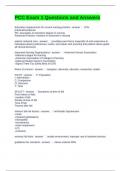
Education requirements for current nursing practice - answer LPN-
practical/vocational
RN- associates or bachelors degree in nursing
Advanced Practice- masters or doctorate in nursing
patient centered care - answer providing care that is respectful of and responsive to
individual patient preferences, needs, and values and ensuring that patient values guide
all clinical decisions
Important Nursing Organizations - answer -American Nurses Association
-National League for Nursing
-American Association of Colleges of Nursing
-National Student Nurse's Association
-Sigma Theta Tau (Delta Beta at USF)
Roles of a Nurse - answer caregiver, advocate, educator, researcher, leader
PICOT - answer P: Population
I: Intervention
C: Comparison
O: Outcome
T: Time
SPLATT - answer Symptoms at time of fall
Prior history of falls
Location of fall
Activity at time of fall
Time of fall
Trauma after fall
Intrinsic fall risk factors - answer -orthostatic hypotension
-meds
-impaired gait/balance
-neuropathy
-incontinence
-vision impairment
-UTI
-confusion
extrinsic fall risks - answer unsafe environment, improper use of assistive devices
guidelines for restraints - answer -Never ordered PRN
, -Follow hospital policy
-Require order within 1 hour (time can vary per unit or hospital)
-Must be re-ordered every 24 hours
-Last resort (must try other measures first
-Behavioral vs medical/surgical restraints
-Assess and document frequently
-Continuously reassess for ongoing need
Alternatives to restraints - answer -assess needs
-bed exit alarm
-discontinue invasive lines
-soothing environment
-family involvement
-sitter
common medical errors - answer -medication errors
-falls
-nosocomial infections
-surgical errors
-equipment failure
-diagnostic errors
orthostatic hypotension - answer sudden drop in BP > 10 mm Hg when moving from
lying to sitting/standing
-assess BP prior to transfer
-sit up/dangle feet prior to transfer
-return to bed if dizzy
venous thromboembolism - answer -unilateral swelling, erythema, pain
-hypoxia, tachy, dyspnea, pleuritic pain
-prevention = early mobilization, leg exercises, SCDs, TED hose
atelectasis - answer alveoli collapse
-prevention: early mobilization, upright position, TCDB (turn, cough, deep breathe),
incentive spirometer
Complications of immobility - answer -constipation
-contractures
-atelectasis/pneumonia
-DVT/VTE
-orthostatic hypotension
Do body mechanics protect from injury? - answer not always
ambulating person with weak side - answer ambulate on the weak side, 2 people
needed for the first time up
Education requirements for current nursing practice - answer LPN-
practical/vocational
RN- associates or bachelors degree in nursing
Advanced Practice- masters or doctorate in nursing
patient centered care - answer providing care that is respectful of and responsive to
individual patient preferences, needs, and values and ensuring that patient values guide
all clinical decisions
Important Nursing Organizations - answer -American Nurses Association
-National League for Nursing
-American Association of Colleges of Nursing
-National Student Nurse's Association
-Sigma Theta Tau (Delta Beta at USF)
Roles of a Nurse - answer caregiver, advocate, educator, researcher, leader
PICOT - answer P: Population
I: Intervention
C: Comparison
O: Outcome
T: Time
SPLATT - answer Symptoms at time of fall
Prior history of falls
Location of fall
Activity at time of fall
Time of fall
Trauma after fall
Intrinsic fall risk factors - answer -orthostatic hypotension
-meds
-impaired gait/balance
-neuropathy
-incontinence
-vision impairment
-UTI
-confusion
extrinsic fall risks - answer unsafe environment, improper use of assistive devices
guidelines for restraints - answer -Never ordered PRN
, -Follow hospital policy
-Require order within 1 hour (time can vary per unit or hospital)
-Must be re-ordered every 24 hours
-Last resort (must try other measures first
-Behavioral vs medical/surgical restraints
-Assess and document frequently
-Continuously reassess for ongoing need
Alternatives to restraints - answer -assess needs
-bed exit alarm
-discontinue invasive lines
-soothing environment
-family involvement
-sitter
common medical errors - answer -medication errors
-falls
-nosocomial infections
-surgical errors
-equipment failure
-diagnostic errors
orthostatic hypotension - answer sudden drop in BP > 10 mm Hg when moving from
lying to sitting/standing
-assess BP prior to transfer
-sit up/dangle feet prior to transfer
-return to bed if dizzy
venous thromboembolism - answer -unilateral swelling, erythema, pain
-hypoxia, tachy, dyspnea, pleuritic pain
-prevention = early mobilization, leg exercises, SCDs, TED hose
atelectasis - answer alveoli collapse
-prevention: early mobilization, upright position, TCDB (turn, cough, deep breathe),
incentive spirometer
Complications of immobility - answer -constipation
-contractures
-atelectasis/pneumonia
-DVT/VTE
-orthostatic hypotension
Do body mechanics protect from injury? - answer not always
ambulating person with weak side - answer ambulate on the weak side, 2 people
needed for the first time up