BIOL 4100 Test 1 Protein Structure & Folding Questions
With Complete Solutions
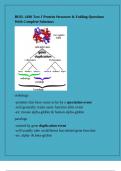
orthologs
-proteins that have come to be by a speciation event
-will generally retain same function after event
-ex: mouse alpha-globin & human alpha-globin
paralogs
-caused by gene duplication event
-will usually take on different but related gene function
-ex: alpha- & beta-globin
, HSP70
1. this protein (ATP bound) interacts w/ partially folded protein
2. presence of peptide in peptide domain of this stimulates ATP
hydrolysis & J-domain proteins (HSP40) increases the binding
of polypeptide to this protein (closes lid)
3. once protein is entirely synthesized by the
ribosome, nucleotide exchange factor (NEF) causes release of
ADP & binding of fresh ATP (opens up lid)
4. polypeptide is released & protein folding is allowed to freely
occur
HSP60
-chaperonins (class 2)
1. hydrophobic interaction w/ misfolded proteins
2. ATP binding along w/ HSP10 increases size of enclosed
space & release of misfolded protein allowing proper folding to
occur (giving it sterile, protected environment)
With Complete Solutions
orthologs
-proteins that have come to be by a speciation event
-will generally retain same function after event
-ex: mouse alpha-globin & human alpha-globin
paralogs
-caused by gene duplication event
-will usually take on different but related gene function
-ex: alpha- & beta-globin
, HSP70
1. this protein (ATP bound) interacts w/ partially folded protein
2. presence of peptide in peptide domain of this stimulates ATP
hydrolysis & J-domain proteins (HSP40) increases the binding
of polypeptide to this protein (closes lid)
3. once protein is entirely synthesized by the
ribosome, nucleotide exchange factor (NEF) causes release of
ADP & binding of fresh ATP (opens up lid)
4. polypeptide is released & protein folding is allowed to freely
occur
HSP60
-chaperonins (class 2)
1. hydrophobic interaction w/ misfolded proteins
2. ATP binding along w/ HSP10 increases size of enclosed
space & release of misfolded protein allowing proper folding to
occur (giving it sterile, protected environment)