Bonding: A GCSE Chemistry Lesson
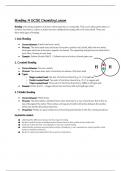
Bonding is the joining together of atoms to form molecules or compounds. This occurs when atoms share or
transfer electrons to achieve a stable electron configuration (usually with a full outer shell). There are
three main types of bonding:
1. Ionic Bonding
● Occurs between: A metal and a non-metal.
● Process: The metal atom loses electrons to become a positive ion (cation), while the non-metal
atom gains electrons to become a negative ion (anion). The oppositely charged ions are attracted to
each other, forming an ionic bond.
● Example: Sodium chloride (NaCl) - Sodium loses an electron, chlorine gains one.
2. Covalent Bonding
● Occurs between: Two non-metals.
● Process: The atoms share pairs of electrons to achieve a full outer shell.
● Types:
○ Single covalent bond: One pair of electrons shared (e.g., H-H in hydrogen gas).
○ Double covalent bond: Two pairs of electrons shared (e.g., O=O in oxygen gas).
○ Triple covalent bond: Three pairs of electrons shared (e.g., N≡N in nitrogen gas).
● Example: Water (H₂O) - Oxygen shares two electrons with each hydrogen atom.
3. Metallic Bonding
● Occurs between: Metal atoms.
● Process: The metal atoms contribute their outer electrons to a "sea of electrons" that is free to
move throughout the metal. This creates a strong electrostatic attraction between the positive
metal ions and the delocalized electrons.
● Properties: Metals are good conductors of electricity and heat due to the free-moving electrons.
Key Points for a Grade 9:
● Understand the differences between the three types of bonding.
● Be able to predict the type of bonding between elements based on their position in the periodic table.
● Know how to draw dot-and-cross diagrams to represent covalent bonding.
● Understand the properties associated with each type of bonding (e.g., ionic compounds are usually crystalline solids,
metals are malleable and ductile).
● Be able to explain how bonding affects the properties of substances.
Bonding is the joining together of atoms to form molecules or compounds. This occurs when atoms share or
transfer electrons to achieve a stable electron configuration (usually with a full outer shell). There are
three main types of bonding:
1. Ionic Bonding
● Occurs between: A metal and a non-metal.
● Process: The metal atom loses electrons to become a positive ion (cation), while the non-metal
atom gains electrons to become a negative ion (anion). The oppositely charged ions are attracted to
each other, forming an ionic bond.
● Example: Sodium chloride (NaCl) - Sodium loses an electron, chlorine gains one.
2. Covalent Bonding
● Occurs between: Two non-metals.
● Process: The atoms share pairs of electrons to achieve a full outer shell.
● Types:
○ Single covalent bond: One pair of electrons shared (e.g., H-H in hydrogen gas).
○ Double covalent bond: Two pairs of electrons shared (e.g., O=O in oxygen gas).
○ Triple covalent bond: Three pairs of electrons shared (e.g., N≡N in nitrogen gas).
● Example: Water (H₂O) - Oxygen shares two electrons with each hydrogen atom.
3. Metallic Bonding
● Occurs between: Metal atoms.
● Process: The metal atoms contribute their outer electrons to a "sea of electrons" that is free to
move throughout the metal. This creates a strong electrostatic attraction between the positive
metal ions and the delocalized electrons.
● Properties: Metals are good conductors of electricity and heat due to the free-moving electrons.
Key Points for a Grade 9:
● Understand the differences between the three types of bonding.
● Be able to predict the type of bonding between elements based on their position in the periodic table.
● Know how to draw dot-and-cross diagrams to represent covalent bonding.
● Understand the properties associated with each type of bonding (e.g., ionic compounds are usually crystalline solids,
metals are malleable and ductile).
● Be able to explain how bonding affects the properties of substances.