ATLS Study Cards with Complete Solution/216 Questions and Answers
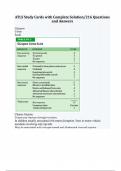
Glasgow Coma Scale Chance fracture Transverse fracture through vertebra. In children usually associated with enterc disruption. Seen in motor vehicle accidents involving only lap belt. May be associated with retroperitoneal and Abdominal visceral injuries. Anterior hip dislocation Flexed, abducted, externally rotated. Burst fracture Associated with vertebral-axial compression injuries Posterior hip dislocation Flexed, aDDucted, internally rotated Anterior shoulder dislocation Squared off appearance Posterior shoulder dislocation Lock in internal rotation. Ankle dislocation Most are Externally rotated, with a prominent medial malleolus. FULL thickness (3rd degree) burn Dark or white and leathery. Translucent white as well. Painless and generally "dry" Does not blanch with pressure. Very little swelling of burned tissue. Principle Life saving measures for patients with burn injuries include -Establishing airway control -Stopping the burning. process -Intravenous access Factors that increase the risk for upper AIRWAY OBSTRUCTION in burns include: -Burns to the head and face -Burn size and depth -Burns inside the mouth Partial thickness burn Red remodeled appearance with associated swelling and blister formation. May have weeping or wet appearance and is painfully hypersensitive even to air current. Signs and symptoms and history that suggest INHALATION INJURY include: These patients should be intubated. Inhalation injury is an indication for transfer to a burn center. Rule of nines - adult The palm represents 1% of the body total surface area. Symptoms of carbon monoxide poisoning and respective levels PaO2 does not reliably predict carbon monoxide poisoning because a CO partial pressure of only 1 mmm Hg results in a hemoglobin CO level of 40% or greater. Carbon monoxide has how many times greater affinity for hemoglobin than oxygen 240 times. It displaces the oxyhemoglobin desaturated curve to the LEFT. Two criteria required for the diagnosis of smoke inhalation injury -Exposure to a combustible agent -Signs of exposure to smoke in the lower airway, below the vocal cords, by bronchoscopy. Performing this action will help reduce neck and chest wall edema in patients with burn and inhalation injury. Elevation of the head and chest by 30 degrees. IV fluid administration formula for burn victims Indicated in burns involving over 20% of the body surface area. *(2-4 mL/kg of LR/NS) (weight in kg) (% area of burn); give 1/2 of this volume in first 8 hours. Remainder in over 16 hours. Large caliber, at least 15 gauge intravenous line should be introduced. Pitfalls for IV fluid requirements for burn victims. These patients require greater fluid requirements: ~immolation injury ~pediatric burn victims ~concomitant blunt or crush injuries. Basic rules regarding IV fluids administration in burn victims IV fluid Rate should not be based on the time of actual injury. In very small children, less than 10 kilograms, it may be necessary to add glucose to the IV fluids to avoid hypoglycemia. Any adjustment in IV fluid rate should be based on urine output. In an adult, urine output above 0.5 ml/ kilogram should result in reduction of IV fluid rate. Initial treatment of frostbite/ cold injuries Place injured part in circulating water and a constant 40 degrees centigrade until pink color and perfusion return, usually within 20 to 30 minutes. Antibiotics are not indicated empirically unless infection develops later. Persisted ACIDEMIA in burn victims may reflect... Cyanide poisoning. (Cyanide is a naturally occurring toxin that may be inhaled in a confined space fire). Hypothermia Severe hypothermia Core temperature of 36 degrees centigrade Temperature below 32 degrees centigrade Definition of frostbite. Freezing of tissue with intracellular ice crystal formation, microvascular occlusion, subsequent tissue anoxia. First degree frostbite Hyperemia and edema without skin necrosis Second-degree frostbite Large clear vesicle formation accompanies hyperemia and edema with partial thickness skin necrosis 3rd degree frostbite Full thickness and subcutaneous necrosis occurs, commonly with hemorrhage and vesicle formation. Although a compartment pressure systolic blood pressure is required to lose a pulse distal to in extremity burn, a pressure of what was in the compartment may lead to muscle necrosis 30 mm Hg. If a pressure of greater than 30 mm Hg in a burned extremity is present, eschatotomy is indicated. Difference between fasciotomy and eschatotomy Compartment syndrome is also present with circumferential chest and abdominal burns, which lead to increased peak inspiratory pressures. Eschatotomy in circumferential chest and abdominal burns. We are generally not needed before the first 6 hours after a burn. Gastric tube placement in burn victims. Place of burn involves more than 20% of total BSA. Alkali burns to the eyes require how many hours of continuous irrigation 8 hours. Electrical burns. Can cause thrombosis and entry to nerves, and digits are especially prone to injury. Patients with electrical injuries frequently require fasciotomies because of the degree of deep tissue injury and should be transferred to a burn center. Immediate ELECTRICAL burn treatment measures. Attention to airway and breathing, IV line placement, ECG monitoring, and placement of an indwelling Foley catheter. Rhabdomyolysis and subsequent metabolic acidosis are common complications. Criteria for transfer of a burn victim to a burn center. Estimating WEIGHT in kilograms for a child (2× AGE) + 10 Infant blood volume estimate 80 ml/kg Child blood volume estimate 70 ml/kg. IO needle size: Infant Child 18 gauge 15 gauge Packed red blood cell volume transfusion for a child 10 mL/ kilogram Pediatric verbal score Impacted fractures Demonstrate no false motion of the humorous when the shoulder is rotated gently from a flexed elbow. Nonimpacted Fractures Generally experience pain on movement of the arm. Generally require hospitalization for orthopedic consultation and often operation Fundal height in pregnancy The amniotic fluid may cause amniotic fluid EMBOLISM and DIC following trauma if the fluid gains access to maternal intravascular space. Physiologic changes in pregnancy 1.Physiologic changes in pregnancysmall increase in rent till volume resulting in a decrease in hematocrit. 2.Elevation and WBC as high as 25,000. 3.Mild elevation in clotting factors. Bleeding and clotting times are unchanged, however. 4. Arterial pH 7.40-7.45 5. PaCO2: 25-30mmHg 6. Bicarbonate space 17-22 (Compensatory metabolic Acidosis). A resting PaCO2 of 35 to 40 mm in the setting of pregnancy may represent impending respiratory failure. Normal PaCO2 for a pregnant woman is between 25 to 30 mmHg Kleinhauer-Betke test Maternal blood smear test which allows detection of fetal RBCs in the maternal circulation, indicates fetomaternal hemorrhage. Indication for Rh immunoglobulin therapy. Drugs to avoid in hypovolemia, head injured and intoxicated patients. Benzodiazepines, fentanyl propofol, ketamine Initial Assessment components of seriously injured patient Primary survey 1. Airway maintenance with cervical spine protection 2. Breathing and ventilation 3. Circulation & hemorrhage control 4. Disability: neurological status 5. Environment/Exposure: completely undress the patient but prevent hypothermia Assume a CERVICAL SPINE injury in patients with BLUNT multisystem trauma, especially those with an altered level of consciousness's or a blunt injury about the clavicles. IV fluid warming temperature in shock 37 to 40°C Associated with aberrant conduction, premature beats, bradycardia. hypoxemia, hypothermia hypokalemia. AMPLE history. Allergies Medications Past illness/Pregnancy, Last meal Environment/events related to injury Frontal impact automobile collision: Bent steering wheel, Knee imprint dashboard Bulls eye fracture windshield Cervical spine fracture Anterior flail chest Myocardial contusion Pneumothorax Traumatic aortic disruption Fractured spleen or liver Posterior fracture/dislocation of hip and/or knee Side impact automobile collision Contralateral next sprain Cervical spine fracture Lateral flail chest Pneumothorax Traumatic aortic disruption Diaphragmatic rupture Fractured spleen/liver and/or Fracture of kidney, pelvis or acetabulum Rear impact automobile collision Cervical spine injury Soft tissue neck injury Ejection from automobile Ejection from the vehicle precludes meaningful prediction of injury patterns. Patient at greater risk from virtually all injury mechanisms. Motor vehicle impact with pedestrian. Head injury Traumatic aortic disruption Blunt force to the neck or Traction injury from a shoulder harness restraint Can cause carotid disruption dissection or thrombosis. Symptoms may develop late Auscultation of chest Auscultate high on the anterior chest for PNEUMOTHORAX and at the posterior basis for detection of HEMOTHORAX Distended neck veins Seen in Cardiac Tampanode or Tension Pneumothorax. Abdominal injury Patients with unexplained hypotension, neurological injury, impaired sensorium secondary to alcohol and/or other drugs, and equivocal or normal findings Should be considered candidates for DPL, or FAST. If hemodynamically stable, CT scan of the abdomen Any increase in intracranial pressure can REDUCE cerebral perfusion pressure, and lead to secondary brain injury. Complete cervical cord transection which SPARES the phrenic nerve, C3 and C4, results in... Results in quadriplegia and ABDOMINAL breathing but paralysis of the intercostal muscles. Assisted ventilation may be required. Size of plastic cannula for cricothyroidotomy for jet insufflation 12 to 14 gauge; 8.5 cm length LMA sizes 3 for small female 4 for large female 5 for large male RANGES FROM 1 FOR NEONATE 5 FOR ADULTS Consider Use when you cannot extend the neck (c-collar in place) Laryngeal tube airway Use when you cannot extend the c-spine (c-collar) CO2 capnography Yellow indicates adequate CO2 levels, violet: too low Definition of Shock Abnormality of the circulatory system resulting in inadequate organ perfusion and tissue oxygenation. Hemorrhage is the most common cause of shock in the injured/trauma patient. Earliest signs of shock Tachycardia and cutaneous vasoconstriction. Tachycardia an infant Greater than 160 beats per minute Tachycardia in a preschool child Greater than 140 beats per minute Tachycardia in a school age to puberty Greater than 120 beats per minute Tachycardia in an adult Greater than 100 beats per minute. Significance of narrowed pulse pressure Significant blood loss and involvement of compensatory mechanisms. What percent of body weight in kilograms represents the circulating blood volume of an adult (in liters). 7%. Example, a 70 kilogram man's total circulating volume is 70 × 7% which equals 4900 ml. Class hemorrhage and hemodynamic effects. Sepsis Hypovolemic shock Both are characterized by tachycardia, narrow pulse pressure, cutaneous vasoconstriction, decreased systolic blood pressure, impaired urinary output. Normal blood volume percentage 7% of body weight. e.g. a 70 kilogram male has a circulating blood volume of 4.9 liters. Normal percentage blood volume for a child 8 to 9% of body weight. Blood loss associated with a fractured tibia or humerus 750 milliliters of blood Blood loss associated with a femur fracture Up to 1500 milliliters of blood Blood loss associated with pelvic fractures 2 liters or more. Initial warmed IV fluid bolus for shock. 1- 2 liters normal saline or LR for adults, and 20 ml/kilogram for pediatric patients. Normal urinary output for adult 0.5 milliliters per kilogram per hour Normal urinary output for children greater than 1 year of age 1 milliliter per kilogram per hour Normal urine output for child less than 1 year of age 2 milliliters per kilogram per hour Responses to initial fluid resuscitation in shock What needs to happen when there is failure to respond to crystalloid and blood administration in the emergency room in the setting of a motor vehicle accident or trauma resulting in shock. Depends, but some intervention such as operation or angioembolization to control exsanguinate hemorrhage Three other causes of failure to respond to IV fluids that are not HEMORRHAGIC in origin. =Tension pneumothorax, =Bunt cardiac injury, =Pericardial tamponade Type-specific blood Indicated in the setting of TRANSIENT responders. Blood to be transfused for minimal or no response trauma patients after crystalloid fluid resuscitation. Typed only packed red blood cells. Rh neg (O negative) preferred for females of childbearing age. Definition of massive transfusion of pack RBC: Greater than 10 units attack with blood cells in the first 24 hours of admission. Preferred temperature of packed red blood cells or peritoneal or thoracic cavity crystalloid solutions for hypothermia 39 degrees centigrade Most common cause of poor response to IV fluids in the setting of shock. Undiagnosed source of bleeding. Central venous pressure Reflects right heart function. May not represent left heart function in patients with primary myocardial dysfunction or abnormal pulmonary circulation. Conditions to consider if a patient does not respond to fluid therapy Unrecognized fluid loss, Ventilatory problems Tension pneumothorax Cardiac tamponade Hypoadrenalism Neurogenic shock Massive hemothorax findings on physical exam Tracheal deviation FLAT neck veins (due to heavy blood loss) Percussion dullness Absent breath sounds Distended neck veins are seen in what two conditions Cardiac tamponade Tension pneumothorax Conditions to consider in transient responders in the setting of shock. 1. Hemorrhagic: Bleeding within the abdomen, pelvis, retroperitoneum, extremity fracture, or obvious external bleeding. 2. Nonhemorrhagic: Tension pneumothorax or cardiac tamponade NONresponder to IV fluids. Diagnostic consideration Blunt cardiac injury. Intraosseous needle size. 18 gauge spinal needle with stylet. Physical signs suggesting a pelvic fracture on physical exam Scrotal hematoma, Blood at the urethral meatus Perineal hematoma, Leg length difference Mobile or high-riding prostate gland, Gross or occult blood in the stool. Accurate lines of the sacrum To treat an open book fracture of the pelvis Life-threatening thoracic injuries that need to be addressed in the primary survey Airway obstruction Tension pneumothorax Open pneumothorax Flail chest and pulmonary contusion Massive hemothorax Cardiac tamponade Most common cause of tension pneumothorax Mechanical ventilation with positive pressure ventilation in patients with visceral pleural injury Flail chest Flail chest radiograph Initial treatment of flail chest Adequate ventilation, humidified oxygen, fluid resuscitation. Later, analgesia. Short Term intubation and ventilation may be necessary. Local nerve block preferred over IV narcotics. MASSIVE hemothorax definition 1500 milliliters of blood or one third or more of the patient's total blood volume in the chest cavity. Neck veins can be distended (if concomitant tension pneumothorax) or flat (if blood loss results in hypovolemia). Treatment of MASSIVE hemothorax Restoration of blood volume (crystalloid then type specific blood) and decompression of the chest cavity. 36 or 40 French chest tube required MASSIVE Hemothorax. Indications for thoracotomy: If Greater than 1500 ml of fluid is immediately evacuated. Less than 1500 milliliters of fluid evacuated but continued blood loss of 200 milliliters per hour for 2 to 4 hours Beck's triad in cardiac tamponade Venous pressure elevation, decline in arterial pressure, muffled heart tones. Kussmal's sign Paradoxical RISE in central venous pressure with inspiration. Seen in cardiac tamponade. Resuscitative thoracotomy Patients with PENETRATING injuries to the chest, pulseless, but with myocardial electrical activity may be candidates. Patients with BLUNT injuries to the chest, arrive pulseless but with myocardial electrical activity are NOT candidates. SIMPLE hemothorax Less than 1500 milliliters of blood. Most common cause is laceration of an intercostal vessel or internal mammary artery or lung laceration due to penetrating or blunt trauma.
Schule, Studium & Fach
- Hochschule
-
Chamberlain College Of Nursing
- Kurs
-
NR 293
Dokument Information
- Hochgeladen auf
- 2. dezember 2024
- Anzahl der Seiten
- 40
- geschrieben in
- 2024/2025
- Typ
- Prüfung
- Enthält
- Fragen & Antworten
Themen
- atls
-
atls study cards with complete solution

Ebenfalls erhältlich im paket-deal