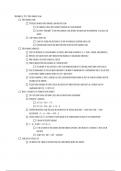
November 6, 2024: Open channel flow
Open channel flow
Difference between open channel flow and pipe flow
The channel flow is only partially enclosed by a solid boundary
The upper “boundary” of an open channel flow, between the water and the atmosphere, is called a free
surface
Start from a simple case:
Flow to be steady and frictionless so that the bernoulli equation can be used
Consider how velocity and water depth are related in open channel flow
Open channel hydraulics
Apply the principles of fluid mechanics to surface-water flow in channels (e.g. rivers, streams, and channels)
Why does the flow in rivers vary from deep and tranquil to shallow and torrential?
What controls the depth of water in a river?
How are water depth and discharge in a stream related?
The answer to this question is a key to determining how fast a flood will move down a river valley
Need to know about the speed of water movement if we want to know how fast a contaminant that is spilled into
a river moves toward the water intake of a city’s water supply
For river channels, there is generally a useful relationship between mean velocity of flow in a channel and the
discharge in the channel
Velocity and discharge in rivers usually are related by a power function, which plots as a straight line on
logarithmic paper (U = 0.28Q^0.62)
Reach: a segment of a stream or river channel
In a very short reach, frictional losses and elevation can be disregarded
Bernoulli’s equation
u^2/2g + p/pg + z = H
u^2/2g + p/pg + (zb + h - d) = h
Uniform horizontal flow (no fluid acceleration in the vertical direction) + steady state flow → total
acceleration = 0 → p = pgd → p/pg = d
Specific energy (E[l]): the energy per unit weight of the flowing water relative to the stream bottom
U and h are related through E
E + zb = H and E = u^2/2g + h
If the elevation of the channel bottom remains constant, then because H is constant, E must also be
constant
Steady state: u1A1 = u2A2 = constant
Flow over a vertical step
The width of the stream is constant and that flow remains within the channel
, What will the surface do as the flow crosses the step: rise, fall, or remain unchanged?
The answer is gained by considering the relationship among: specific energy, specific discharge, and
water depth
Qw is known and constant, so we can create a specific energy diagram
E1 = e2 + (delta)z = H
Locate e1 = 0.8m
Estimate (delta)z = 0.1m
Locate e2 = e1 - (delta)z = 0.7m
Find alternative solutions h2 and h2’ (h1>h2>h2’)
H1 → h2 → ho → h2’
H1 → h2: only requires a rise in the bed elevation
H2 → h0 → h2’: requires an upward step of a certain critical height followed by
a downward step such that the final height of the step is less than the initial height
H2 is the only solution physically meaningful
What is the relationship between h1 and h2 + (delta)z?
u1^2/2g + h1 = u2^2/2g + h2 + (delta)z
H1 - (h2 + (delta)z) = u2^2/2g - u1^2/2g
Qw = u1h1 = u2h2 = constant
h1>h2
u2^2/2g - u1^2/2g > 0
u1<u2
H1 - (h2 + (delta)z) > 0
H1 > h2 + (delta)z
Exercise
Consider steady, frictionless flow in a rectangular channel under subcritical conditions. A smooth vertical step
decreases the bottom elevation over a short reach of the channel. There is no change in channel width.
How will specific discharge change over the step?
How will specific energy change over the step?
Will the specific energy change over the step?
Will the flow become supercritical over the step?
How will the water depth change over the step?
Solution of specific energy equation
E = qw^2/2gh^2 + h
How to calculate h0?
How can we solve h for given E and qw?
Open channel flow
Difference between open channel flow and pipe flow
The channel flow is only partially enclosed by a solid boundary
The upper “boundary” of an open channel flow, between the water and the atmosphere, is called a free
surface
Start from a simple case:
Flow to be steady and frictionless so that the bernoulli equation can be used
Consider how velocity and water depth are related in open channel flow
Open channel hydraulics
Apply the principles of fluid mechanics to surface-water flow in channels (e.g. rivers, streams, and channels)
Why does the flow in rivers vary from deep and tranquil to shallow and torrential?
What controls the depth of water in a river?
How are water depth and discharge in a stream related?
The answer to this question is a key to determining how fast a flood will move down a river valley
Need to know about the speed of water movement if we want to know how fast a contaminant that is spilled into
a river moves toward the water intake of a city’s water supply
For river channels, there is generally a useful relationship between mean velocity of flow in a channel and the
discharge in the channel
Velocity and discharge in rivers usually are related by a power function, which plots as a straight line on
logarithmic paper (U = 0.28Q^0.62)
Reach: a segment of a stream or river channel
In a very short reach, frictional losses and elevation can be disregarded
Bernoulli’s equation
u^2/2g + p/pg + z = H
u^2/2g + p/pg + (zb + h - d) = h
Uniform horizontal flow (no fluid acceleration in the vertical direction) + steady state flow → total
acceleration = 0 → p = pgd → p/pg = d
Specific energy (E[l]): the energy per unit weight of the flowing water relative to the stream bottom
U and h are related through E
E + zb = H and E = u^2/2g + h
If the elevation of the channel bottom remains constant, then because H is constant, E must also be
constant
Steady state: u1A1 = u2A2 = constant
Flow over a vertical step
The width of the stream is constant and that flow remains within the channel
, What will the surface do as the flow crosses the step: rise, fall, or remain unchanged?
The answer is gained by considering the relationship among: specific energy, specific discharge, and
water depth
Qw is known and constant, so we can create a specific energy diagram
E1 = e2 + (delta)z = H
Locate e1 = 0.8m
Estimate (delta)z = 0.1m
Locate e2 = e1 - (delta)z = 0.7m
Find alternative solutions h2 and h2’ (h1>h2>h2’)
H1 → h2 → ho → h2’
H1 → h2: only requires a rise in the bed elevation
H2 → h0 → h2’: requires an upward step of a certain critical height followed by
a downward step such that the final height of the step is less than the initial height
H2 is the only solution physically meaningful
What is the relationship between h1 and h2 + (delta)z?
u1^2/2g + h1 = u2^2/2g + h2 + (delta)z
H1 - (h2 + (delta)z) = u2^2/2g - u1^2/2g
Qw = u1h1 = u2h2 = constant
h1>h2
u2^2/2g - u1^2/2g > 0
u1<u2
H1 - (h2 + (delta)z) > 0
H1 > h2 + (delta)z
Exercise
Consider steady, frictionless flow in a rectangular channel under subcritical conditions. A smooth vertical step
decreases the bottom elevation over a short reach of the channel. There is no change in channel width.
How will specific discharge change over the step?
How will specific energy change over the step?
Will the specific energy change over the step?
Will the flow become supercritical over the step?
How will the water depth change over the step?
Solution of specific energy equation
E = qw^2/2gh^2 + h
How to calculate h0?
How can we solve h for given E and qw?