The Aging Self
Describe how, according to Professor de Medeiros, the social construction of later life privileges
the perspectives of middle age. (300 words)
Societies views of old age and ageing are often defined by the views and experiences of people
in middle age, not the elderly themselves. This can lead to stereotypes and a misattribution of
values.
Many perceptions of people’s age are based on chronology, for example the age in which you
can drive or drink and the age that you retire. The problem with this definition is it is too linear.
It does not take into account lifestyle, genetics or how someone has lived. Thus someone can
seem very old at 50, whereas another very young at 80. The disconnect happens when society’s
impression of someone is different than the way they feel. Society may treat an older person as
less capable and needing help, despite what the individual feels they are capable off.
Society believes middle-aged people to be superior. They lived enough life to have wisdom.
They are often in optimal health. They are in their most productive stage of life. Therefore, these
characteristics are highly valued. Society’s definition of old age is based on the perceived loss of
these abilities. Elderly people are no longer independent, they need help and support. Older
people are perceived as having declining mental functions and not as sharp or intellent as they
were when they were younger. Society values productivity and therefore as people age and leave
the workforce, they are perceived to have less value.
This mindset can lead to stereotypes about aging, like assuming all elderly people are frail, forgetful or in
decline. This perspective ignores the fact that people age at different rates and have diverse experiences
that impacts the way they age.
Second, Hazan and Raz argue that older age is understood from a middle aged perspective. In this way,
both childhood and older age are constructed from the perspective of the alleged superiority of middle
age. This is done through ritualized forms of talk and middle aged language of separation.
Middle age, he argues, uses language to define old age including portrayals of older people as victims of
crime, of social abuse, of experiencing cognitive decline, as non-productive, as ill, as needing care, and
others. This linguistic positioning gives middle age “authority” over later life, often in the form of “a
helpful hand.” It’s a protectionist framework whereby people are positioned as needing protection as they
age. There is certainly a lot of evidence to point to reduced self efficacy in people who are exposed to
ageist attitudes toward them, especially when people internalized such ageist beliefs.
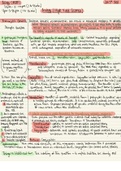
-The way we see ourselves is different from the way society sees us.
, Our own identities vs. the way others see us
Functional Age, Ableism,
Vulnerability, and Frailty
What is the reality of aging
What values have been undervalued in becoming older.
Stereotypes of older people:
-incompetent, selfish, a treat to economic security and even health of others.
-poor, disabled, and isolated from their families.
-old women are reviled as grumpy, frumpy, sexless, and uninteresting.
The reason we have such an issue with old age is because its middle age that defines old age.
-it is a social and cultural construct.
-old age is not smt new. the study of old age is not new either.
-it’s been around for about 75 years. writings from ancient
mesopotamia, ancient greece, early england, etc.
-many immortality stories (vampires: quite young, wealthy and never
age)
-people have been thinking about this for a long time
-old people were never revered in our society.
-the demographic change are for the first time time in human history
there are more people aged 65 and older than under age 5. never
before has this happen. due to changes in public health, fresh water,
food that’s not spoiled, vaccinations.
-there’s no meaning to age. 65 being the age of being old is simply a
social construct.
-ability to perform: can you walk up a flight of stairs, can you go a
certain distance on a track, what’s your resting heart rate. That doesn’t
necessarily correspond to chronological age.
-subjective age: “i don’t feel like 50” because we can’t actually feel
age. again because chronically age is pretty meaningless.
-people age at very different rates, what you’re exposed to, what you
genetically have inherited, spend a lot of time in the sun, stressful job.
Describe how, according to Professor de Medeiros, the social construction of later life privileges
the perspectives of middle age. (300 words)
Societies views of old age and ageing are often defined by the views and experiences of people
in middle age, not the elderly themselves. This can lead to stereotypes and a misattribution of
values.
Many perceptions of people’s age are based on chronology, for example the age in which you
can drive or drink and the age that you retire. The problem with this definition is it is too linear.
It does not take into account lifestyle, genetics or how someone has lived. Thus someone can
seem very old at 50, whereas another very young at 80. The disconnect happens when society’s
impression of someone is different than the way they feel. Society may treat an older person as
less capable and needing help, despite what the individual feels they are capable off.
Society believes middle-aged people to be superior. They lived enough life to have wisdom.
They are often in optimal health. They are in their most productive stage of life. Therefore, these
characteristics are highly valued. Society’s definition of old age is based on the perceived loss of
these abilities. Elderly people are no longer independent, they need help and support. Older
people are perceived as having declining mental functions and not as sharp or intellent as they
were when they were younger. Society values productivity and therefore as people age and leave
the workforce, they are perceived to have less value.
This mindset can lead to stereotypes about aging, like assuming all elderly people are frail, forgetful or in
decline. This perspective ignores the fact that people age at different rates and have diverse experiences
that impacts the way they age.
Second, Hazan and Raz argue that older age is understood from a middle aged perspective. In this way,
both childhood and older age are constructed from the perspective of the alleged superiority of middle
age. This is done through ritualized forms of talk and middle aged language of separation.
Middle age, he argues, uses language to define old age including portrayals of older people as victims of
crime, of social abuse, of experiencing cognitive decline, as non-productive, as ill, as needing care, and
others. This linguistic positioning gives middle age “authority” over later life, often in the form of “a
helpful hand.” It’s a protectionist framework whereby people are positioned as needing protection as they
age. There is certainly a lot of evidence to point to reduced self efficacy in people who are exposed to
ageist attitudes toward them, especially when people internalized such ageist beliefs.
-The way we see ourselves is different from the way society sees us.
, Our own identities vs. the way others see us
Functional Age, Ableism,
Vulnerability, and Frailty
What is the reality of aging
What values have been undervalued in becoming older.
Stereotypes of older people:
-incompetent, selfish, a treat to economic security and even health of others.
-poor, disabled, and isolated from their families.
-old women are reviled as grumpy, frumpy, sexless, and uninteresting.
The reason we have such an issue with old age is because its middle age that defines old age.
-it is a social and cultural construct.
-old age is not smt new. the study of old age is not new either.
-it’s been around for about 75 years. writings from ancient
mesopotamia, ancient greece, early england, etc.
-many immortality stories (vampires: quite young, wealthy and never
age)
-people have been thinking about this for a long time
-old people were never revered in our society.
-the demographic change are for the first time time in human history
there are more people aged 65 and older than under age 5. never
before has this happen. due to changes in public health, fresh water,
food that’s not spoiled, vaccinations.
-there’s no meaning to age. 65 being the age of being old is simply a
social construct.
-ability to perform: can you walk up a flight of stairs, can you go a
certain distance on a track, what’s your resting heart rate. That doesn’t
necessarily correspond to chronological age.
-subjective age: “i don’t feel like 50” because we can’t actually feel
age. again because chronically age is pretty meaningless.
-people age at very different rates, what you’re exposed to, what you
genetically have inherited, spend a lot of time in the sun, stressful job.