APBI 244 Quiz 2 (L8-12)
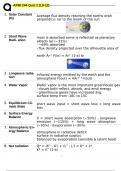
1. Solar Constant Average flux density reaching the earths orbit
(Io) perpendicu- lar to the beam of the sun
2. Short Wave most is absorbed some is reflected as planetary
Radi- ation albedo (a) (~31%)
- ~69% absorbed
- flux density projected over the silhouette area of
earth Àr ² F(in) = Àr ² (1-a) Io
3. Longwave radia- infrared energy emitted by the earth and the
tion atmosphere F(out) = 4Àr² * I(out)
4. Water Vapor Water vapor is the most important greenhouse gas
- clouds both reflect, absorb, and emit energy
- greenhouse gases have increased avg.
surface temp from -18C to 15C
5. Equilibrium Cli- short wave input = short wave loss + long wave
mate State loss
6. Surface Energy
Balance 0 = short wave absorption (~50%) - longwave
emission (~115%) + long wave absorption
(~95%) - Evaporation (~30%)
7. Atmospheric En-
ergy Balance atmosphere in radiative deficit
surface in radiative surplus
balanced by evaporation (sensible & latent heat)
8. Net radiation Q* = (K“ - K‘) + (L“ - L‘) = K* + L*
K* = K“ (1-a)
1/
3
1. Solar Constant Average flux density reaching the earths orbit
(Io) perpendicu- lar to the beam of the sun
2. Short Wave most is absorbed some is reflected as planetary
Radi- ation albedo (a) (~31%)
- ~69% absorbed
- flux density projected over the silhouette area of
earth Àr ² F(in) = Àr ² (1-a) Io
3. Longwave radia- infrared energy emitted by the earth and the
tion atmosphere F(out) = 4Àr² * I(out)
4. Water Vapor Water vapor is the most important greenhouse gas
- clouds both reflect, absorb, and emit energy
- greenhouse gases have increased avg.
surface temp from -18C to 15C
5. Equilibrium Cli- short wave input = short wave loss + long wave
mate State loss
6. Surface Energy
Balance 0 = short wave absorption (~50%) - longwave
emission (~115%) + long wave absorption
(~95%) - Evaporation (~30%)
7. Atmospheric En-
ergy Balance atmosphere in radiative deficit
surface in radiative surplus
balanced by evaporation (sensible & latent heat)
8. Net radiation Q* = (K“ - K‘) + (L“ - L‘) = K* + L*
K* = K“ (1-a)
1/
3