QUÍMICA TEMA 2
TEMA 2
TERMODINÁMICA
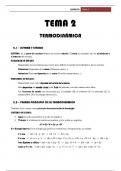
2.1 – SISTEMA Y ESTADO
SISTEMA: Es la parte del universo objeto de nuestro estudio.
estudio El resto sin estudiar son los alrededores o
el entorno del sistema.
VARIABLES DE ESTADO:
Magnitudes macroscópicas que sirven para definir el estado termodinámico de un sistema.
Extensivas: Dependen de la masa (Volumen, masa…).
Intensivas: Éstas no dependen de la masa (Presión, temperatura…).
FUNCIONES DE ESTADO:
Magnitudes cuyo valor depende del estado del sistema.
sistema
Sólo dependen del estado inicial y del final del sistema y no del camino entre ellos.
Las funciones de estado son la presión (p), la entalpía (H), el volumen (V), la entropía (S), la
temperatura (T) y la energía interna (U).
2.2 – PRIMER PRINCIPIO DE LA TERMODINÁMICA
También se le conoce como principio de conservación de la energía.
energía
CRITERIO DE SIGNOS:
• Calor: Si entra es positivo y si sale es negativo.
• Trabajo: Si el sistema lo realiza es positivo y si lo recibe es negativo.
ΔU = Q – W = Q – p · ΔV
U = Energía interna:
interna Es la energía que posee en virtud de su composición y su estado.
V = cte. → ΔU = Q – p · ΔV → ΔV = 0 → ΔU = QV.
P = cte. → H = u + p · V → ΔH = ΔU + Δ(p · V) = (Q – p · ΔV) + p · ΔV + V · Δp → ΔH = Qp.
Para líquidos y sólidos → ΔH = Δu + Δ(p · V) → Δ(p · V) ⋍ 0 → ΔH = ΔU → Qp = QV.
Gases a T = cte.
te. → ΔH = ΔU + Δ(p · V) → p · V = n · R · T → ΔH = ΔU + Δ(n · R · T).
TEMA 2
TERMODINÁMICA
2.1 – SISTEMA Y ESTADO
SISTEMA: Es la parte del universo objeto de nuestro estudio.
estudio El resto sin estudiar son los alrededores o
el entorno del sistema.
VARIABLES DE ESTADO:
Magnitudes macroscópicas que sirven para definir el estado termodinámico de un sistema.
Extensivas: Dependen de la masa (Volumen, masa…).
Intensivas: Éstas no dependen de la masa (Presión, temperatura…).
FUNCIONES DE ESTADO:
Magnitudes cuyo valor depende del estado del sistema.
sistema
Sólo dependen del estado inicial y del final del sistema y no del camino entre ellos.
Las funciones de estado son la presión (p), la entalpía (H), el volumen (V), la entropía (S), la
temperatura (T) y la energía interna (U).
2.2 – PRIMER PRINCIPIO DE LA TERMODINÁMICA
También se le conoce como principio de conservación de la energía.
energía
CRITERIO DE SIGNOS:
• Calor: Si entra es positivo y si sale es negativo.
• Trabajo: Si el sistema lo realiza es positivo y si lo recibe es negativo.
ΔU = Q – W = Q – p · ΔV
U = Energía interna:
interna Es la energía que posee en virtud de su composición y su estado.
V = cte. → ΔU = Q – p · ΔV → ΔV = 0 → ΔU = QV.
P = cte. → H = u + p · V → ΔH = ΔU + Δ(p · V) = (Q – p · ΔV) + p · ΔV + V · Δp → ΔH = Qp.
Para líquidos y sólidos → ΔH = Δu + Δ(p · V) → Δ(p · V) ⋍ 0 → ΔH = ΔU → Qp = QV.
Gases a T = cte.
te. → ΔH = ΔU + Δ(p · V) → p · V = n · R · T → ΔH = ΔU + Δ(n · R · T).