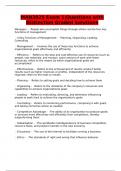
MAN3025 Exam 1|Questions with
Distinction Graded Solutions
Managers - -People who accomplish things through others via the four key
functions of management
- 4 Key Functions of Management - -Planning, Organizing, Leading,
Controlling
- Management - -Involves the use of these key functions to achieve
organizational goals effectively and efficiently
- Efficiency - -Refers to the wise and cost-effective use of resources (such as
people, raw materials, and money); same amount of work with fewer
resources; refers to the means by which organizational goals are
accomplished
- Effectiveness - -Refers to the achievement of results; product better
results (such as higher revenues or profits), independent of the resources
required; refers to the ends or results
- Planning - -Refers to setting goals and deciding how to achieve them
- Organizing - -Refers to the utilization of the company's resources and
capabilities to achieve organizational goals
- Leading - -Refers to motivating, directing, and otherwise influencing
people to work hard to achieve the organization's goals
- Controlling - -Refers to monitoring performance, comparing it with goals,
and taking corrective action as needed
- Competitive Advantage - -The ability of an organization to produce goods
or services more effectively and efficiently than competitors, thereby
outperforming them
- Globalization - -The worldwide interdependence of business competition,
resource flows, and product markets in the new economy
- E-business - -The use of the Internet to facilitate running a business
- Ethics - -The standards of right and wrong that influence behavior
, - Sustainability - -Meeting the needs of the present without compromising
future generations' ability to meet their needs
- Top Managers - -Make long-term decisions about the overall direction of
the organization and establish the long-term objectives, policies, and
strategies for it; deal with problems in the organization's environment;
maintain a future orientation to deal with uncertainty; more experienced;
responsible for the entire organization's success or failure (C-Level)
- Middle Managers - -Implement the policies and plans of the top managers
above them, and supervise and coordinate the activities of the first-line
managers below them
- First-Line Managers - -Make short-term operating decisions, directing the
daily tasks of non-managerial personnel
- Non-managerial personnel - -Not managers; carry out the instructions of
first-level managers and are the ones who ultimately do the work
- Functional Managers - -Focus on one aspect of the firm; ie. lower level
managers
- General Managers - -Focus on several aspects; ie. top-level managers
- Interpersonal Roles - -Roles in which managers provide direction and
supervision to the organization and its employees (Figurehead, Leader,
Liaison)
- Figurehead - -A manager symbolizes the organization's objectives and
mission
- Leader - -A manager trains, mentors, and counsels employees in order to
achieve high performance
- Liaison - -A manager connects and coordinates the activities of individuals,
both inside and outside of the organization
- Informational Roles - -Roles in which managers receive and communicate
information (Monitor, Disseminator, Spokesperson)
- Monitor - -A manager gathers and analyzes information from the
environment (both inside and outside the organization)
- Disseminator - -A manager conveys information to employees in order to
impact their attitudes and behaviors
Distinction Graded Solutions
Managers - -People who accomplish things through others via the four key
functions of management
- 4 Key Functions of Management - -Planning, Organizing, Leading,
Controlling
- Management - -Involves the use of these key functions to achieve
organizational goals effectively and efficiently
- Efficiency - -Refers to the wise and cost-effective use of resources (such as
people, raw materials, and money); same amount of work with fewer
resources; refers to the means by which organizational goals are
accomplished
- Effectiveness - -Refers to the achievement of results; product better
results (such as higher revenues or profits), independent of the resources
required; refers to the ends or results
- Planning - -Refers to setting goals and deciding how to achieve them
- Organizing - -Refers to the utilization of the company's resources and
capabilities to achieve organizational goals
- Leading - -Refers to motivating, directing, and otherwise influencing
people to work hard to achieve the organization's goals
- Controlling - -Refers to monitoring performance, comparing it with goals,
and taking corrective action as needed
- Competitive Advantage - -The ability of an organization to produce goods
or services more effectively and efficiently than competitors, thereby
outperforming them
- Globalization - -The worldwide interdependence of business competition,
resource flows, and product markets in the new economy
- E-business - -The use of the Internet to facilitate running a business
- Ethics - -The standards of right and wrong that influence behavior
, - Sustainability - -Meeting the needs of the present without compromising
future generations' ability to meet their needs
- Top Managers - -Make long-term decisions about the overall direction of
the organization and establish the long-term objectives, policies, and
strategies for it; deal with problems in the organization's environment;
maintain a future orientation to deal with uncertainty; more experienced;
responsible for the entire organization's success or failure (C-Level)
- Middle Managers - -Implement the policies and plans of the top managers
above them, and supervise and coordinate the activities of the first-line
managers below them
- First-Line Managers - -Make short-term operating decisions, directing the
daily tasks of non-managerial personnel
- Non-managerial personnel - -Not managers; carry out the instructions of
first-level managers and are the ones who ultimately do the work
- Functional Managers - -Focus on one aspect of the firm; ie. lower level
managers
- General Managers - -Focus on several aspects; ie. top-level managers
- Interpersonal Roles - -Roles in which managers provide direction and
supervision to the organization and its employees (Figurehead, Leader,
Liaison)
- Figurehead - -A manager symbolizes the organization's objectives and
mission
- Leader - -A manager trains, mentors, and counsels employees in order to
achieve high performance
- Liaison - -A manager connects and coordinates the activities of individuals,
both inside and outside of the organization
- Informational Roles - -Roles in which managers receive and communicate
information (Monitor, Disseminator, Spokesperson)
- Monitor - -A manager gathers and analyzes information from the
environment (both inside and outside the organization)
- Disseminator - -A manager conveys information to employees in order to
impact their attitudes and behaviors